


Middle East Forum Fellow/North Africa Risk Consultant
The Maghreb Pivot: Washington’s New Anchor in North Africa
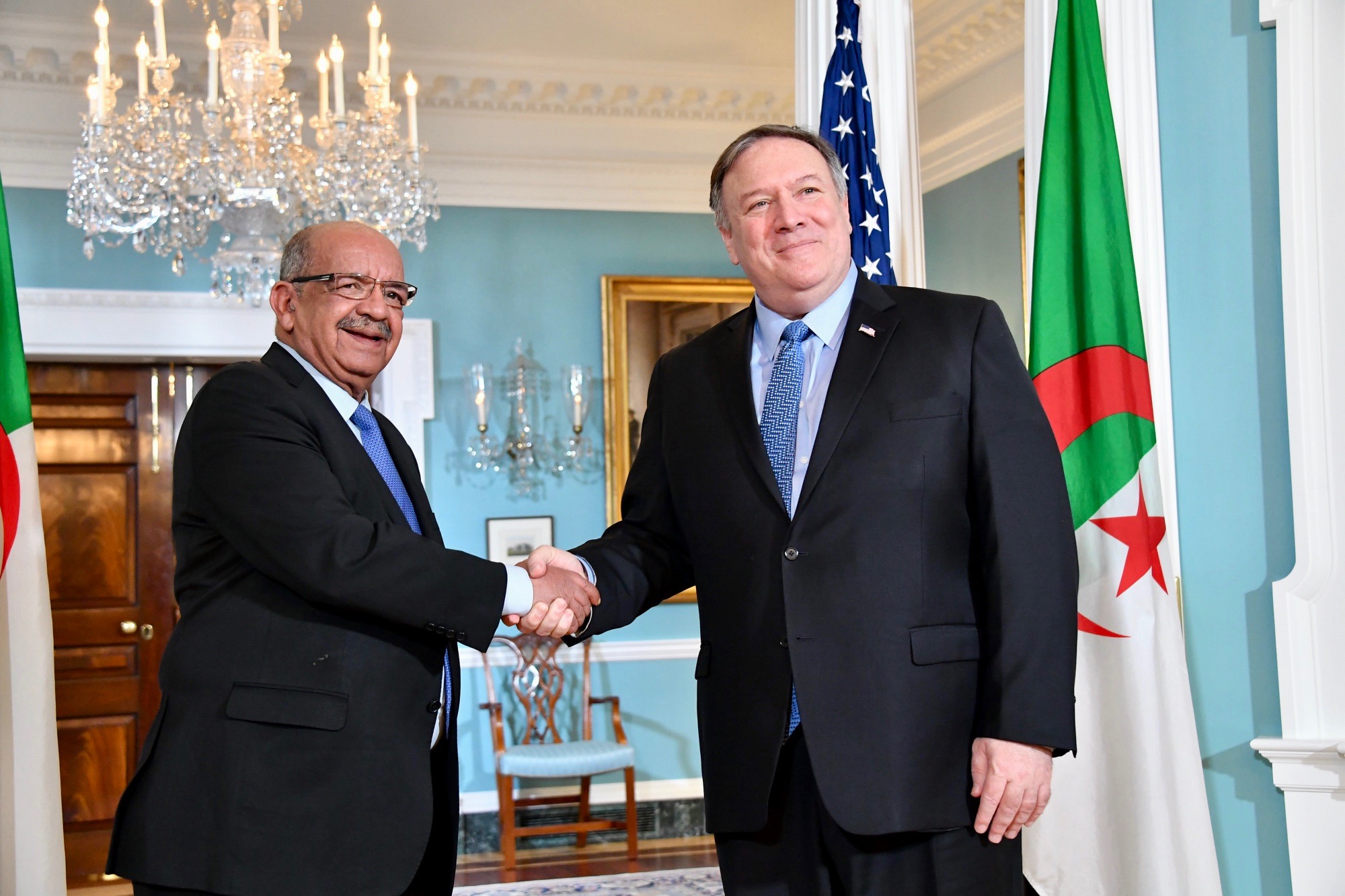
Secretary of State Mike Pompeo with Algerian Foreign Minister Abdelkader Messahel in January 2019 https://commons.wikimedia.org/w/index.php?curid=76200470
The departure of Ambassador Elizabeth Moore Aubin from Algiers on January 5, 2026, was not merely a routine diplomatic rotation; it was a deliberate closing of the books on the policy of “balanced management” in the Maghreb. As the Trump administration sweeps nearly thirty ambassadorial posts to make way for a more transactional “America First” cadre, the appointment of Richard Duke Buchan III to Rabat signals that Washington has finally chosen its anchor. While Algiers remains tethered to a Cold War military apparatus—fueled by Russian hardware and Chinese digital infrastructure—Morocco has positioned itself as the indispensable hub for Western security, energy, and the critical mineral supply chains of the twenty-first century.
The Failure of the Algerian Balancing Act
For four years, U.S. policy toward Algeria attempted to walk a tightrope, treating the regime as a potential energy partner for Europe while ignoring its deepening dependency on the Russia-China-Iran axis. The results of this “values-based” engagement were anemic. Algeria has nearly doubled its defense budget to $25 billion, with over 70% of its arsenal sourced from Moscow.
Washington’s patience for “neutrality” from a state that siphons its resources into Russian air defense systems and Chinese satellite technology has evaporated. The recall of Ambassador Aubin marks the transition to a “Deals, Not Aid” doctrine, where U.S. support is reserved for partners who provide tangible security dividends. In the new strategic calculus, an Algeria that remains a “fortress state” on the model of the Iranian “Resistance Axis” is no longer viewed as a bridge, but as a bottleneck.
Morocco: The Transatlantic Pivot State
Conversely, the arrival of Richard Duke Buchan III in Rabat—a financier and Trump confidant who previously served as National Finance Chair for the RNC—elevates the relationship to a premier economic and security partnership. Buchan’s mandate is explicitly transactional: to integrate Morocco into the Western industrial base and secure the “friend-shoring” of strategic assets.
Morocco’s strategic value is underscored by its emergence as the primary gateway for the global energy transition. With 70% of the world’s phosphate reserves and a top-tier production of high-purity cobalt, the Kingdom is the only viable alternative to the Chinese monopoly on LFP (lithium-iron-phosphate) battery technology.The U.S. International Development Finance Corp. (DFC) is already backing major projects, such as an $870 million facility in Tan-Tan for polysilicon production, to break the 80% global material dominance currently held by Beijing.
Furthermore, Morocco’s long-term vision is anchored in the 2030 FIFA World Cup, which it will co-host alongside Spain and Portugal.While the U.S. prepares for its own 2026 World Cup hosting duties, Washington views Morocco’s 2030 horizon as a decade-long roadmap for infrastructure integration, including the Dakhla Atlantic Port and green hydrogen corridors that will supply 4% of global demand by 2030.This “World Cup Diplomacy” is more than sport; it is a signal of Morocco’s permanent orientation toward the Mediterranean and Atlantic communities.
The Witkoff Ultimatum and the “Terror” Stick
The most aggressive facet of this new realism is the peace initiative announced by Special Envoy Steve Witkoff and Jared Kushner in late 2025.This is not a request for dialogue, but a timeline for the resolution of the Western Sahara conflict on Morocco’s terms.The framework was set by UN Security Council Resolution 2797, which identifies Morocco’s Autonomy Plan as the “sole basis” for negotiations, conspicuously omitting any reference to the outdated referendum option.
Washington is now wielding a significant legislative stick: the Polisario Front Terrorist Designation Act (H.R. 4119). Introduced in June 2025, the bill seeks to label the Algeria-backed militia as a foreign terrorist organization (FTO) due to its reported coordination with Hezbollah and its role in an axis that threatens U.S. national security. For Algiers, the cost of continued obstruction has been made painfully clear: refusal to engage with the Witkoff roadmap could lead to “state sponsor of terrorism” sanctions and total diplomatic isolation.
As the 2025 “African Lion” exercises demonstrated—the largest multi-domain maneuvers in the history of the continent—the U.S.-Morocco alliance is now the primary guarantor of stability in North Africa and the Sahel.For the regime in Algiers, the January 2026 diplomatic reset is an invitation to either join the “contagion of peace” or accept a self-imposed irrelevance as a Russian outpost in a Maghreb that has already moved toward the West.