
Professional Indian author and strategic affairs writer.
The Majdal Zoun Blueprint: Why Hezbollah’s Drone Tunnels Should Terrify South Asia
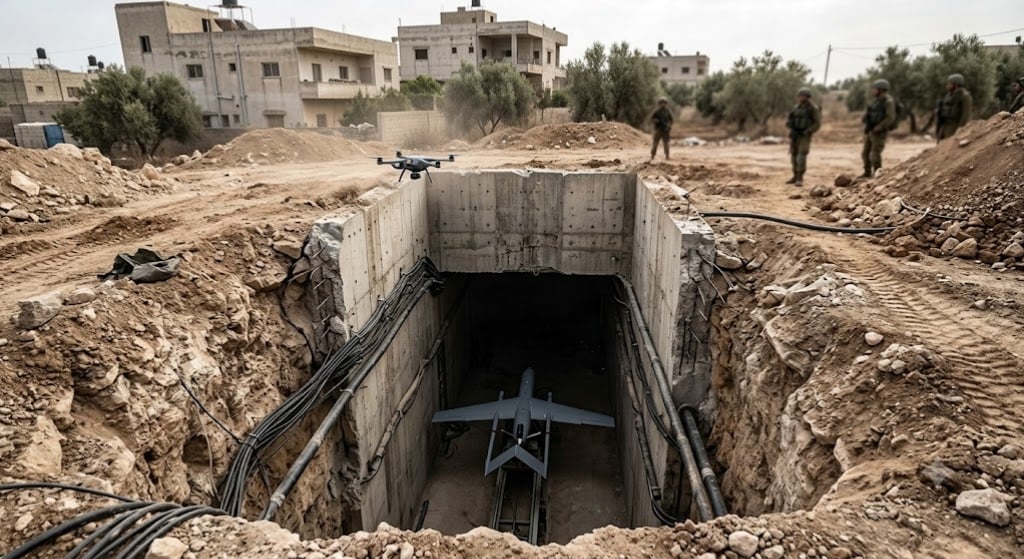
Conceptual illustration: A highly fortified subterranean drone launchpad concealed near civilian infrastructure symbolizes the terrifying evolution of proxy warfare and the emerging threat of underground military complexes spreading to regions like South Asia. Image: AI-generated (free for commercial use).
Deep beneath the rocky terrain of southern Lebanon, the architecture of modern warfare has fundamentally shifted. Just days ago, during intense combat operations, the Israel Defense Forces (IDF) captured and exposed a massive underground fortress hidden under the civilian village of Majdal Zoun. Located a mere six kilometers from the Israeli border, this was no rudimentary smuggling route. It was a state-of-the-art, fortress-grade military airbase built entirely underground, financed and designed by the Islamic Republic of Iran. Plunging 25 meters deep and stretching hundreds of meters, the subterranean complex featured living quarters, armories packed with explosives, and, crucially, vertical launch shafts built specifically to unleash swarms of sophisticated attack drones into the heart of Israel.
The discovery of the Majdal Zoun complex presents a terrifying tactical reality. While diplomats in Washington and Geneva celebrate the prospect of a US-Iran memorandum of understanding, the physical infrastructure of terror on the ground remains deeply entrenched and highly advanced. Iran has successfully exported a subterranean military blueprint that turns proxy militias into heavily fortified, technologically superior combat forces.
For the defense establishment in New Delhi, the footage emerging from Majdal Zoun should trigger immediate, high-level alarms. The strategic distance between the hills of southern Lebanon and the rugged peaks of the Line of Control (LoC) in Kashmir is shrinking rapidly. The exact military blueprint currently threatening northern Israel is perfectly tailored for replication by Pakistan-backed militant networks in South Asia.
To grasp the magnitude of the threat, one must understand the technological leap demonstrated in Majdal Zoun. Historically, Hamas and Hezbollah utilized tunnels primarily for covert movement, kidnapping operations, and sheltering personnel from Israeli airstrikes. The Iranian engineers behind the Majdal Zoun facility have upgraded the concept entirely. The tunnel is an offensive launchpad. By hiding drone launch shafts inside civilian infrastructure, Hezbollah can deploy First Person View (FPV) drones and heavier unmanned aerial vehicles (UAVs) without ever exposing their operators to preemptive strikes.
Furthermore, recent battlefield assessments from southern Lebanon indicate that Hezbollah is increasingly utilizing fiber-optic FPV drones. These tethered aircraft rely on a spool of physical cable that maintains a direct link between the operator underground and the drone in the sky. Because they do not rely on radio frequencies, they are entirely immune to standard electronic warfare and GPS jamming. Launching unjammable drones from undetectable underground shafts creates an asymmetric nightmare for conventional standing armies.
South Asia is intimately familiar with the challenge of cross-border tunnels. For decades, the Border Security Force (BSF) in India has waged a quiet, relentless battle against underground infiltration. In the Jammu and Samba sectors alone, Indian forces have unearthed numerous tunnels designed to bypass the heavily fortified border fence, allowing terrorists from Jaish-e-Mohammed and Lashkar-e-Taiba to slip into Indian territory. To counter this, India has deployed drone-mounted ground penetration radars, relying on complex radio wave emissions to detect hollow structures beneath the earth.
Yet, the traditional Pakistani tunnel network has historically been crude, built for the singular purpose of moving men and small arms. The Majdal Zoun blueprint changes the stakes. If the Islamic Revolutionary Guard Corps (IRGC), flushed with billions of dollars in imminent sanctions relief, shares its advanced subterranean engineering and fiber-optic drone technology with its strategic allies in Rawalpindi, the security paradigm along the LoC will collapse.
Imagine an Iranian-standard underground complex carved into the mountains of Pakistan-occupied Kashmir. Rather than risking the lives of infiltrators attempting to breach the Indian border fence, militants could sit safely in reinforced subterranean bunkers 25 meters below ground, launching untraceable, unjammable attack drones directly into Indian military bases in Rajouri, Poonch, or Srinagar. We already caught a glimpse of this future during the brief but intense drone skirmishes between India and Pakistan in the spring of 2025. The theater of conflict has undeniably moved to the skies, but the Majdal Zoun discovery proves that the launching pads for that aerial war will be buried deep underground.
The geological similarities between the Levant and the Himalayas make the technology transfer even more plausible. The hard rock and mountainous topography of Kashmir offer the same natural cover that Hezbollah exploited in Lebanon. The IDF estimates that the Majdal Zoun facility took nearly ten years to construct. It was excavated right under the noses of the United Nations Interim Force in Lebanon (UNIFIL), proving that international peacekeeping operations are structurally incapable of identifying or dismantling deeply buried terror infrastructure.
India cannot afford to assume that international pressure will deter the construction of such facilities in its neighborhood. Just as Israel has learned that relying on UN Security Council Resolution 1701 guarantees no safety for its northern communities, India knows that global diplomatic reprimands do little to dismantle the terror infrastructure operating in Pakistan.
The shared security reality between Jerusalem and New Delhi has never been more pronounced. Both nations are democracies fighting state-sponsored, technologically advancing proxy armies hiding behind civilian shields. The immediate policy response must be a radical acceleration of bilateral defense cooperation. The intelligence sharing regarding Iranian engineering techniques, tunnel ventilation designs, and subterranean structural supports must flow seamlessly between the IDF and the Indian Armed Forces.
Furthermore, the technological race to defeat the Majdal Zoun blueprint requires joint capital investment. India and Israel must pioneer the next generation of deep-earth seismic sensors, advanced ground-penetrating radar arrays, and kinetic anti-UAS systems capable of neutralizing fiber-optic drones the second they emerge from their launch shafts.
The unearthing of the drone fortress in southern Lebanon is a stark warning. The architects of proxy warfare are no longer satisfied with building hidden footpaths; they are constructing invincible underground airbases. The blueprints exist, the technology is functional, and the funds are flowing. If South Asia ignores the lessons currently being unearthed in the rubble of Majdal Zoun, the next subterranean drone war will be fought on Indian soil.
Related Topics
Related Posts