The Man Who Kept the Key: Adam Czerniaków and the Judenrat
The drawer
In a drawer of his desk, Adam Czerniaków kept cyanide tablets. According to a witness account, he once showed fellow members of the Warsaw Jewish Council where the tablets were kept and explained where they could find the key.
On July 23, 1942, the second day of the great deportation from the Warsaw Ghetto, he swallowed cyanide.
The Germans had ordered the Jewish Council to supply thousands of Jews each day for supposed “resettlement” in the East. Czerniaków had spent his tenure bargaining, pleading, and attempting to mitigate German demands. Now, as the deportations engulfed the ghetto, he confronted the demand that children from Jewish orphanages be included.
He could not bring himself to comply.
In one of the notes he left behind, he explained that the Germans demanded that he hand over children and that he could not do so.
Eighty-four years later, we are still arguing about what his death means.
An engineer, not a hero
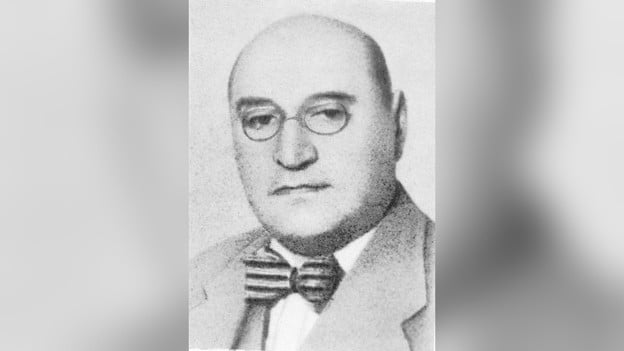
Czerniaków was born in Warsaw in 1880. He trained as a chemical engineer, taught at Jewish vocational schools, and served on Warsaw’s city council. Elected to the Polish Senate in 1931, he never took his seat.
He was an educated, Polish-speaking Jewish civic leader whose life had been devoted largely to public administration.
Nothing in his background prepared him for the moral catastrophe that awaited him.
In September 1939, as German bombs fell on Warsaw, the city’s mayor appointed him head of the Jewish community. After the German occupation, the authorities transformed the Jewish communal administration into a Judenrat, a Jewish council compelled to carry out German orders.
Czerniaków remained at its head.
It was a position that offered responsibility without genuine power, authority without freedom, and obligations that would become increasingly impossible to fulfill.
A government with no power
The Judenrat was a German-imposed institution. Reinhard Heydrich’s September 1939 directive called for Jewish councils in occupied Polish territories to administer Jewish communities under German control.
On paper, these councils appeared to exercise local authority. In practice, they transmitted and implemented the orders of their persecutors.
In Warsaw, the council administered a city within a city. More than 400,000 Jews were crowded into the ghetto, where starvation, disease, and overcrowding became instruments of Nazi persecution.
The Judenrat collected taxes, administered social services, operated soup kitchens, supported hospitals, and attempted to maintain communal institutions. It also organized forced labor, collected German-imposed levies, and supervised the Jewish police, whose members later participated in deportation roundups.
The same institution that struggled to keep Jews alive was compelled to serve the system destroying them.
The same institution that struggled to keep Jews alive was compelled to serve the system destroying them.
I think of Edna, a little girl from Miła Street, when I read the word “labor.”
While researching the wartime experiences of my mother-in-law, Edna Stefania Brill, I came to understand this terrible contradiction through the suffering of her own family.
Edna told me of her father, Avraham, and his unshakable trust in the Judenrat. He believed that the Jewish Council, operating under German occupation, was acting in the interests of the Jewish community.
When Avraham and his eldest son, Shlomo, were sent to Lublin with the promise of work and wages for their starving family, he trusted that promise.
No wages ever arrived.
Instead, according to Edna’s family testimony, father and son were forced to build Majdanek, the Nazi concentration camp outside Lublin.
Avraham never came home.
He died in the very camp he had been made to build. In one of the most harrowing accounts preserved within the family, Shlomo was forced to place his own father’s body in the crematorium.
I have carried that story with me for years.
The Judenrat did not create Majdanek. The Nazis did. The Jewish Council did not design the machinery of mass murder. The Germans did.
But for Edna’s family, the promise of work delivered through the Jewish administration became the road to catastrophe.
The moral distinction matters. So does the human cost.
The orchestra on the sinking ship
We know something of Czerniaków’s inner world because he kept a diary from September 1939 until the day of his death.
Published in English in 1979, edited by Raul Hilberg, Stanisław Staroń, and Josef Kermisz, it records the daily humiliations of administering a Jewish community under Nazi domination.
There were demands for money, labor, and property. German officials threatened, beat, and humiliated him. He petitioned authorities, sought exemptions, negotiated for food, and tried to preserve fragments of ordinary life.
He also supported playgrounds and activities for children, gestures of normalcy in a place where normal life was being systematically destroyed.
On July 8, 1942, he invoked an extraordinary image in his diary: a captain aboard a sinking ship ordering an orchestra to play jazz to lift the spirits of the passengers.
The metaphor is devastating because it can be understood in two ways.
Was the captain offering comfort to people facing catastrophe?
Or was the music distracting them from the danger surrounding them?
Perhaps both.
That was the terrible predicament of the Judenrat.
Every effort to preserve normal life took place within a system designed to eliminate it. Every concession might buy time for some, while facilitating the machinery of persecution.
The Germans controlled the terms. Jewish leaders bore the consequences.
The verdicts
Judgments about the Judenräte began during the Holocaust and continued long after the war.
Some critics viewed Jewish council leaders as collaborators whose compliance made Nazi policies easier to administer. Others emphasized the coercion under which they operated and their attempts to protect their communities from even greater suffering.
In 1963, Hannah Arendt, writing in Eichmann in Jerusalem, advanced one of the most controversial arguments of the postwar era. She contended that the organizational role of Jewish leadership had contributed to the efficiency of Nazi persecution and destruction.
Her argument provoked fierce criticism, particularly from survivors and scholars who believed it failed to account adequately for the extreme coercion under which Jewish leaders acted.
The historian Isaiah Trunk approached the question through extensive documentary research.
In his landmark 1972 study Judenrat, Trunk examined the conduct of Jewish councils across Nazi-occupied Europe. His findings revealed a complicated history that resisted sweeping judgments.
The circumstances varied. So did the conduct of individual leaders.
Some sought accommodation in the hope of saving lives. Others resisted particular demands. Many attempted to preserve their communities while operating within a system that offered no genuine security.
The sharpest contrast to Czerniaków may be Chaim Rumkowski, the head of the Jewish Council in the Łódź Ghetto.
In September 1942, Rumkowski publicly appealed to Jewish parents to surrender their children for deportation. He believed that sacrificing those deemed unable to work might preserve the remaining population.
Czerniaków, confronted with demands involving the children of Warsaw, refused to participate further.
Neither man’s actions stopped the Nazi killing program.
Yet their contrasting responses remain among the most painful examples of the moral dilemmas imposed upon Jewish leadership during the Holocaust.
Choiceless choices
The Holocaust scholar Lawrence Langer introduced a phrase that helps illuminate these impossible circumstances: choiceless choices.
These were situations in which victims faced alternatives so profoundly constrained by Nazi terror that ordinary concepts of free moral choice could not adequately describe them.
Jewish council leaders were often forced to choose not between good and evil, but between different forms of catastrophe.
To comply might prolong some lives while endangering others.
To refuse might invite immediate retaliation against an entire community.
To resign might merely place another person in the same position.
None of this erases the consequences of the councils’ actions.
Edna’s family experienced those consequences in the most devastating way imaginable.
Her father trusted the Judenrat. That trust did not save him. Nor did it spare his son the unimaginable trauma of witnessing and participating in the final indignity inflicted upon his father’s body.
Yet the ultimate responsibility for their suffering belongs to the Nazi regime that created the ghettos, imposed forced labor, constructed the camps, and carried out the murder of European Jewry.
The victims forced to make impossible choices must never be confused with the murderers who created those choices.
The children
On July 23, 1942, Adam Czerniaków reached the limit of what he could endure.
His suicide did not halt the deportations. The trains continued to carry Jews from Warsaw to Treblinka, where hundreds of thousands were murdered.
His death did not save the children.
Historians continue to debate whether his final act should be understood as moral refusal, personal despair, or a tragic combination of both.
But one fact remains: when confronted with the demand to surrender Jewish children, he would not continue.
I return to Edna, who was six years old when the Warsaw Ghetto was sealed.
She was one of the Jewish children whose lives depended on decisions made by adults operating under circumstances almost impossible for us to comprehend.
Her father believed in the Judenrat. Czerniaków believed, for much of his tenure, that negotiation and administration might preserve lives.
Neither man’s faith could overcome a system designed for destruction.
The Nazis reduced Jewish families to labor quotas, deportation lists, and transport numbers.
But these were not numbers.
They were fathers like Avraham, sons like Shlomo, and little girls like Edna.
We owe Czerniaków neither easy absolution nor easy condemnation. We owe history something more difficult: the willingness to confront its moral complexities without losing sight of who created the catastrophe.
And we owe the children something more enduring than statistics.
The children were not numbers on a deportation list. They had names, families, and futures the Nazis intended to erase.
We owe them their names.
–
Janet Bond Brill, PhD, is the author of Little Edna’s War, published January 27, 2026, the true story of her mother-in-law, a Jewish child who survived the Warsaw Ghetto, fought in the Warsaw Uprising, and lived to tell her story.
Learn more at LittleEdnasWar.com.