


The Man Who Put Iran’s Revolt on Israel’s Walls
There are, broadly speaking, two kinds of artist. The first treats art as a private luxury, a pleasantly decorative accompaniment to life. The second insists that art is a weapon, or at least a form of testimony, and behaves accordingly.
Hooman Khalili belongs, with almost indecent clarity, in the second category.
For years, he inhabited what most people would regard as the happy shallows of Western entertainment. An Iranian-born, American-raised broadcaster in San Francisco, he interviewed actors, hyped films, and floated amiably through the FM ether. He did the morning shows, voiced trailers, lent his tones to animated studios, pushed other people’s art into the world. It was a good living and, one imagines, not an unpleasant one.
Then a young woman called Mahsa Amini was killed by the Islamic Republic’s “morality” police, and something in Khalili snapped into focus. A regime that has made an ideology out of throttling women’s hair and minds finally overreached; Iran’s streets erupted under the slogan Woman, Life, Freedom; and Hooman decided, rather unusually for a man with a comfortable media career, not to be a spectator.
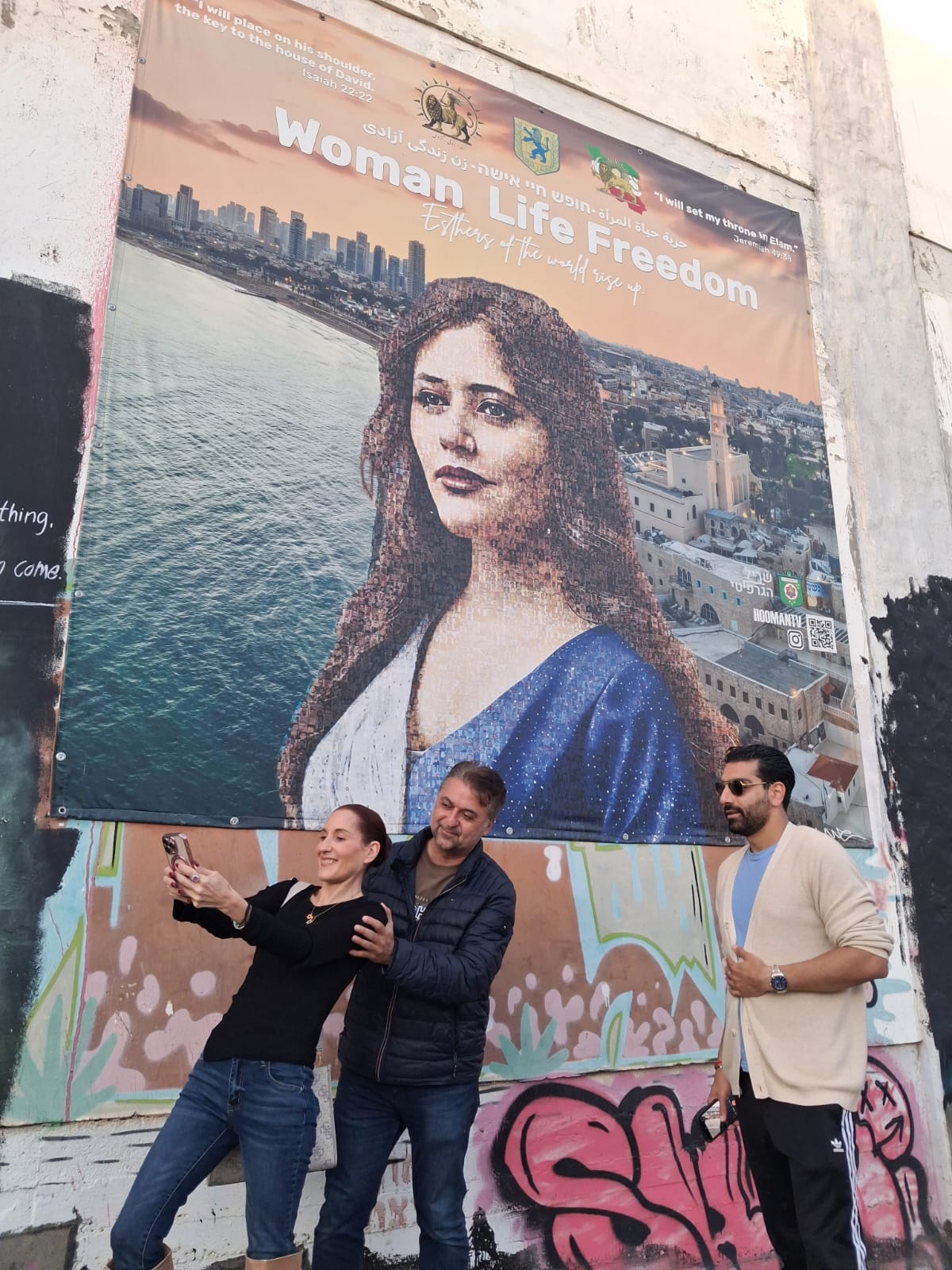
It began with one mural in San Francisco. That, in itself, would have been commendable – a gesture of solidarity in paint. But Khalili is not a man for half-measures. He conceived instead a project of almost lunatic ambition: eighteen monumental murals in Israel, honoring Iranian women and dissidents and reasserting, against both Tehran and the Western academy, the ancient friendship between Persians and Jews.
Eighteen, because in Hebrew numerology the value of chai – “life” – is 18. The point could hardly be more explicit: in the face of a death cult stalking Tehran and a death cult firing rockets at Sderot, one man proposed to answer with life, daubed on walls from Jerusalem to Eilat.
He spent the better part of two years shuttling back and forth, by his own count more than a dozen trips in under two dozen months, pouring his savings into walls that most of the art world will never trouble itself to notice. He is not, by training, a studio painter. He works like a film director or a field commander: he conceives the piece, chooses the imagery, theme and text, and then marshals a small army of Israeli graffiti artists and designers to realise it. The result is a chain of public artworks that form, taken together, a sort of visual indictment of the Islamic Republic and a love letter to the possibility of a different Iran, and a different Middle East.
His subjects are not invented. They are not symbols in search of a cause; they are casualties in search of remembrance.
There is Mahsa Amini herself, whose face has become a kind of secular icon of resistance. There is Shirel Haim-Pour, a 20-year-old Persian-Jewish soldier killed defending Israel on 7 October, whose Persian and Jewish identities the regime in Tehran would dearly love to pretend do not exist in the same body. There are the schoolgirls apparently poisoned for daring to protest, and the rapper Toomaj Salehi, imprisoned for giving the uprising a soundtrack. There are biblical echoes: Esther, the Persian-Jewish queen who thwarted an earlier genocidal project, appears in one mural as if to remind us that this particular struggle between clerical power and Jewish survival did not begin in 1979.
In some works, thousands of tiny photographs of Iranian and Israeli victims alike are woven into a vast mosaic, so that the viewer is compelled to confront the individual faces the regime would prefer to reduce to anonymous statistics. In others, archers, lions and crowns are deployed to drag the Book of Esther out of the synagogue and onto the street. The intention is not subtle, and that is all to the good. The Islamic Republic thrives on euphemism; Khalili deals in bluntness.
Unlike the fashionable intersectionalist, he is capable of holding more than one thought in his head at once. He understands – because he has lived it – that the regime that beats women in Tehran for a stray lock of hair is the same regime that arms and trains men who murder teenagers at a music festival near Gaza. His answer is not a convoluted seminar on “complexity”, but a series of walls that say, in effect: Look. These victims are related. These struggles are connected. Choose a side.
What makes this more than a curiosity is the geography of the thing. Khalili has chosen, quite deliberately, to anchor his project in the one state that the ayatollahs most obsessively demonise: Israel. He has put Iranian women’s faces on Israeli walls, in Israeli cities, with Israeli collaboration. In doing so, he has committed the unforgivable sins of our time: he has rejected the script that says Jews and Persians must be eternal enemies; he has declined to chant the required slogans about “from the river to the sea”; and he has placed the Jewish state, rather than its would-be destroyers, in the role of ally to the oppressed.
It is not a posture likely to win him invitations to biennales or plaudits from those Western liberals who can find room in their hearts for every cause so long as it is safely distant from Jewish self-defense. Universities and cultural institutions have, predictably, been skittish. When he sought to export the project to American campuses, some decided that murals honouring dead Iranian women and Jewish victims of 7 October were too “divisive” for their fragile quads. Hamas flags and chants for intifada could be excused as “context”. Painted Iranian girls without hijabs, flanked by a Star of David, apparently could not.
He did not, mercifully, stop there. One of his most striking canvases stands in Jerusalem, on the façade of a museum – a vast proclamation of Woman, Life, Freedom in Farsi and English, facing a city that has seen more empires come and go than any UN committee will ever list. That phrase, borrowed from Kurdish resistance and now adopted by Iranian protesters, sits rather comfortably in a place where women do indeed vote, speak, protest and remove their headscarves without being carted off in police vans. In an age of slogans, Khalili has had the wit to place the right one on the right wall.
His own biography spills out of his work in unexpected ways. He is Iranian by birth, American by adoption, rooted in Western media and unapologetically attached to Israel. He quotes Hebrew scripture with more ease than many Jews, and speaks of Jerusalem and ancient Elam in the same breath. He has moved from radio waves to what we might call freedom walls, trading the warm bath of celebrity chatter for the cold shower of activism.
It is sometimes said – and not only by the religiously inclined – that a life acquires meaning when it is spent in the service of something larger than the self. In Khalili’s case, one can see the line being drawn in real time. The man who once promoted hundreds of films for studios now uses film, photography and concrete as instruments against a regime that has turned Iran into a vast open-air prison. The broadcaster who used to help others’ messages reach an audience has now found his own: that the struggle of Iranian women, the survival of the Jewish state, and the defence of basic human dignity are not separate battles but one and the same.
There is an unfashionable word for this sort of thing: courage. Not the theatrical bravery of those who shout safe slogans in safe cities, but the quieter, colder kind displayed by a man who has chosen to put his name, his money and his time into artworks that the powerful, and not a few of the cowardly, would rather not see.
We are forever being told that art must “speak truth to power”. Very well, then: here is a man doing precisely that, in Farsi, Hebrew and English, on plaster and stone, in a country the mullahs have pledged to wipe off the map. If there is any justice in the record posterity keeps, it will remember that while intellectuals at comfortable distances tied themselves in knots to avoid condemning a theocracy and its proxies, an Iranian with a paint-splattered ladder and an inconvenient affection for Jews decided simply to start painting.