CEO of Time to Stand Up for Israel
The Media’s Blind Spot: Iran’s Killing Fields
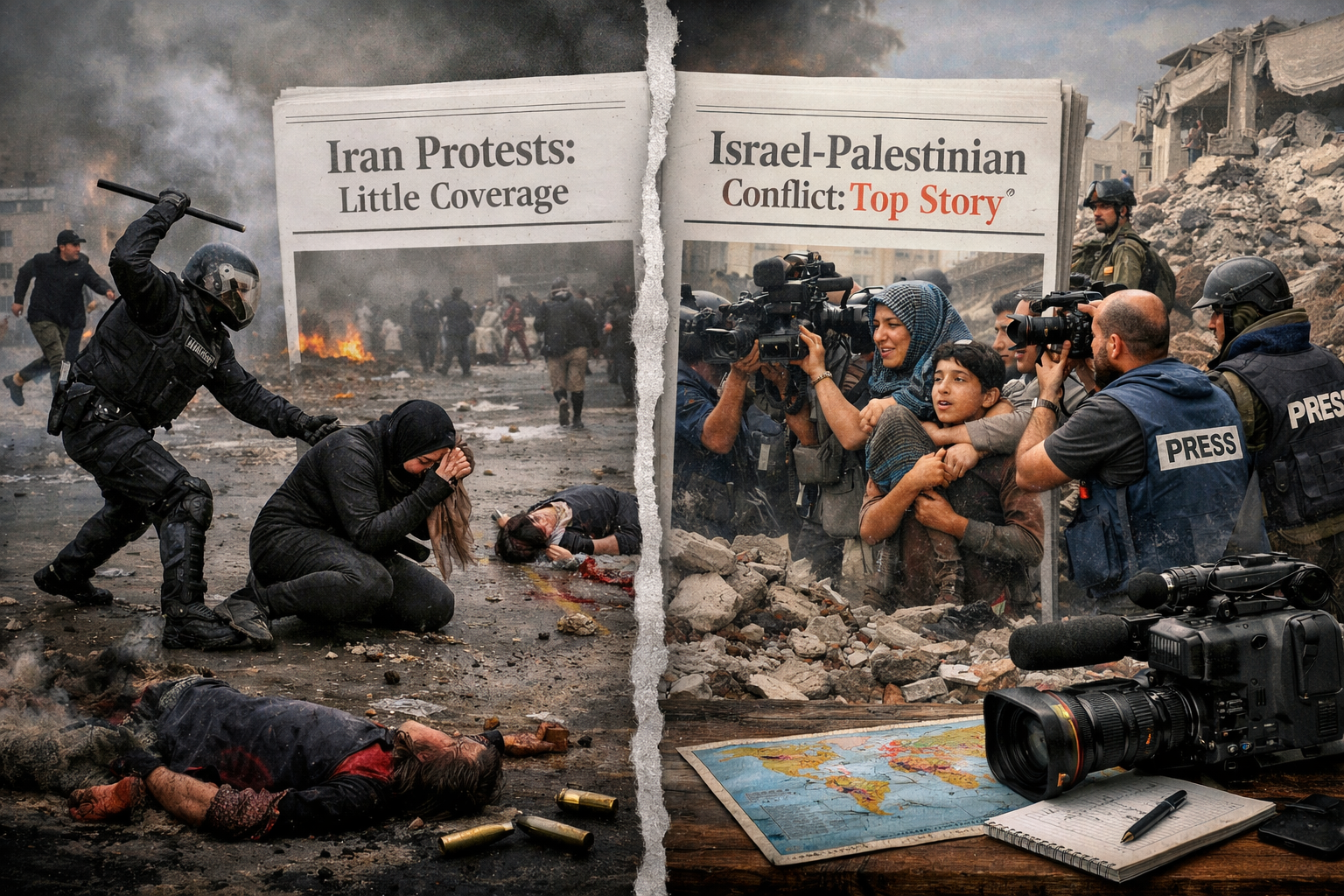
Photo Credits: Sabine Sterk(AI)
Selective Outrage: Why Iran’s Dead Don’t Matter to the Media
In the span of two weeks, an estimated 12,000 Iranian citizens were killed amid internal unrest. Men and women protesting repression, economic collapse, and a theocratic regime that has ruled through fear for decades. And yet, outside a few brief mentions, the international media largely looked away.
At the same time, headlines, panels, campus protests, and social media feeds remain saturated with relentless focus on Palestinians and Israel.
This is not a coincidence but It is a pattern and it exposes a deep moral and structural failure in global journalism and activism.
The first explanation often offered is access. Iran is a closed dictatorship. Foreign journalists are restricted, surveilled, expelled, or imprisoned. The regime shuts down the internet, blocks social media, intimidates families of victims, and obscures casualty figures. Reporting from Iran is dangerous and difficult.
But access alone does not explain silence.
Journalists have historically reported from war zones, dictatorships, and genocides with limited access, from Syria to North Korea to Sudan. When there is will, there is coverage. What is missing in the case of Iran is not only footage, but interest.
Israel, by contrast, is one of the most scrutinized countries on earth. It allows foreign media full access. It has a free press, independent courts, human rights NGOs, parliamentary oversight, and public investigations. Journalists can move freely, ask hostile questions, and broadcast live.
Ironically, this openness becomes Israel’s greatest liability.
Democracies are held to impossible moral standards; dictatorships are excused by low expectations. When Israel acts to defend itself, every action is framed as a potential crime. When Iran kills its own citizens, it is dismissed as “unrest,” “crackdowns,” or “internal affairs.”
This is not moral consistency. It is moral cowardice.
The Palestinian cause, as framed by much of the international media, offers a simple and emotionally comfortable narrative: oppressed versus oppressor, weak versus strong, victim versus villain. It requires little context, no historical depth, and no acknowledgment of internal failures or extremist violence. It also provides a familiar villain…The Jewish state.
Iranian protesters disrupt this narrative.
They reveal an uncomfortable truth: that the Middle East’s greatest source of suffering is not Israel, but authoritarian Islamist regimes that brutalize their own populations. They expose the lie that Israel is the region’s central moral problem. And they undermine the ideological framework that many activists and commentators have built their careers upon.
That is why their voices are sidelined.
There is also a geopolitical dimension that cannot be ignored. Iran has spent decades exporting chaos while carefully deflecting attention outward. Through proxy terror groups like Hamas, Hezbollah, and the Houthis, and through relentless anti-Israel propaganda, Tehran ensures that global outrage is directed anywhere but inward.
Every headline condemning Israel is a strategic victory for the Iranian regime. It shifts scrutiny away from executions, torture, mass arrests, and the killing of protesters. It allows the regime to posture as a “resistance force” rather than what it is: one of the world’s most prolific violators of human rights.
Western activism plays a complicit role. Modern protest culture thrives on symbolism, hashtags, and binary thinking. It prefers causes that can be reduced to slogans and framed through fashionable ideological lenses. Iranian dissidents, many of whom openly oppose Islamist extremism, reject antisemitism, and call out Western hypocrisy, do not fit neatly into those categories.
So they are ignored.
Perhaps the most uncomfortable truth is this: Jewish suffering is always contextualized, while Jewish self-defense is condemned. Violence against Jews is explained; violence by Jews is criminalized. Israel is denied the moral latitude granted to every other nation on earth, while regimes like Iran are spared sustained scrutiny altogether.
Twelve thousand dead Iranians should shake the world. The fact that it does not tells us something deeply troubling about whose lives are deemed worthy of attention.
Human rights cannot be selective. Journalism cannot be ideological. And outrage cannot depend on whether a tragedy fits a preferred narrative.
Iranian lives matter, not only when they can be weaponized against Israel, but always.
Until the media learns that lesson, its moral authority will continue to erode, one ignored grave at a time.
Time To Stand Up for Israel
Time To Stand Up for Israel is an independent foundation dedicated to fighting misinformation, countering antisemitism, and providing clear, fact-based education about Israel. We do not engage in internal Israeli politics. We stand on two core principles: Israel has the right to exist. Israel has the duty to defend itself. Support our work: Donate and/or subscribe at: www.timetostandupforisrael.com