The Melody We Thought Was Ancient
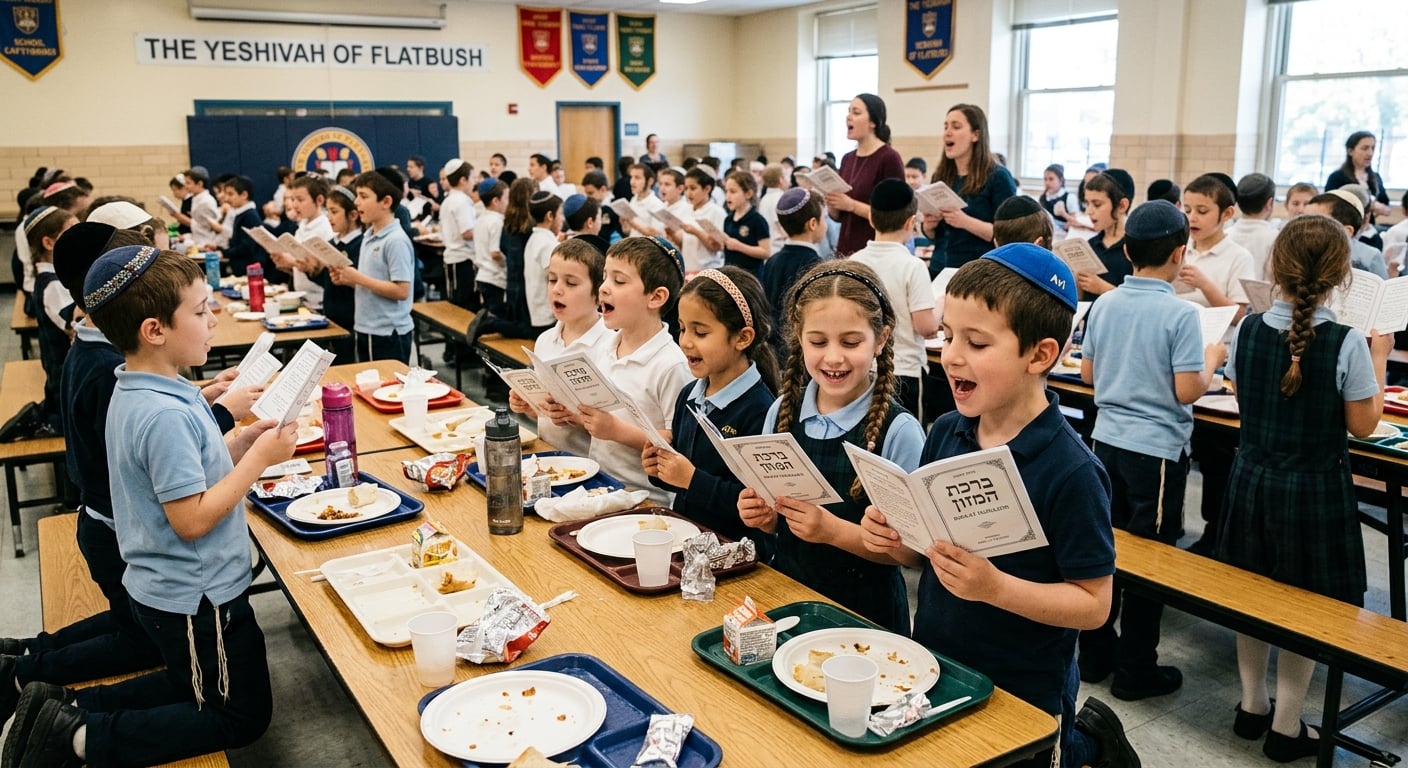
There are very few musical composers who can say that their melody is sung every day by hundreds of thousands of children.
Cantor Moshe Nathanson—who I’m guessing very few of my readers are even familiar with—is one of them.
Who was Cantor Moshe Nathanson, and why might he be the most famous Jewish musician that you have never heard of?
Nathanson is the individual who composed the melody that’s universally sung for the grace after meals.
The story of Cantor Moshe Nathanson and the melody of Birkat haMazon is one of those wonderful Jewish stories in which something that feels ancient, eternal, and almost biblically ordained turns out to have a surprisingly recent—and very human—origin.
There is also a wonderful irony: millions of Jews have sung Nathanson’s melody, often assuming that it was handed down from their grandparents and great-grandparents in Europe, when in fact it was composed in America in the late 1930s, less than 100 years ago.
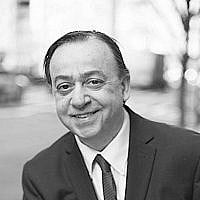
Moshe Nathanson was born in Jerusalem in 1899 and grew up in a traditionally Orthodox environment. As a young man, he studied music with the great Jewish musicologist Abraham Zvi Idelsohn, the man associated with the preservation and popularization of Jewish and Middle Eastern musical traditions. Nathanson eventually came to America, where he became a cantor and an important teacher and promoter of Hebrew music.
He became the longtime cantor of the Society for the Advancement of Judaism, the New York synagogue founded by Rabbi Mordecai Kaplan that became the center of the emerging Reconstructionist movement. Yet Nathanson’s musical influence crossed denominational lines: he taught in Orthodox Jewish schools, including the Yeshivah of Flatbush and the Crown Heights Yeshiva, and directed music at Jewish summer camps.
In the 1930s, Nathanson was heavily involved in Jewish education and summer camping. He noticed something that Jewish educators have probably noticed for centuries: children don’t particularly enjoy mumbling Birkat haMazon.
The prayer is long. It contains unfamiliar words. It is recited after everyone has just eaten and is ready to leave the table. And unlike many of the prayers in the synagogue, it didn’t have one universally compelling melody that made children want to sing it.
At Camp Achvah, where Nathanson served as music director, he set out to change that.
The melody emerged in 1938, when Nathanson created a lively, accessible tune for the opening section of Birkat haMazon.
And it worked! The children loved it.
Nathanson subsequently published the melody, and it began spreading through the Jewish camping and educational world. Rabotai Nevarekh, the 1954 Birkat haMazon booklet published by the Cantors Assembly, specifically included Nathanson’s musical notation for the popular Ashkenazi melody.
And then something extraordinary happened: the Jewish camping movement became an enormous transmission system.
Camp Achvah’s traditions were picked up by other camps. Camp Massad, an Orthodox Hebrew-speaking camp, inherited the tradition. Later, Camp Ramah was established, with some of its staff having connections to Massad. The melody traveled with the counselors, teachers, and campers.
Those campers grew up. They became parents. They became rabbis. They became teachers. They became synagogue presidents. They started their own schools and camps.
And then they taught their children the tune.
Within a generation, something composed for Jewish children at a summer camp had become part of the soundtrack of Jewish life. By the 1950s, one source reports, the tune was being sung in yeshivas throughout the country.
And here’s the really delicious irony about the story: people forgot that it had a composer.
Cantor Sherwood Goffin recalled the phenomenon perfectly: people would insist that their great-grandfather had sung the tune in Europe.
But Nathanson was still alive!
His daughter, Deena Starr, recalled visiting Israel with her father years later. At a Friday-night meal, the people sitting nearby began singing the Birkat haMazon to Nathanson’s melody. Her father asked them, “Whose melody is that?”
They replied, “It’s traditional.”
He told them that he had written it, but they didn’t believe him.
That may be the most wonderful detail in the entire story.
But why did this melody take over and generate such universal appeal?
I think there are several reasons:
- It is extraordinarily singable. Nathanson understood something that many sophisticated composers don’t: a melody intended for communal singing cannot be too complicated. You don’t need musical training. You hear it once or twice and can join in.
- It solved a practical Jewish problem. Nathanson wasn’t asking, “How can I compose a beautiful piece of music?” Instead, he asked himself, “How can I get children to actually sing Birkat haMazon?” That’s a different—and often more fruitful—question.
- The summer camps were enormously powerful cultural incubators. American Jewish summer camps created a common musical vocabulary for Jews who otherwise belonged to very different synagogues and movements. A child who learned a song at camp took it home. Then he taught it to his children. And the children took it to their schools and synagogues. The melody essentially went viral before there was such a thing as going viral.
- It crossed denominational boundaries. The composer was the cantor of a Reconstructionist congregation, yet his melodies entered Orthodox institutions. He taught at Orthodox schools. Orthodox camps transmitted his music. Conservative institutions published it. And eventually, Jews across the religious spectrum were singing it. The melody didn’t care about ideology.
- Nobody copyrighted Jewish tradition in people’s minds. Once the melody became ubiquitous, people stopped asking where it came from. That happens constantly with Jewish music. A melody gets sung by a cantor, then a congregation, then a camp, then a school—and eventually it becomes “the traditional melody.” (Think Carlebach.) Indeed, the 1954 Cantors Assembly publication itself described the melodies it retained as “universally sung” traditional melodies while specifically identifying Nathanson’s contribution.
One small but important qualification: it would be slightly misleading to say that Nathanson composed the entire tune Jews use for all of Birkat haMazon today. The melody people commonly call the “bentching tune” is really a collection of melodies, some of which have older European roots. Nathanson’s great contribution was the opening paragraph, which became the iconic melody associated with communal bentching. Other sections have accumulated melodies from different sources over time.
What can we learn from the Nathanson story?
For one thing, traditional doesn’t necessarily mean ancient. We often assume that if Jews everywhere sing something, it must be hundreds—or thousands—of years old. Not necessarily. A melody can become “traditional” remarkably quickly. In fact, tradition is sometimes simply something that has been successfully transmitted for long enough that we have forgotten its point of origin, which is a fascinating phenomenon in Jewish life.
Also, the Jewish tradition is constantly being created. We tend to imagine tradition as something that flows from the past into the present. However, Nathanson’s story reminds us that tradition also works in the other direction: someone creates something today. Children adopt it. The next generation inherits it. Eventually, the creation becomes indistinguishable from the tradition.
In addition, Nathanson’s story teaches us that the most influential Jewish innovations aren’t necessarily the most sophisticated. Nathanson wasn’t trying to write Beethoven. He was trying to get kids to sing.
And he succeeded spectacularly.
There is something profoundly Jewish about that. Jewish religious culture has always depended not only on great scholars and theologians, but on people who figure out how to make Judaism memorable.
Finally, the story is a perfect example of how children can be the greatest agents of Jewish continuity. Nathanson’s melody didn’t spread because a committee of rabbis declared it authoritative. It spread because children liked it. They sang it. Then they grew up. And they taught their children.
If you want to know how Jewish tradition survives, that’s a pretty good case study.
Despite his significant musical contribution, there is something very poignant about Nathanson’s anonymity. He heard people singing his own creation and calling it “traditional.” And rather than becoming famous for it, he gradually disappeared behind the melody.
There is a larger lesson here about all cultural creators: the ultimate success of a Jewish artist may be that his or her work becomes so thoroughly absorbed into Jewish life that people stop remembering who created it.
Nathanson lost the credit—but won something far more important.
Every Shabbat, every holiday, every family meal, every camp, every yeshiva, and every synagogue where that melody is sung is, in a sense, a continuation of his work.
And perhaps the greatest irony is that the melody achieved exactly what Nathanson wanted it to achieve in the first place: people sing Birkat haMazon together.
Indeed, a melody written for children at a summer camp became, within a generation, something that millions of Jews experienced as though it had been there forever.
That is how a tune becomes a tradition.
And, in a very real sense, that is how Jewish tradition itself is made.