CEO of Time to Stand Up for Israel
The Memories of Sukkot
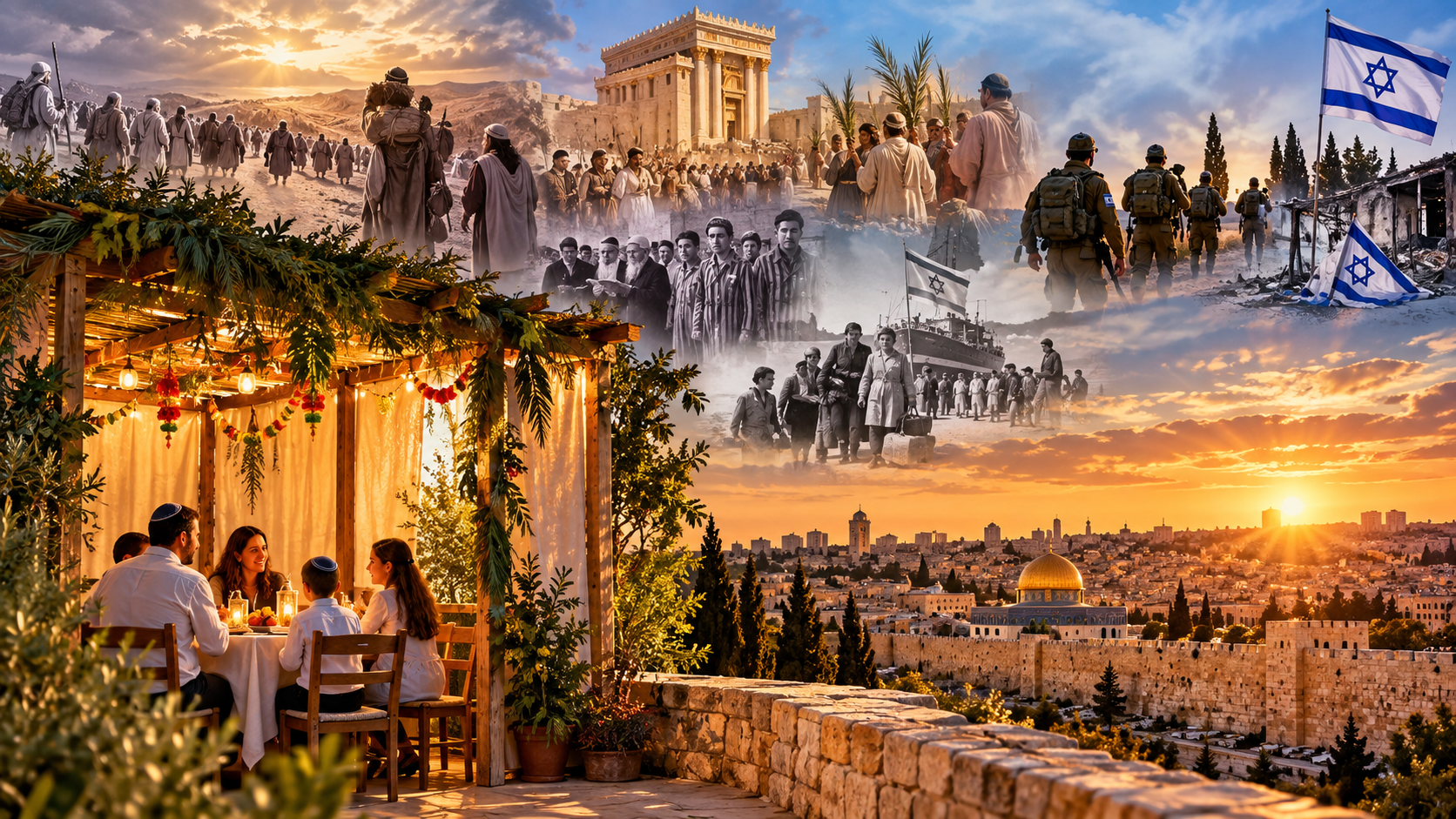
Photo Credits: Sabine Sterk ( AI)
The Memories of Sukkot
There are holidays that celebrate a moment, and there are holidays that seem to carry the entire history of a people within them. For me, Sukkot has increasingly become one of those holidays.
Sukkot is among the most ancient Jewish festivals, rooted in the Torah and connected both to the agricultural cycle of the Land of Israel and to the journey of the Israelites after the Exodus from Egypt. For seven days Jews are commanded to dwell in temporary shelters, the sukkot, remembering the vulnerability of their ancestors during their journey through the wilderness.
There is something extraordinarily Jewish about that commandment.
Leave the security of your house. Sit beneath a fragile roof. Understand that walls are never an absolute guarantee of safety. Remember where you came from. Remember those who walked before you. Then eat, celebrate, welcome guests and give thanks anyway.
That last word matters.
Anyway.
Because Jewish history could almost be summarized by it.
We suffered, and we lived anyway.
We were expelled, and we rebuilt anyway.
We were persecuted, and we celebrated anyway.
We buried our dead, and eventually we planted another tree, built another home, raised another child and danced again anyway.
Sukkot itself has witnessed extraordinary chapters of Jewish history. According to the biblical account, King Solomon gathered the people of Israel during the festival season for the dedication of the First Temple in Jerusalem. Centuries later, after exile and destruction, Jews returning to their homeland again celebrated Sukkot. The Book of Nehemiah describes the people building booths and rediscovering the commandments of the festival.
Think about the symbolism.
Exile had not erased them.
Destruction had not erased them.
Foreign empires had not erased them.
They returned to Jerusalem and built their sukkot again.
Thousands of years later, the Jewish people would repeat that pattern on an almost unimaginable scale.
After centuries of persecution, expulsions, pogroms and ultimately the Holocaust, the State of Israel was reborn in 1948. Once again Jews defended themselves in their ancestral homeland, built cities, cultivated fields, revived Hebrew as the language of everyday life and created families where enemies throughout history had attempted to create only graves.
Then came October 1973.
The Yom Kippur War began on October 6, when Egypt and Syria launched a coordinated surprise attack against Israel on Judaism’s holiest day. The fighting continued through the period of Sukkot. Once again a Jewish festival became intertwined with war, fear, sacrifice and the struggle for survival.
Israel survived.
Fifty years later, almost to the day, history delivered another terrible memory.
Sukkot 2023 ended in Israel on October 6 with Hoshana Rabbah. The following morning, October 7, was Shemini Atzeret and Simchat Torah, a day normally associated with celebration and the completion and restarting of the annual Torah reading cycle. Instead, at approximately 6:30 in the morning, Hamas launched its massive surprise attack against Israel. Thousands of terrorists infiltrated Israeli territory while rockets were fired toward Israeli communities. Civilians were murdered in their homes, people were attacked at the Nova music festival, communities were devastated and hundreds of people were abducted into Gaza.
A morning meant for dancing with Torah scrolls became one of the darkest mornings in modern Jewish history.
That date can never again be separated completely from the Jewish calendar.
There will always be a before October 7 and an after October 7.
Yet there is another part of the story that deserves to be remembered.
Israel did not disappear.
In the hours and days after the attack, Israelis mobilized. Soldiers reported for duty. Civilians organized food, clothing and accommodation. Volunteers drove across the country. Communities supported displaced families. People opened their homes to strangers. Israelis abroad returned home.
This does not erase failures, grief or difficult questions. A strong country must be capable of examining its failures honestly. Resilience does not mean pretending that everything went right. It means refusing to allow catastrophe to become the final chapter.
And perhaps that is why Sukkot carries such extraordinary meaning now.
The sukkah is fragile.
That is the entire point.
Its roof is not concrete. Its walls are not a fortress. It reminds us that human beings can never control everything around them. Security can disappear. Certainty can disappear. An ordinary morning can become history within minutes.
But the sukkah also teaches something else.
After thousands of years, Jews are still building it.
Babylon could not stop them.
Rome could not stop them.
Expulsions could not stop them.
Pogroms could not stop them.
The Holocaust could not stop them.
Wars against the State of Israel could not stop them.
October 7 did not stop them.
And today, throughout Israel, sukkot are built again.
Children decorate them. Families eat inside them. Friends gather beneath branches and stars. The same ancient words are spoken in a modern Jewish state, in the same homeland from which so much of Jewish history emerged.
That is not merely tradition.
That is continuity.
And continuity may be one of the most powerful forms of resistance the Jewish people have ever possessed.
Jewish strength has never meant the absence of tears. Jewish resilience has never meant that wounds do not hurt. Israel carries enormous scars, and October 7 added wounds that will remain part of the country’s collective memory for generations.
Strength means carrying those memories without surrendering the future to them.
It means remembering those who were murdered while continuing to live.
It means mourning while rebuilding.
It means protecting the living while honoring the dead.
It means understanding that Jewish history did not end in Egypt, Babylon, Rome, Auschwitz or on October 7.
And perhaps that is the deepest message of Sukkot.
We build something fragile because we believe there will be a tomorrow.
We invite people inside because we still believe in community.
We celebrate because our enemies do not get to decide when Jewish joy ends.
We remember because forgetting would betray those who came before us.
And we rebuild because that is what the Jewish people have done for thousands of years.
This Sukkot, look at the sukkah and remember what it represents.
A temporary structure.
An ancient people.
An extraordinary history.
And a nation that, generation after generation, refuses to disappear.
Am Yisrael Chai.
Chag Sukkot Sameach. חג סוכות שמח
Related Topics