

The Michael Rubin File – Part 3: My Man in Palestine
Previously, in The Michael Rubin File…
Part 1 introduced Michael Rubin, my great-uncle: a Polish-born mechanical engineer who settled in Palestine in the 1930s, served as a captain in the British Royal Engineers during World War II, and helped smuggle his brother Moshe and three children from postwar Poland. Yet this accomplished and resourceful man eventually vanished from our family’s life, leaving behind more questions than answers.
Part 2 explored possible explanations for his disappearance. Was he pursuing professional opportunities abroad? Escaping the economic and social upheavals of early Israel? Starting a new personal life? Or had a family rupture driven him away? We examined the historical circumstances and family tensions that might support these theories but reached no verdict.
The investigation continues. The suspects are numerous, the evidence incomplete, and the mystery remains very alive.
Drilling
This is now prime time. I need to decide where to drill. And that’s a challenge. I will use an example from my experience in subsurface exploration.
There are two obvious locations for drilling. Israel is one, USA is the other. A third, less obvious one may emerge, perhaps even more, as we sift through new information. Selecting a drilling location is risky. In oil exploration, a wrong decision could mean losing $40 million on a well that turns out to be dry. How does that happen? Well, drilling locations are selected based on what we already know. That sounds sensible enough, except that what we know can blind us to what we don’t know.
Donald Rumsfeld famously described “known knowns,” “known unknowns,” and “unknown unknowns.” His formulation drew considerable ridicule—unfairly, I think—but he had a point: we do not know where to look for what we do not know. If we drill only where existing knowledge directs us, we may never discover what we are missing. As I explained in Part 2, oil and water explorers reduce the risk of dry wells by studying geologically similar formations and proceeding one well at a time, using well logs to guide their next steps. A colorful saying captures this caution: “How do porcupines make love? Very slowly.”
But USA and Israel are obvious candidates for drilling. And what we would come up with could invite additional drilling locations.
Drilling in Israel/Palestine
I enlisted my sister Irit to investigate. She made a major discovery: a 90-year-old file buried deep in the Israeli government archives. Michael Rubin’s file. It is a treasure trove. It is all forms and bureaucratic jargon and many (almost) indecipherable names and signatures, but it is my first ever glimpse into Michael’s life during his time in Palestine, from the mid-1930s and all the way to his disappearance, in the early 1950s.
So, what did I learn about Michael from the Palestine file?
First thing that caught my eye was his picture. Here it is, right in the center below, shown just next to the pictures of his two brothers:
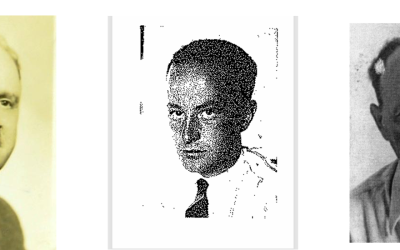
Image 1 – The unusual suspects: Michael Rubin, shown at the center, right next to his brothers Moshe (on the left) and Karl.
Michael’s picture is circa 1938. His brothers’ pictures are likely from the early 1950s. Michael appears like a younger version of his brothers. The resemblance is there, despite the time gap—the receding hairlines, the narrow mouths, the prominent noses. It is not proof positive but not a showstopper either.
But there’s some additional information indicating this Michael is “our” guy. The file states his place of birth (Sniatyn, where his two brothers were born) and date of birth (1904, in line with his US entry document I presented in my first report). It also identifies Michael as a mechanical engineer, which is common knowledge in the family.
Michael’s file documents his steady path towards Palestinian citizenship. This was the 1930s. There was no Israeli citizenship.
Michael applied for certification of naturalization in late 1938 (see Image 2), four years after his arrival in Palestine and 10 years prior to the establishment of the State of Israel. It is followed by an application for citizenship in 1939 (Image 3).
All the documents carry Government of Palestine as a header. Israel is mentioned by acronym EI (for Eretz Israel) and only above the Hebrew texts (see Image 4). Michael and his peers were citizens of Palestine. A different era, a world apart. Well, it is for me. Until now, the history of my family in Israel started after World War 2.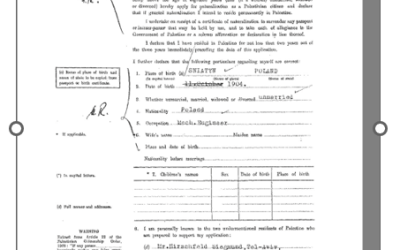
Image 2
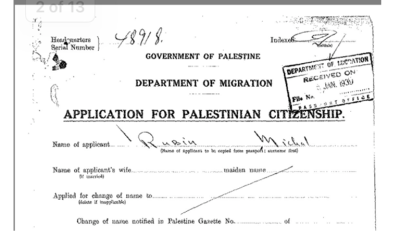
Image 3
Michael is mentioned in the English section as Michal, his given name. The signature part of the document (see Image 3) states his Hebrew name, which is pronounced MICHAEL.
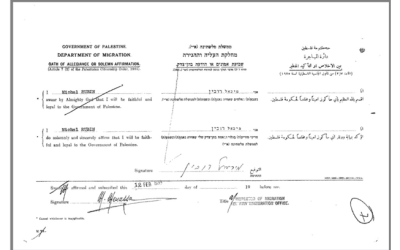
Image 4 – Michael’s statement
Image 4 reveals that Michael chose the civil Solemn Affirmation over the religious Oath of Allegiance. A shocker? Not in the slightest. Selecting the non-religious option is not surprising, not in my family. Choosing the other option would raise questions about his family affiliation, given what I learned over the years about the religious choices of the other Rubins I know. This is a classic example of what statisticians refer to as prior information. We use the priors to assess new information. With caution.
Moving on.
Michael stated 162 Hayarkon Street in Tel Aviv as his residence. Hayarkon Street defines, to this day, the western boundary of the rapidly developing city. It stretches along the Mediterranean coast. Its many sea-facing buildings offer easy access to a nice, breezy promenade, sandy beaches and cafés, all ideally suited for Tel Aviv’s long, hot summers. This was a desirable address, associated with comfortable middle-class or upper-middle-class living. Today you can find there the US, British, Russian and Indian embassies. It was a far cry from the meager, mosquito-infested tents that housed the pioneers.
There is a story here. Not a mystery, but a story, nevertheless. Israel pre-independence, i.e., Palestine-EI (for Eretz Israel, as the Brits had it), was not just brave pioneers drying swamps and dying of Bilharzia while doing that. There was also a growing middle class and upper class too. Wealth was created. Recanati, Chelouch, Rokach, Yafet, Elran, Feuchtenberg, Matalon, Karaso and Saharov were among the richest families in Palestine, and invested heavily in banking, real estate, construction and agriculture (mostly citrus cultivation). No mystery here, it is just an anecdote. When I grew up, the pioneer was the story, not the wealthy capitalist and not even the middle-class engineer living in an apartment overlooking the beach.
There’s more to the story.
Michael’s application names two individuals who were prepared to support his naturalization: Mr. Hirschfeld and Dr. Kurt Moosberg, both from Tel Aviv.
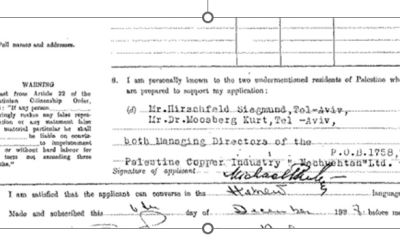
Image 5 – Mchael’s professional acquaintances
The document describes both as managing directors of the Palestine Copper Industry company and the Nechushtan Company. A historical economic study identifies Palestine Copper Industry as a nonferrous-metal manufacturer with capital of £P45,000 (45,000 Palestine pounds). Its products included copper goods and water heaters. That is evidence of established industrial operation, rather than a small workshop. Nechushtan was particularly famous for manufacturing and installing elevators in Israel. It eventually became one of the country’s leading elevator companies.
The two witnesses on Michael’s application may be more revealing about Michael’s professional and social standing than the Hayarkon address itself. They demonstrates a possible connection to the management of an industrial enterprise, not merely a residential location. Michael was mingling with the elite. Living on Hayarkon Street and having directors Moosberg and Hirschfeld for your buddies: our man was part of the elite. And did I mention brother Karl Rubin, a leading architect in Palestine at the time?
Michael’s application for Palestinian citizenship was officially approved in 1939, with the blessing, kind of, of the King. Not just any king, the British one. And there’s the signature of Sir Harold Macmichael to affirm that. It reads to me like a statement of legitimacy of sorts. Like saying: “you are no longer Joe Shmoe from Yehupetz. You have the British King on your side, welcoming you to Palestine with open arms. You are now part of the British Empire.” I imagine this played an important role in shaping the psyche of prewar Jewish immigrants. This has nothing to do with Michael. Just random thoughts. Well, not totally random. There was a huge chasm between the Prewar immigrants Like Michael and those who moved there after the war, without the blessing of the British Monarch.
The Passport
The archival file contains no information about Michael’s whereabouts during World War 2. The next period covered by the file is in the late 1940s. The postwar documents cover Michael’s passport application (see Image 6). Our man in Palestine was planning to travel. He applied for renewal of a passport issued in 1939 and expired in 1944.
Here is the application form:
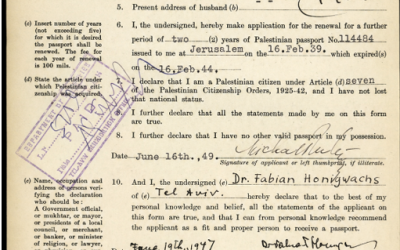
Image 6: Michael Rubin Passport application (enhanced for readability)
It begins like a contradiction—almost like a mistake.
A document dated June 1949.
The address: Tel Aviv.
The applicant: Micha[e]l Rubin, a Jew, living in what is already the State of Israel.
And yet, at the top of the page, you can see that it was issued by the “Government of Palestine.”
Below it, without hesitation, the bureaucracy proceeds. An application. A renewal. A passport issued years earlier in Jerusalem—February 1939—now extended, approved, stamped, signed. Everything is in order.
It shows Michael applying for a passport from a country that no longer existed. There is no “Government of Palestine” in 1949. That entity ended—at least politically—with the British departure in May 1948. In its place stands a new state, declared, fighting, consolidating itself: Israel.
Yet in Tel Aviv—the administrative heart of the new state—someone processed a passport renewal on a form that belongs to a bygone regime.
It feels like a ghost at work: A government that no longer exists, continuing to issue documents to people who no longer belong to it. The explanation is likely less dramatic—but in its own way, more revealing: States change overnight, but paperwork does not.
What we are seeing, then, is not an anomaly. It is a document from a narrow, fleeting moment—from a period you might call an Interregnum, when one state had ended, another had begun, and in between, the machinery of daily life simply kept going.
Why am I fussing over this? It is a dissonance. Palestinian citizens. In my family. It was a different world back then. You apply for it, and you get it. It paints history in a different set of colors. Michael’s application makes it look attainable. You just fill in a form, like Michael did, and you become one.
This was not the first time Michael was planning a trip out of Palestine.
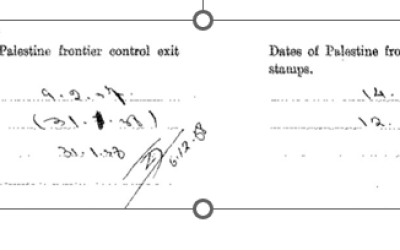
Image 7
The second page of his January 1939 Palestinian citizenship application (Image 7) informs us that Michael took a five-day trip in early 1937 (see Image 7) and a twelve-day trip in early 1938, destinations unknown. Both journeys took place in midwinter. Were these ski vacations, consulting assignments, or trips elsewhere in Europe or the Middle East? These were different times, and traveling around the Middle East with a Palestinian passport was easy. I know that Michael’s brother, the architect Karl Rubin, had projects all over Palestine and as far as Damascus. Wherever Michael was heading, the trips suggest that Michael was doing well professionally and financially—certainly far better than the stereotypical Zionist immigrants, who were busy draining swamps and cultivating desert land.
And in 1948–1949, Uncle Michael was in Tel Aviv, preparing to travel abroad. He still lived at 162 Hayarkon Street, his registered address throughout his wartime absence. Did he own an apartment there? Even renting could suggest middle-class comfort at a time when most immigrants to Palestine lived in tents. Think of rental units in London’s Belgravia or New York’s Fifth Avenue: Hayarkon Street was Tel Aviv’s equivalent. But I need more evidence here. An address on Hayarkon Street could also be a windowless basement room.
Meanwhile, in Lwów
Michael’s seemingly quick move into a comfortable life in Palestine—and Karl Rubin’s standing as a leading architect—made me wonder how Grandfather Moshe and his family were doing in Poland. Time to drill there. Here’s what I found.
While Michael was getting settled in Palestine, his brother Moshe was raising his family in Poland. The family was living in Lwów (now Lviv, in Ukraine). Moshe had two children from his first wife Amalie: Rosa (b. 1925) and Artur (b. 1925, yes!) and a third one, daughter Hava (b. 1936), born to his second wife, Paula. He was running a bookstore located in the heart of Lwów’s business district. It was doing well. But there were signs of trouble all over.
My father documented antisemitic events taking place in his hometown of Lwów during the mid-1930s. Here are a few samples I collected from his notes:
August 12, 1935: a bomb exploded near the synagogue on Szannocha Street. It was the second explosion near that synagogue.
May 29, 1936: Dr. Salomon Rozenman of Powszechny Spital (Central Hospital) was attacked by 8 hooligans while strolling along Park Strysjki. Dr. Rozenman died after 12 days of heroic struggle for his life. A student by the name Mieczyslaw Rojel was charged.
On October 15, 1937 “…as if by a signal, in all higher academic institutions in Lwów started brutal assaults against the Jewish students. Undoubtedly, those repeated and coordinated acts of violence have behind them the same conspiratorial hand, which directs the bojówki – the storming parties [Folks in Poland were developing their own version of storm troopers? YR] armed with knuckle-dusters, sticks and iron bars to attack the Jews… .”
There are dozens of other events he recorded. And he witnessed a few on his own. He recalled a female Jewish student who, bruised and bleeding all over, sought shelter in the family’s bookshop in Central Lwów, after being chased by an antisemitic gang.
By 1937, Moshe had decided it was time to act. He wanted to send his daughter Rosa and son Artur to Palestine. He planned to stay behind with his second wife, Paula, and daughter Hava.
He managed to obtain two precious documents. They were immigration certificates for both Rosa and Artur. These certificates were issued by the British authorities in Palestine. He chose Ben Shemen, an agricultural boarding school near Tel Aviv, as a place to host and educate the children.
But the children stayed in Europe.
In 1939, Germany invaded Poland. The route Moshe had tried to create in 1937 disappeared. Rosa and Artur survived the war. That sentence—they survived—covers several years of events that took me an entire book to tell. Moshe’s second wife, Paula, was murdered by the Nazis.
An interim summary and what next
The drilling in Palestine was productive. I now know considerably more about Uncle Michael than I did before. He appears to have settled rather comfortably in Tel Aviv, living at a desirable address, rubbing shoulders with prominent industrialists, and traveling abroad. He became a Palestinian citizen, with the blessing of His Majesty the King. Not bad for a young mechanical engineer from Poland.
But what was he actually doing for a living? Where did his travels take him? And what happened after the war? The file offers a few clues, but no answers to the big question: why did Michael eventually leave Israel and disappear from our family’s life?
And then there’s Poland. While Michael was making himself at home in Palestine, his brother Moshe was trying to get his children out of Europe. He had obtained immigration certificates for Rosa and Artur. He had a school in mind. But the children stayed behind.
Why? What went wrong?
I have some leads worth pursuing. And another drilling location.
Time to move the rig.