


The Middle East: The World’s Battleground
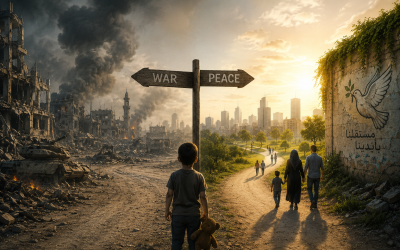
The Middle East is no longer just a geographical region; it has become a mirror reflecting global power struggles, the failures of political systems, ideological conflicts, and the heavy cost of foreign intervention. For decades, millions have lived amid wars, economic collapse, and displacement, while alliances shift faster than ordinary people can rebuild their lives.
The region’s greatest crisis is not its religious or ethnic diversity, but the manipulation of that diversity for political gain. Religion is often exploited to mobilize supporters, nationalism is used to justify hostility, and sectarianism has become a tool for dividing societies instead of enriching their cultural identities.
At the same time, major world powers have played a significant role in shaping the region’s instability. The United States, Russia, European nations, along with regional powers such as Iran, Turkey, Israel, and the Gulf states, have frequently viewed the Middle East as a strategic arena for advancing their own interests. As one conflict ends, another emerges, and every peace agreement seems to be followed by a new crisis that pushes the region back into turmoil.
Iran has expanded its regional influence through networks of allied armed groups across several countries, presenting this strategy as a means of protecting its interests and strengthening its regional position. However, many Arab states view these policies as a source of growing instability and regional tension. Meanwhile, Israel has relied on military superiority and strong international alliances to safeguard its security. Yet the continuation of the Israeli-Palestinian conflict and repeated military operations have kept the region trapped in cycles of violence while drawing widespread international criticism over their humanitarian consequences.
Many Arab countries, meanwhile, face overlapping challenges including security threats, economic hardship, unemployment, and declining public confidence in state institutions. In many cases, governments have focused on managing crises rather than building sustainable futures. The result has been unprecedented waves of migration and a generation of young people searching for hope beyond their own borders.
The greatest tragedy is that ordinary civilians continue to bear the highest price. They do not decide when wars begin, draw borders, or negotiate political agreements. Yet they lose their homes, their livelihoods, and often their lives. Millions of children have grown up knowing nothing but the sound of explosions, while countless young people have lost faith that a better future is possible.
Economically, the Middle East possesses enormous advantages. It holds vast reserves of oil and natural gas, occupies one of the world’s most strategic geographic locations connecting three continents, and is home to a young and capable population. Yet its economic potential remains largely unrealized because of corruption, poor governance, and recurring conflicts. Sustainable investment requires stability, and stability cannot exist while wars continue.
The future of the Middle East will not be secured through extremist rhetoric, greater militarization, or the revival of old conflicts. Lasting peace begins when human dignity becomes more important than political gain, when those responsible for fueling wars and committing abuses against civilians are held accountable, and when development, education, and the rule of law take precedence over the politics of force.
History has repeatedly demonstrated that military victories alone cannot produce lasting peace. Only justice, respect for human rights, meaningful dialogue, and strong institutions can create a different future for the region.
The defining question facing the Middle East today is simple yet profound: Will the region remain imprisoned by the conflicts of its past, or will it find the courage to build a future where human beings—not ideology or weapons—come first?