The Middle East’s Favorite Scapegoat
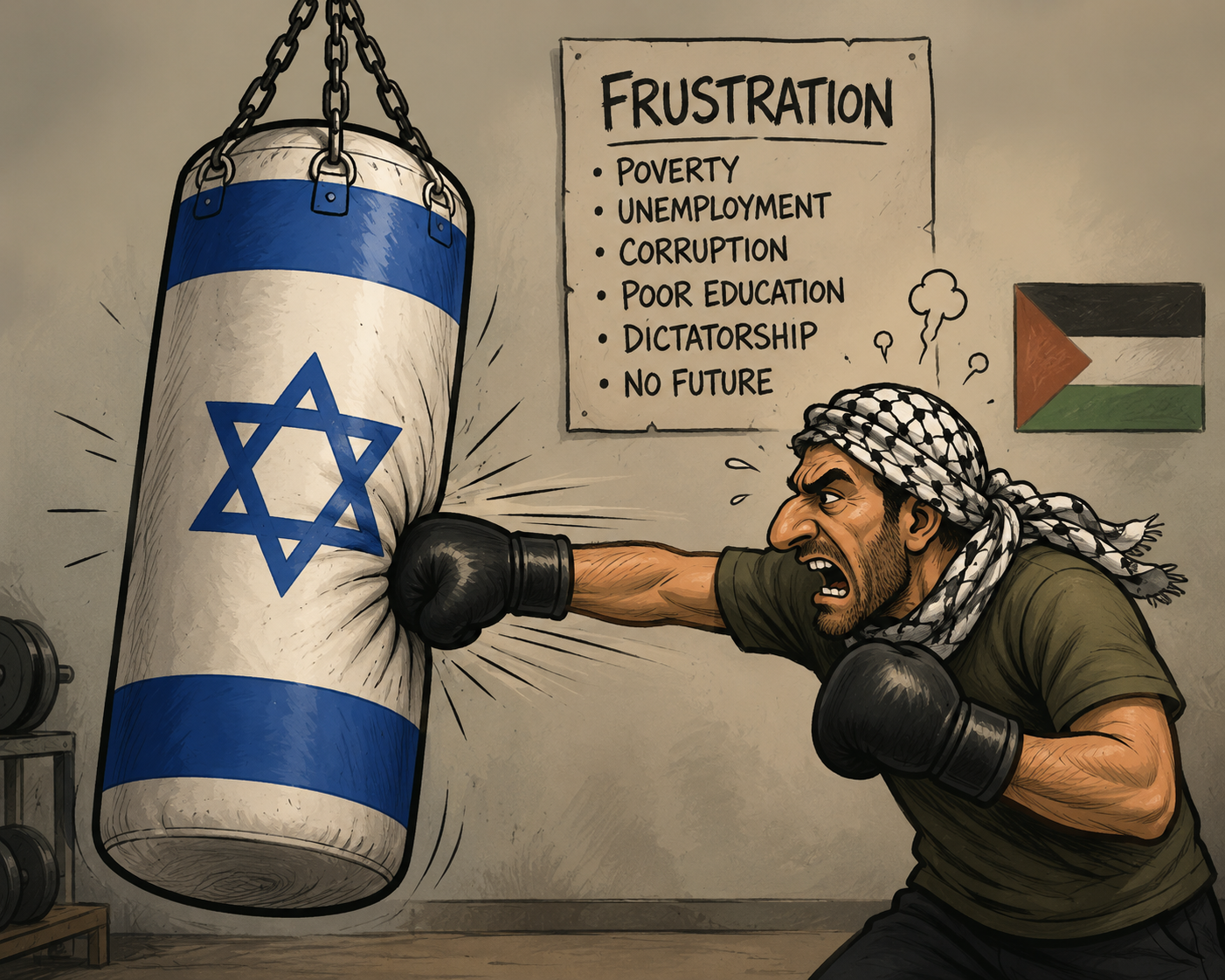
Every society looks for a way to cope with frustration. Some people exercise until exhaustion. Others listen to music, meditate, seek therapy, or spend an hour hitting a heavy bag at the gym. Anger demands an outlet. It is part of the human condition. The tragedy in much of the Middle East is that, for decades, our chosen punching bag has not been an object or an activity. It has been Israel and, by extension, the Jews. Rather than confronting the real sources of our political, economic, and social failures, we have been conditioned to believe that our suffering is someone else’s fault. That belief has become one of the most enduring political myths in the modern Arab world.
Across the Middle East and North Africa, millions of young people are living with legitimate frustrations. From Morocco to Iraq, from Yemen to Lebanon, unemployment remains high, educational systems often fail to prepare students for meaningful careers, corruption corrodes public institutions, economic opportunity is limited, and political freedoms are restricted in many countries. It is hardly surprising that so many young Arabs dream not of building a future at home but of leaving altogether. These grievances are real, and no honest observer should dismiss them. What deserves to be challenged is the narrative that has been offered to explain them.
For generations, many Arabs have been encouraged to believe that Israel lies behind nearly every disappointment in the region. We have been told that Zionism is responsible for our poverty, that Israel is responsible for our instability, that Jewish influence explains our political failures, and that the existence of the Jewish state somehow prevents Arab societies from prospering. This narrative has served one purpose extraordinarily well: it has redirected public anger away from those who actually govern our countries. Instead of asking why corruption persists, why economies stagnate, why schools underperform, or why young people continue to emigrate in search of dignity and opportunity, we have marched through our streets demanding Israel’s destruction, convinced that eliminating an external enemy would somehow solve problems created within our own borders.
The truth is both simpler and more uncomfortable. Israel did not build corrupt institutions in Arab capitals. Israel did not create dysfunctional educational systems. Israel did not embezzle public funds, suppress political reform, or deny millions of young people economic opportunity. Israel is not responsible for governments that have failed their own citizens. Those failures belong to those who have exercised power for decades while refusing to accept accountability. Yet blaming Israel has often proved politically easier than confronting entrenched corruption or authoritarian rule. A society consumed by hatred toward an external enemy is less likely to demand answers from those who actually hold power.
The cost of this culture of scapegoating extends far beyond politics. It has cultivated an environment in which hostility toward Israel too often spills over into hostility toward Jews as people. That distinction, which many insist upon in theory, frequently collapses in practice. I witnessed this after Morocco’s World Cup defeat to France. Morocco lost a football match to the better team that day. Israel played no role in the game. It scored neither goal. It made none of the tactical decisions. Yet videos soon emerged of some Moroccans in Europe chanting against Jews, calling for Israel’s destruction, and repeating slogans rooted in some of history’s darkest antisemitic traditions. A sporting defeat became another excuse to direct rage toward an entirely unrelated people. It was not merely irrational; it was revealing. It demonstrated how deeply anti-Israel propaganda has shaped the instinctive reactions of too many people who have been taught to blame Israel for events bearing no connection to it whatsoever.
The same pattern emerged only days later inside Morocco itself, when videos circulated of activists publicly insulting Jacky Kadoch, the respected head of the Jewish community in the Marrakech region. He was denounced as a Zionist, branded a traitor, and subjected to a torrent of public abuse. Whatever political disagreements people may have, campaigns that single out identifiable members of a tiny religious minority carry consequences far beyond the individual being targeted. Jacky Kadoch is a Moroccan patriot who has devoted decades to serving his country and strengthening Morocco’s international relationships. Attacking him because he is Jewish, or because of assumptions made about his identity, sends a message to every remaining Moroccan Jew that they too can become targets of public intimidation.
That reality should concern every Moroccan, regardless of political views. Morocco’s Jewish community, once among the largest and oldest in the Arab world, has dwindled dramatically over the past century. Those who remain are not outsiders or temporary guests. They are part of Morocco’s indigenous history, culture, and national identity. Jewish civilization has been woven into the Moroccan story for well over two thousand years. To create an atmosphere in which Moroccan Jews are publicly vilified is not simply an attack on one community; it is an attack on Morocco itself and on the pluralistic identity that has long distinguished the kingdom from much of the region.
If the Arab world genuinely seeks progress, it must first abandon the comforting illusion that Israel is responsible for its internal failures. No country has ever built prosperity by blaming foreigners for problems created by its own political system. No society has ever achieved reform by substituting conspiracy theories for accountability. The path toward a stronger future begins with the courage to acknowledge that corruption, authoritarianism, economic stagnation, and institutional failure cannot be defeated by chanting against Israel or by directing hatred toward Jews. They can only be confronted through honest self-examination, political responsibility, and the willingness to hold our own leaders to the standards we have too often reserved for others.
As a Moroccan Muslim, I refuse to accept that antisemitism is part of my identity or my heritage. Morocco’s greatness has always rested on the coexistence of Arabs, Amazigh, Jews, Muslims, and other communities whose histories are inseparable from one another. When one part of that heritage is attacked, the entire nation is diminished. The future of the Arab world will not be determined by how loudly we condemn Israel. It will be determined by whether we finally find the courage to confront ourselves.