The ‘million-man’ protest and Israel’s democratic test
Today’s “million-man rally,” with masses of ultra-Orthodox demonstrators filling the streets of Jerusalem, tops off a series of ultra-Orthodox protests that expose a deep fracture in Israeli society. The rare unity among Lithuanian, Hasidic, and Sephardic groups in opposing military conscription and the anticipated scale of participation are symptoms of a deeper crisis. Yet the numbers themselves are not the main issue.
In recent weeks, hundreds of ultra-Orthodox children aged 10 and 11 were bused to a military prison, wearing yellow hats and holding balloons printed with the image of a draft evader. Their slogan read: “Bring him back to the yeshiva now.” The campaign for Ariel Shamai, a student of the Ataret Shlomo Yeshiva who was arrested, included the caption “Until the last abductee.” Protest organizers made no effort to hide the source of their inspiration – they consciously replicated the symbols of the public movement to return the hostages from Gaza, symbols that have come to represent national pain and mutual responsibility.
The comparison between a draft-evading yeshiva student and an abductee in Gaza is disturbing on two levels. First, the obvious implication: the Israel Defense Forces are depicted as a cruel enemy, a kidnapper, rather than as an army that protects the nation. Second, this appropriation reveals a near-complete detachment from the collective trauma of October 7, from the bereaved families, the wounded, the soldiers, and the reservists.
This is no longer merely a political disagreement but a genuine rupture. An entire community lives within the state, enjoys its services, and influences its policies, yet remains alienated from its pain. When its leaders proclaim, “Better to die as a Jew than to live as a Zionist,” they are not only rejecting the state, they are rejecting the suffering of its citizens, as if the hostages and fallen soldiers were not part of the collective “we.”
Ultra-Orthodox parties are central players in Israel’s political system. They have joined nearly every governing coalition, secured massive budgets, and shaped policies that affect all citizens. Yet the public they represent simultaneously declares that the state’s laws are “heretical,” that its army “fights Judaism,” and that conscription is “a war against the Torah.” This is the paradox: active participation in the democratic game while denying its very rules.
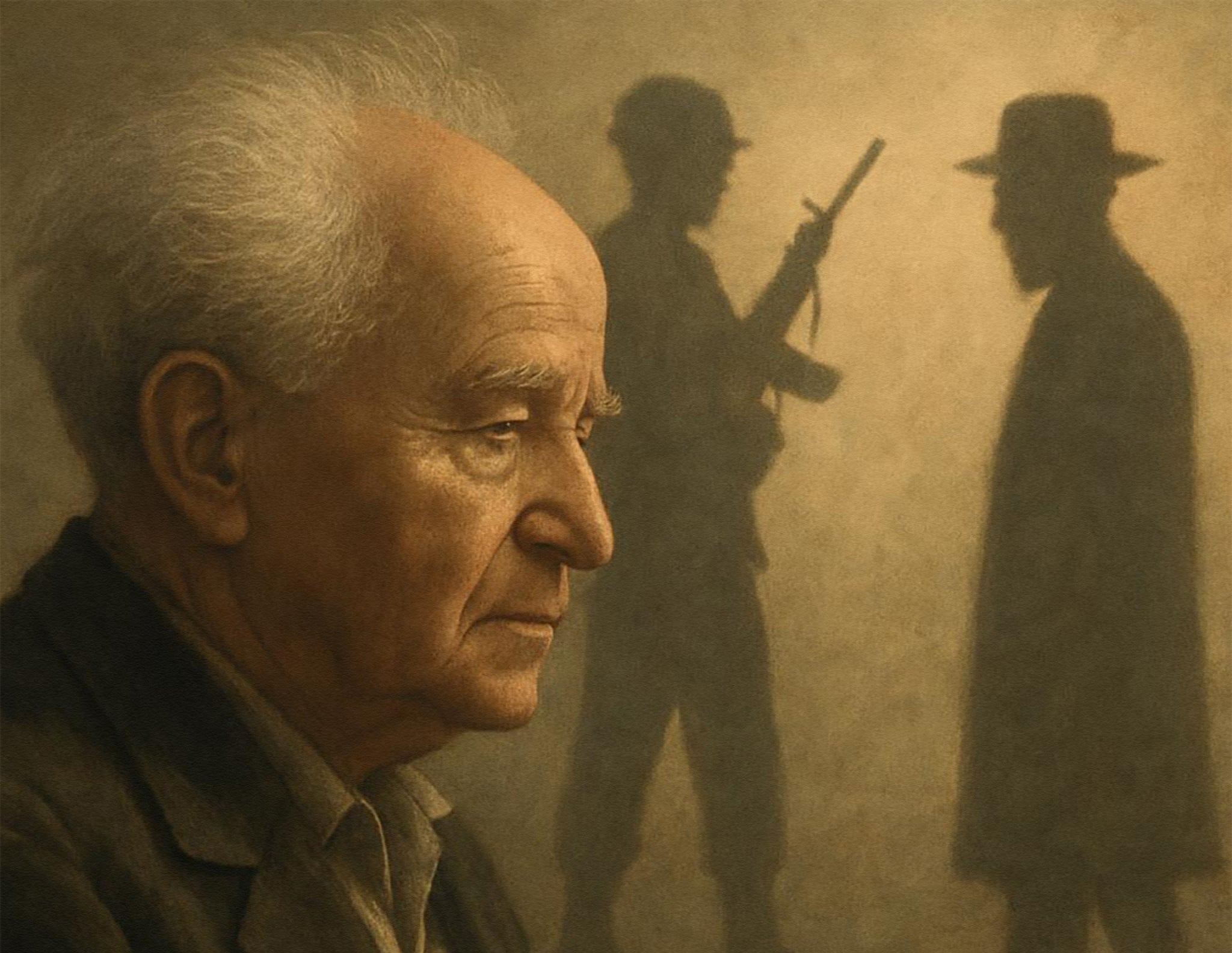
The roots of this paradox go back to 1948, when David Ben-Gurion exempted 400 yeshiva students from military service – a temporary gesture aimed at rebuilding the Torah world destroyed in the Holocaust. A decade later, he already regretted the decision: “Those yeshiva students neither built the land nor risked their lives for its independence.” But the mechanism became entrenched. The 1977 political shift gave ultra-Orthodox parties unprecedented political and financial power, while a completely separate educational system grew alongside – one devoid of core subjects, despite the original “status quo” agreement that promised minimal studies in Hebrew, history, and science. What began as a temporary accommodation turned into a self-perpetuating structure of separation and inequality.
Today, one must ask: is this truly a defense of the “world of Torah,” or a defense of a political and economic power structure built on an exemption granted in good faith more than seventy years ago?
In this reality, radical proposals have emerged – such as Yair Lapid’s suggestion to revoke voting rights from those who do not serve in the army. The temptation is understandable: why should those who do not share the burden determine the country’s fate? But such a move endangers democracy itself. The right to vote is not a privilege for the deserving; it is a fundamental right of citizenship. Once it becomes conditional – on military service, taxes, or the “correct” worldview, or ethnicity – democracy turns into an exclusive club of the “worthy.”
Practically speaking, such a measure would only deepen the divide. It would transform difficult citizens into a hostile minority, reinforcing their sense of persecution and isolation.
The appropriation of hostage symbols, then, is not merely in poor taste – it is symptomatic of a deeper mindset: a perpetual victimhood consciousness, a self-image of persecution even amid immense political power. So what can be done? Revoking rights will only deepen the rift. Yet maintaining the current status quo is equally untenable.
Israel stands between a hammer and an anvil: on one side, a population that shapes national policy yet refuses to share the burden – a social and economic imbalance that undermines the very principle of equality; on the other, the danger that any coercive solution will tear apart the fragile democratic fabric.
We must therefore begin by recognizing the depth of this divide. This is not a dispute over budgets or military service but a clash between two worldviews that have lost their shared language. Democracy must be strong enough to contain even those who challenge it from within. That is not weakness: it is strength. The task is not to exclude the ultra-Orthodox from the democratic game but to adjust its rules so that they cannot be exploited to absurdity.
What is needed are measured corrections, not revolutions. As Karl Popper wrote, an open society sustains itself through small, testable, and reversible steps – not through sweeping upheavals. In Israel, this means gradual reforms: full budget transparency across sectors, genuine civil-service alternatives for those who do not enlist, and inclusion of core studies in all state-funded schools. Small but cumulative changes that strengthen equality without tearing the social fabric. Only in this way can democracy renew itself without breaking apart.
And those who must first acknowledge the depth of the rift and take responsibility are the leaders of the ultra-Orthodox communities themselves. As long as they continue to cultivate a sense of persecution and justify alienation from Israeli society as a whole, the divide will only widen. Courageous recognition by the ultra-Orthodox leadership, alongside a willingness by Israeli society to reengage in dialogue, could open a path toward genuine repair.