


The Moon Apartment Problem
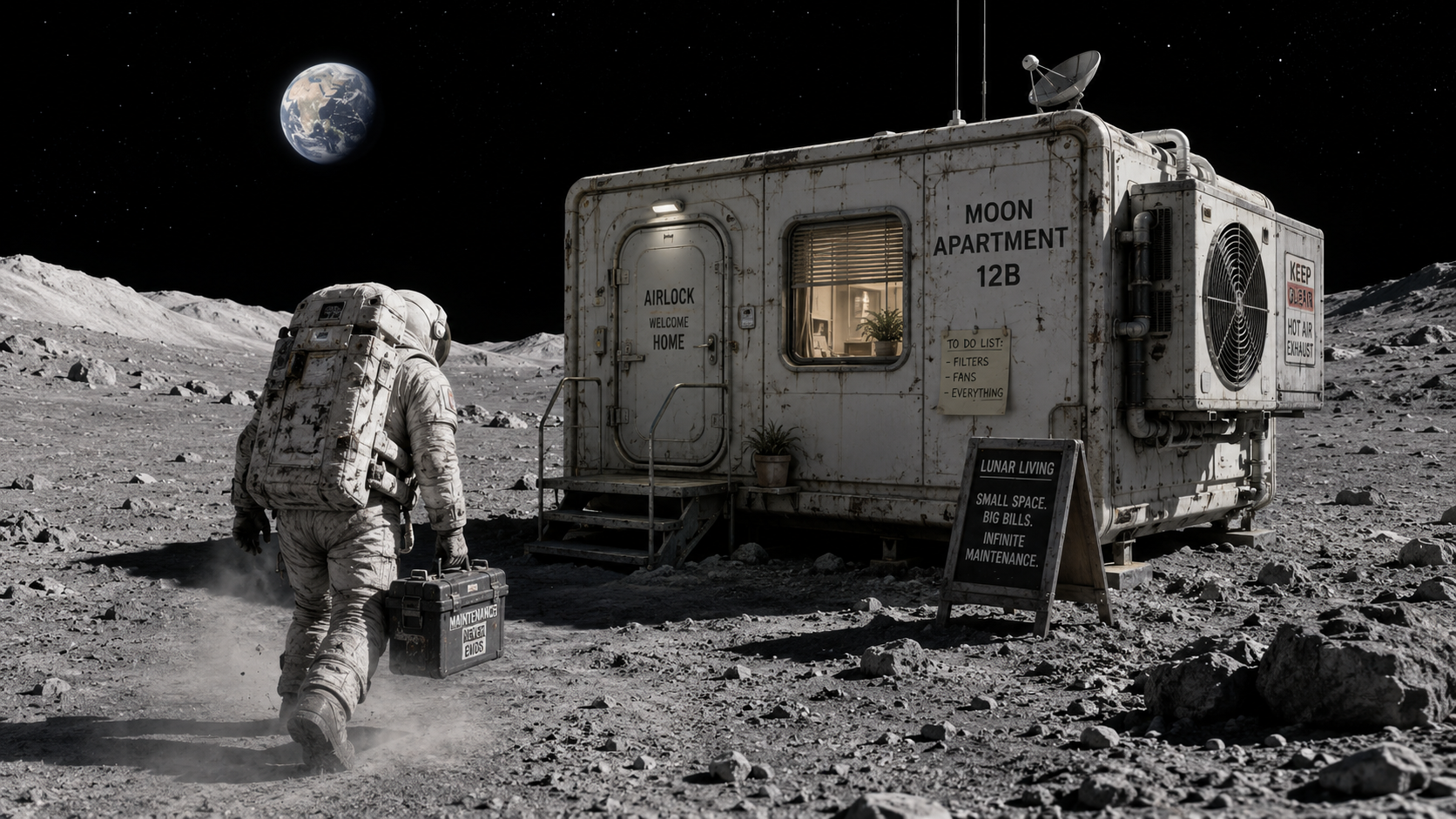
Permanent lunar living is not mainly a construction problem. It is a maintenance problem.
Imagine being offered an apartment on the Moon.
The view is magnificent. The stars do not twinkle. Earth hangs above the horizon and never sets. There are no neighbors. No traffic. No street noise.
Absolute silence — because outside, there is vacuum.
The cost of living is unknown. But for now, let us say the apartment is free.
Everything sounds perfect.
Except for one small problem: every speck of dust outside your window is trying to kill you.
In Dust We Trust.
We Solved the Wrong Problem
Most people think the main challenge of settling the Moon is getting there.
It is expensive, dangerous, technically difficult — and yes, it is still a major engineering achievement.
But in that direction, humanity has already taken a huge step.
Heavy-lift rockets, reusable launch systems, lunar landers, and renewed national space programs are making the Moon reachable again. The old question – “Can we get there?” – is no longer the whole story.
The real question is different: “How do we live there after we arrive?”
That is where the problem becomes much more interesting.
Question One: Who Fixes the Apartment?
Suppose your air conditioner breaks.
On Earth, you call a technician. The technician comes, fixes it, leaves, and probably complains about parking.
On the Moon, the technician must put on a spacesuit. Pass through an airlock. Go outside. Work in gloves that make holding a screwdriver feel like performing surgery with boxing gloves. Then come back in and go through decontamination, because the material stuck to the suit is not just dirt.
We will get to that material shortly.
A simple repair becomes an operation. Every malfunction becomes a small crisis.
This is not science fiction. It is the basic maintenance reality of lunar infrastructure.
Question Two: Who Cleans the Windows?
Here we reach the real enemy.
On the Moon, there is no wind. No rain. Nothing to wash dust away, blow it off, or carry it somewhere else.
But there is regolith — the fine, sharp, stubborn lunar soil.
Lunar dust is not like household dust on Earth. Earthly dust has been rounded and softened by wind, water, weather, and time. Lunar dust was formed by meteorite impacts over millions of years in vacuum. Its particles are jagged, abrasive, and sharp — more like microscopic broken glass than powder.
And it is electrically charged.
The solar wind bombards the lunar surface and creates electrostatic effects. Dust clings to glass, solar panels, spacesuits, seals, joints, and instruments. You do not simply wipe it away. It has a way of coming back, as if it has taken the entire base personally.
Apollo astronauts returned from the lunar surface with suits darkened by dust. After only a few hours outside, equipment looked as if it had spent a shift in a coal mine.
Except coal mines do not have vacuum, radiation, and no repair shop.
Question Three: Who Takes Out the Trash?
On Earth, waste disposal is a municipal service. Most of us do not think about it.
On the Moon, every kilogram matters.
A worn-out part, a used filter, a damaged panel, a broken tool — all of it either stays on the surface or requires a logistics operation. Returning mass to orbit is expensive. Bringing replacement parts from Earth is also expensive. And the round trip takes time.
That means a lunar base cannot rely on casual replacement.
It needs spare parts, redundancy, repair capability, storage, recycling, and careful planning. It needs to behave less like a building and more like a small isolated city that cannot call the city.
This is not an apartment anymore.
It is a tiny civilization with no hardware store.
Question Four: Who Replaces the Worn-Out Parts?
On the Moon, everything that works on Earth still has to work — but under worse conditions.
Metals expand and contract under extreme temperature swings. During a lunar day-night cycle, the surface can experience temperatures from deep cold to intense heat. Seals degrade. Some lubricants evaporate in vacuum. Mechanisms designed for thousands of cycles on Earth may not survive nearly as long in the lunar environment.
And everywhere, again, there is dust.
It gets into gears, bearings, joints, connectors, hinges, seals, electrical contacts, and ventilation systems. It does not merely make things dirty. It grinds them down.
Dust is not a nuisance on the Moon.
Dust is a maintenance regime.
The Main Point
A permanent base on the Moon is not mainly a construction problem.
It is a maintenance problem.
We know how to build things. Humans have built fortresses in deserts, cities on swamps, ports on cliffs, stations in polar regions, and habitats under the sea. Building in extreme environments is difficult, but it is not new.
Maintaining them is different.
And on the Moon, maintenance is not a background service. It is the difference between settlement and failure.
A permanent lunar base will need more than rockets, reactors, habitats, and landing pads. It will need maintenance technologies that barely exist today at the required level: robots that can work reliably in vacuum and abrasive dust; materials that survive thermal cycling; seals that do not fail after repeated exposure; systems that can detect damage early; and infrastructure that can repair itself before small failures become cascading ones.
Dust as the Perfect Symbol
Of all the problems of lunar life, dust is the most eloquent.
It does everything wrong at once.
It:
- damages machinery through abrasive wear;
- contaminates optics and reduces the efficiency of solar panels and windows;
- enters habitats through airlocks, suits, tools, and ventilation systems;
- threatens human health because sharp particles can damage the lungs if inhaled.
Solving this one problem requires several technological advances at once: better materials, better cleaning systems, dust-resistant seals, robotic surface maintenance, safer suitports, and smarter habitat design.
Some approaches are already being tested.
Electrodynamic dust shields can use electric fields to move dust away from surfaces. Passive coatings may reduce adhesion. Vibrational systems can help shake dust off solar panels or optical surfaces.
These are promising beginnings.
But they are not yet a complete answer.
On Earth, every city survives because of an invisible army of technicians, trucks, warehouses, mechanics, electricians, spare parts, supply chains, and maintenance crews.
A lunar base will have to replace much of that infrastructure with a few people, a few robots, and a very unforgiving environment.
On Earth, leaving your house takes minutes.
On the Moon, going outside may require hours of preparation, checks, life-support procedures, airlock cycling, dust control, and post-EVA cleanup.
For a future lunar resident, taking a walk around the house may be more complicated than going outside during an Arctic storm.
What About Radiation and Everything Else?
Yes, there is radiation.
Yes, there are extreme temperature swings.
Yes, there are micrometeoroids.
Yes, there are many other problems.
But they all share one feature: every protective system will itself need maintenance.
Radiation shielding must remain intact. Thermal systems must keep working. Airlocks must keep sealing. Filters must be replaced or cleaned. Robots must be repaired. Solar panels must be cleared. Habitats must be inspected. Water loops must be protected. Life-support systems must be monitored continuously.
The Moon does not only challenge construction.
It challenges endurance.
We Have Done Impossible Things Before
Humanity knows how to inhabit the impossible.
We crossed oceans in wooden ships. We built cities in deserts and near the poles. We learned to live in mountains, underwater, and in orbit. Each time, the task seemed unreasonable — until engineering, logistics, discipline, and persistence made it normal.
The Moon is the next step.
But to take that step seriously, we need to change the question.
Not only:
“How do we get there?”
But:
“How do we live there for the next ten years?”
That question receives far less public attention than it deserves.
The Next Step
We may need to admit that a lunar base is not just a box full of electronics.
It is a living, breathing, aging environmental organism.
On Earth, if the air conditioner breaks, it is a repair.
On the Moon, a cascading failure of environmental systems can become something closer to clinical death of the habitat itself.
And if the habitat can “die,” then we need an engineering discipline that knows how to keep it alive.
Not just construction.
Not just life support.
Not just robotics.
Something broader: “extraterrestrial eco-reanimatology” — the engineering of keeping local off-world environments viable, diagnosing their failures, stabilizing their systems, recovering them after damage, and scaling them from single habitats to permanent settlements.
A lunar base will not survive because we build it once.
It will survive only if we learn how to keep treating it as a patient.
––––––––––––––––––––––––––––––––––––––––––––––––––––
A full technical review of the main engineering problems of permanent lunar habitation – including dust, radiation, thermal cycling, maintenance, resource loops, and life-support infrastructure – is published on Zenodo: https://doi.org/10.5281/zenodo.20731687