An Aging Jewish Feminist
The Moral Test of Power: From the Captive Woman to Amalek
I am going to New York this week for a family simcha—the last of my immediate family’s bar mitzvot. On Monday, we celebrated the first wedding of the next generation of our family, and my sister was sorely missed. In the past, most of my trips to New York were to visit her. So returning now, probably for the last time, is bittersweet.
I probably said goodbye to my home in Omer as well, two weeks ago. This seems to be my season of farewells—though, at least, this one is for a happy occasion. August 27 also marks the anniversary of our coming to Israel in 1967. My life, like the Jewish calendar, seems to be moving through a series of departures, arrivals, losses, and new beginnings.
Perhaps that is why I find myself returning once again to Parashat Ki Teitzei, one of my favorite Torah portions. It is extraordinarily rich, and over the years I have written and lectured about many of its troubling passages. This year, however, I want to bring several of them together around one central question: What happens to our morality when we are the ones who have power over the other?
The question of power also came up this week in a Zoom class I regularly attend. We were discussing David, who, once he becomes king, discovers just how much power he has—and how easily he can use it without getting his own hands dirty. One of the striking literary motifs in 2 Samuel 11 is the repeated verb va-yishlach (וישלח, “and he sent”), which appears again and again as David orders others to carry out his wishes. David himself does not have to act. He simply sends.
That is precisely what makes the story so disturbing. David is not on the battlefield; he is sitting in his palace. He sees a beautiful woman, desires her, and uses the machinery of his power to obtain her. The contrast between David’s position of power and the vulnerability of those over whom he exercises it provides an unexpected but powerful entry point into this week’s parasha.
THE CAPTIVE WOMAN
Our portion begins with one of the most disturbing laws in the Torah:
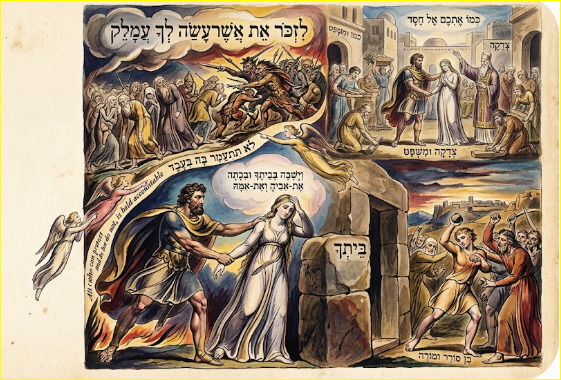
“When you go out (ki tetzei) to war against your enemies… and you see among the captives a beautiful woman and you desire her and would take her to wife, you shall bring her into your house… and she shall be your wife. Then, should you no longer want her, you must release her outright. You must not sell her for money: since you had your will of her, you must not enslave her” (Deut. 21:10–14).
I have written extensively about this passage in connection with human trafficking. At first reading, the Torah appears to acknowledge a brutal reality: a victorious soldier desires a woman captured in war. Yet instead of allowing him to treat her as booty, the Torah imposes restrictions. She must be brought into his house, given time to mourn her parents, and if he no longer wants her, released outright. He cannot sell her or enslave her. There is a distinction between the battlefield and the home. Once she enters the Israelite household, she can no longer be treated simply as an object of war.
Yet I no longer find this explanation sufficient. After listening to discussions about sexual violence in war, and finally watching the film Screams Before Silence, I found myself unable simply to “understand” this biblical law as a humane regulation of male sexuality. I had to look at it from the perspective of the woman who is raped, captured, traumatized, and treated as collateral damage in war.
The question becomes much more painful when we place the biblical text alongside what happened to Israeli women on October 7 and what happens to women in war more generally. The Torah requires that “she shall spend a month’s time in your household lamenting her father and mother” (Deut. 21:13). The month of mourning is significant. The woman is not merely a sexual object. She has a family. She has lost people. She has a past. She is a human being whose life has been shattered. And yet the text still permits sexual access to her. That tension cannot simply be resolved.
WHAT OUR SAGES DID WITH THE PROBLEM
The rabbis were acutely aware of this moral difficulty. The discussion in Kiddushin 21b-22a asks whether a priest who captures a beautiful woman in war may have sexual relations with her. Rav permits it; Shmuel prohibits it. The Gemara explains the first position by saying:
“The Torah spoke only in response to the evil inclination.”
The Torah, in other words, knows that men have sexual desires and attempts to regulate rather than simply deny them. The Talmud then develops the law in extraordinary detail: the soldier cannot pressure the woman during the war; he must first bring her into his home; he cannot take two women; and there are extensive discussions about whether he may subsequently marry her.
The passage contains genuine concern for the captive woman. But it also contains language that is profoundly disturbing to us. The Talmud compares the situation to eating the meat of an animal that is dying but has been properly slaughtered rather than eating an animal that will become a carcass. The underlying assumption remains: the Torah is making an otherwise forbidden sexual act permissible in order to restrain the yetzer hara.
I appreciate this Talmudic passage because it refuses to hide the problem. Judaism is not monolithic. Rav and Shmuel disagree. The rabbis argue. Judaism preserves competing, uncomfortable voices.
However, some midrashic traditions turned the victim into a temptress. In its comments on the removal of her captive clothing, Midrash Tanaim on Deuteronomy 21 suggests:
“She transfers her beautiful clothing and puts on widow’s garb, for the nations are cursed and their daughters decorate themselves during wartime in order to tempt others into whoring after them.”
Instead of asking what was done to her, the text asks what she did to the man. The victim becomes the temptress. This psychological mechanism—dehumanizing the enemy woman to justify mistreatment—is frighteningly relevant today. While an ancient biblical text and modern atrocities are not the same, we must have the intellectual honesty to examine our own tradition alongside the ideologies of our enemies. Could the same mechanism of dehumanization operate whenever women on the “other side” are seen as less human, as sexually available, as dangerous, as deserving of what happens to them?
I do not want to make a facile equation between an ancient biblical text and Hamas’s atrocities. They are not the same thing. But the psychological mechanism—dehumanizing the woman who belongs to the enemy—should make us deeply uncomfortable.
The biblical command to allow her to mourn offers a radical imperative for today: let the victim mourn. Do not demand that she immediately explain herself or turn her trauma into a political tool. If she wants to speak, listen; if she needs help, offer it; if she wants solitude, respect it.
FROM THE CAPTIVE WOMAN TO THE HATED SON
The verses that follow make this even more interesting. Immediately after the captive woman comes the law of the two wives:
“If a man has two wives, one loved and the other unloved, and both the loved and the unloved have borne him sons, but the first-born is the son of the unloved one…” (Deut 21:15-17).
The next law concerns a rebellious son:
“If a man has a wayward and defiant son, who does not heed his father or mother… They shall say to the elders of his town, ‘This son of ours is disloyal and defiant; he does not heed us. He is a glutton and a drunkard.’ Thereupon the men of his town shall stone him to death. Thus you will sweep out evil from your midst: all Israel will hear and be afraid” (Deut 21:18-21).
When I read the law of the rebellious son to teenagers in synagogue, I joke, “You better behave yourselves—or else!” But the joke covers a dark rabbinic connection: the rebellious son is understood to be the child of the unloved captive wife.
The Torah implies a chain of trauma: war → captive woman → unwanted wife → unloved child → rebellious child → violent death. The child acts out within a family structure built on capture and rejection. Instead of asking what trauma he inherited, the community stones him. The sequence invites us to ask what happens when initial violence produces generations of domestic collapse.
POWER AND THE OTHER:: THE CAPTIVE WOMAN AND AMALEK
At the end of Ki Teitzei, we encounter a striking contrast to the captive woman: the command to remember Amalek.
“Remember what Amalek did to you on the road, on your way out of Egypt—how, undeterred by fear of God, he surprised you and cut off the stragglers in your rear, when you were famished and weary” (Deut. 25:17–18).
What possible connection can there be between the beautiful captive woman at the beginning of the portion and Amalek at the end?
The beautiful woman belongs to an enemy nation, but she is now in Israelite hands. Amalek is the enemy who attacked Israel when Israel was vulnerable and exhausted. The difference is crucial. With the captive woman, we have the power. With Amalek, we were powerless.The woman is the “other” whom we control. Amalek is the “other” who once controlled the terms of our vulnerability. The captive woman belongs to the future: how will we behave when we enter the land, defeat our enemies, and become powerful? Amalek belongs to the past: what happened to us when we were weak, exhausted, and defenseless?
These are therefore not unrelated laws. They are two tests of morality. The first asks: What will you do when the enemy is in your hands? The second asks: What will you remember about what was done to you when you were helpless?
At the beginning of this section, the Torah says that if we behave properly, God will give our enemy into our hands (Deut 21:9). In other words, victory is not itself the moral achievement. What we do with victory is the test. When we are the victors, we must regulate our power. When we are the victims, we must remember what vulnerability feels like.
The Problem of Hierarchy
This tension extends to how tradition treats the non-Israelite. Leviticus 25:39–46 explicitly distinguishes between an Israelite worker (who must not be ruled over ruthlessly) and foreign slaves (who may be kept as inherited property).
We cannot pretend our texts say something simpler than they do. Tradition contains passages that establish a hierarchy between “us” and “them.” When modern politicians make statements prioritizing one group’s rights over another’s, they can find precedents to quote. Our task is not to deny these texts, but to choose which voices within our tradition we amplify—and who we choose to become when we hold power.
Contemporary Accountability: Trafficking and Refugees
This is not merely an ancient theoretical debate. Human trafficking thrives wherever unequal power allows one person to control another’s body or survival. While Israel has made strides against human trafficking, international reports (such as the U.S. State Department’s 2023 Trafficking in Persons Report) continue to point out gaps: inadequate accountability for labor traffickers, challenges in victim identification, and the precarious situation of refugees.
A society that aspires to moral integrity cannot only protect its own; it must account for how it treats the vulnerable non-citizen in its midst.
Who Is Responsible When Power Is Abused?
The Talmud teaches:
“All who can protest against something wrong that one of their family is doing and does not protest, is held accountable for their family… in the whole city… in the whole world. How did the elders sin? Because the elders do not protest against the princes” (b. Shabbat 54b–55a).
Responsibility expands with the capacity to act. Silence in the face of misapplied power is itself an entanglement. Ki Teitzei does not offer easy answers. Its laws contain both humane protection and brutal realities. Amalek represents what was done to us when we were weak; the captive woman represents what we can do when we are strong.
When we are powerless, we demand justice. When we are powerful, we must practice it.
Memory must not become an excuse for revenge; memory must serve as a moral warning. Remember what was done to us, remember what we are capable of doing to others, and remember that power is always a test.
Related Topics