
Exploring Memory, War, and Survival
The Mountain That Refused the War
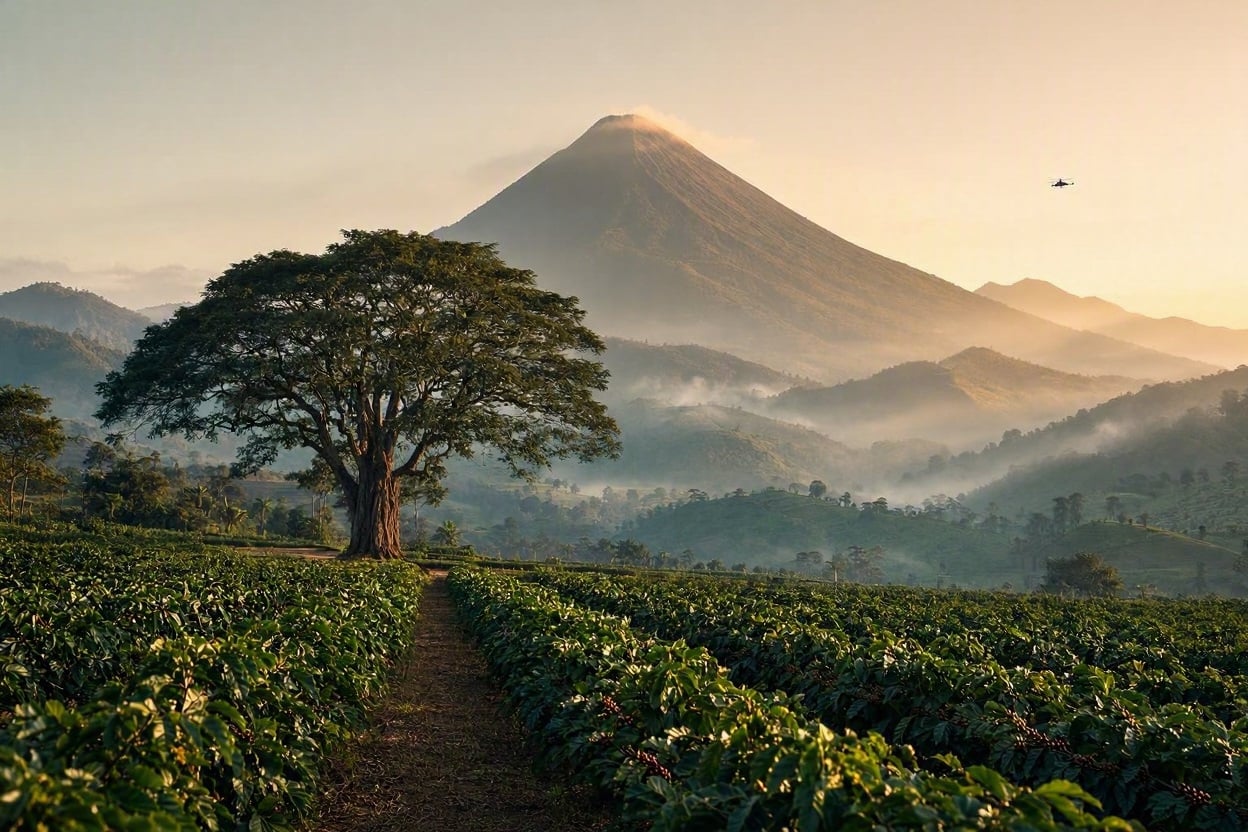
AI-generated illustration inspired by the slopes of Chaparrastique volcano in El Salvador.
People often ask me what I remember most about growing up during El Salvador’s civil war. They expect stories about soldiers, explosions, fear, or death. Those memories exist, but they are not the first ones that come to me. The first thing I remember is the wind.
Every coffee season, before sunrise, we climbed the slopes of Chaparrastique, the volcano that watched over my hometown of San Jorge. We rode in an ox cart along narrow dirt roads that climbed the mountain, its wooden wheels groaning over stones and uneven ground while the oxen pulled us steadily upward. Dust clung to our clothes, and with every turn, the valley slowly opened behind us. The higher we climbed, the cooler the air became. It was so gradual that, as a child, I never noticed the exact moment the mountain took the heat away. I simply knew that Chaparrastique had its own breath. Even today, decades later, I can still feel that invisible line where the heat of the valley ended and the fresh wind of the volcano began. At the time, I thought every mountain did that. I thought every child knew that feeling.
When we finally reached the coffee fields, another world opened before us. From those slopes, I could see almost everything that mattered in my small world. Below us lay San Jorge, surrounded by green hills that seemed endless. To the south shimmered El Jocotal Lagoon, reflecting the morning sun like a second sky resting on the earth. Beyond the valley rose the silhouettes of distant volcanoes, standing quietly as they had for centuries. From that height, the world looked impossibly peaceful. It is strange to realize now that a country at war could look so beautiful.
The mountain never seemed to notice that human beings had divided themselves into enemies. The coffee trees continued to grow, the wind continued to descend every morning, and the birds continued their songs. Each bird seemed to have its own melody, yet together they formed a concert that belonged only to that mountain. Above them all, I always remember hearing the unmistakable song of the torogoz, El Salvador’s national bird. At the time, I did not know it was our national bird; I only knew that it was always there.
The old amate trees spread their enormous branches across the hillsides as if inviting us to sit beneath them for a while and listen. Their shade felt cooler than anywhere else on earth. There, the mountain seemed to slow down. We rested after working. We picked oranges and mangoes straight from the branches, their juice running between our fingers, down our wrists, onto our shirts and dusty legs. Our lips became sticky with sweetness while the smell of coffee leaves, damp earth, and warm wood surrounded us. For a few quiet minutes, nothing else existed. Then we stood up, picked up our baskets, and went back to work. Because that was simply life.
The remarkable thing is that none of these memories erased the war. The war was there too. Sometimes soldiers passed along those same mountain trails. Sometimes military helicopters crossed above the coffee fields. Sometimes distant gunfire echoed across valleys too beautiful to carry such sounds. And at night, back home, I climbed onto the roof of our small wooden house and watched flashes of explosions illuminate the horizon beyond the darkness.
As a child, I never thought these realities contradicted each other. The mountain could be beautiful. The country could be breaking apart. Both things were true. Children have a remarkable ability to accept realities that adults find impossible to reconcile. Only years later did I begin asking how beauty and violence could occupy the same landscape.
Today, I no longer think the mountain survived because it escaped the war. I think it survived because nature refused to participate in it. The wind did not choose sides. The coffee trees did not choose sides. The amate trees continued offering shade to anyone who sat beneath them. The torogoz never stopped singing because men had decided to kill one another.
As I have grown older—and as I have learned more about Judaism—I have come to appreciate something that I could not have articulated as a child. Jewish memory does not preserve only catastrophe. It remembers suffering without surrendering hope, destruction without forgetting renewal, exile without abandoning the possibility of return. Sorrow is preserved, but it is never given the final word.
Looking back now, I realize my childhood contained something similar. The war taught me how fragile human beings can become. But the mountain taught me something equally important: it taught me that creation possesses a quiet faithfulness that human history often lacks.
Long after the soldiers disappeared, long after the checkpoints vanished, and long after the war itself passed into history, I imagine the wind still descending from Chaparrastique every morning. The amate trees still casting their shade. The torogoz still singing. The coffee trees still waiting for another harvest.
And I remember something I could not have understood as a boy. The war tried to teach us fear. The mountain never stopped teaching us wonder.
Perhaps that is what I carry with me more than anything else. Not simply memories of war. But the memory of a mountain that never stopped teaching a child that beauty could survive, even when people forgot how to live in peace.
Related Topics
Related Posts