Grammy and Emmy nominated singer-songwriter, author, essayist
The Nexus Point: Reflections on a Seattle Morning, and a New Grandson
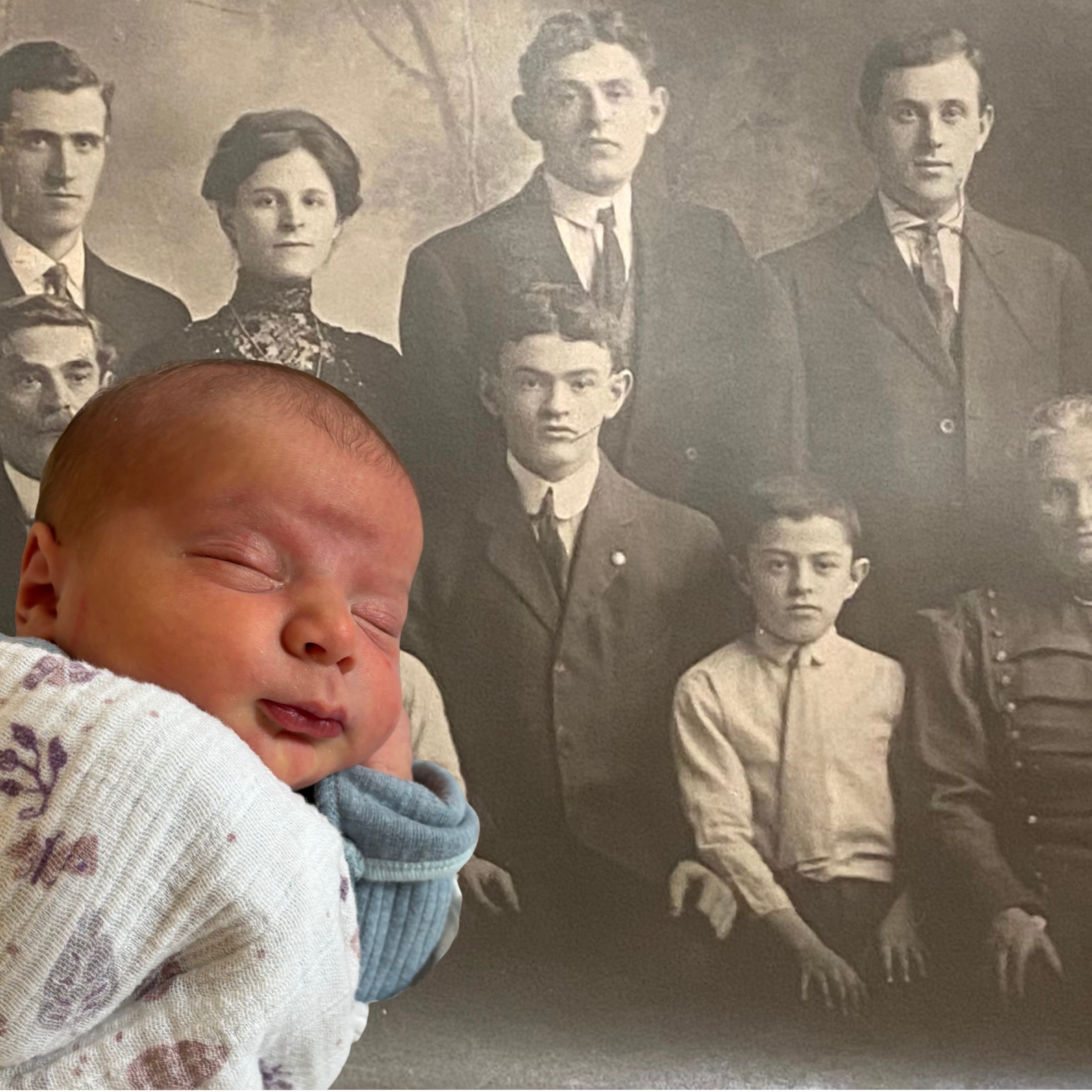
The author's grandfather, seated second from the right, in Yekaterinoslav (now Dnipro), Ukraine.
I went to sleep late last night, and, as is common for me these days, I woke much earlier than I would have hoped. Not surprising, though. Later today, we will celebrate the bris of another grandson, born just a couple of weeks after our last one.
There are several ways to look at the arrival of a new child. One is the glib way, the way certain people, lacking words for either their joy or their incredulity at the enormity of the event itself, say, “Grandchildren are so much better than your own kids. You play with them, and when they get fussy, you hand them back to their parents.”
I get it. It’s true. But there is another feeling at play, one that is much harder to describe.
You had once been a kid yourself, doing whatever it was you did—playing Little League or, in my case, the guitar—dreaming about what life would be like once you’d graduated from the constraints of youth and blasted off into the reality of adulthood, something even the most powerful imagination could never have conceived.
Then, suddenly, at least in my experience, you undergo a kind of spiritual awakening. You no longer see yourself as a solitary figure making his way through life. You see yourself as inextricably linked to the generations that came before you.
You think more deeply about your parents. How they raised you. The time and effort it took. And about your grandparents, who somehow no longer seem quite as old as they once did. Then you think about their parents, and the long line of ancestors stretching back beyond memory.
I picture it not as a crowd, but as a literal line stretching across a field, disappearing over a grassy hill, ending somewhere near Mamre or Hebron. Some carry staffs. Others ride donkeys or camels.
So now I’m no longer simply a person from St. Louis Park, Minnesota. A boy who attended Peter Hobart Elementary School, and who, in fourth grade, wrote a petition protesting a new rule that prohibited speaking in the lunchroom. The principal called my mother to complain about my youthful subversion. Rather than cower, my mother—an educator herself—scolded the principal.
“Here my son is doing something you should be proud of. He’s taken the initiative to protest something he rightly sees as unfair.”
The principal relented.
Speaking was again allowed.
But there are other agreements, far older and deeper than schoolhouse rules, that require no debate or petitions to be felt.
The Hebrew word brit—or bris in Ashkenazi pronunciation—means covenant.
On the eighth day of his life, a Jewish child enters a covenant binding the Jewish people to God. He does so without consent or volition. Just as even the most intelligent and imaginative adult cannot begin to grasp the full meaning of that relationship, the child enters not through intellect, but through something beyond reason. Perhaps the survival of the Jewish people throughout their long and often embattled history has depended on a faith of a similar kind.
The bris is performed not on a child’s elbow or hand, but on the very organ of reproduction.
On one level, this is the place where a human being most resembles the creative power of God: the ability to bring forth another human life. And not simply one life, but a life capable of creating generations yet to come.
(Again, in my imagination, I see my forebears stretched out in that long line over the ancient hills, through the shtetls of Romania, and finally into the Golden Medina of America.)
At the same time, it is also the place where our most powerful physical drives reside. Not evil, as some traditions would have it, but something requiring discipline and sanctification.
One could rightly think of the bris as a nexus point: the most spiritual aspect of the human being intertwined with his most primal.
All of this is difficult to express as I sit here in the faint dawn light of Seattle, where this child, as yet unnamed, was born. There is a feeling of both fullness and lightness. Of pure and simple joy, and also the weight of something of the greatest importance.
At this moment, in America, throughout the West, and certainly in Israel, many Jews feel a renewed sense of embattlement, a heightened alertness I certainly didn’t feel only a few years ago. Which is why the birth of another Jewish child represents yet another duality: something at once deeply personal and profoundly civilizational. The continuity of the Jewish people.
Why I feel this so strongly is difficult to explain. Surely it has something to do with my upbringing. We weren’t “religious” in the way people commonly understand religion. We didn’t keep kosher as I do now. We didn’t observe Shabbat. I don’t think I even knew a family that did.
But we were unmistakably Jewish. Even as a child, I somehow knew that belonging to this people was both necessary and precious.
When I was quite young, I had a girlfriend who wasn’t Jewish. We had just finished a romantic interlude. I wore a Jewish star around my neck. She wore a cross.
She asked if she could wear my star.
“Of course,” I said.
Then she smiled.
“Put on my cross.”
Even with the promise of one more romantic interlude hanging in the air, I refused.
I couldn’t have fully explained it then. I simply knew I couldn’t do it. Some lines, once recognized, simply aren’t meant to be crossed.
The sky outside is gray beneath thick cloud cover. The sun is straining to break through.
It will. It always does.
And by the time it does, another Jewish boy will have entered a covenant he cannot yet understand.
Neither, if I’m honest, can I. But perhaps understanding has never been the point.
Either way, this morning, everything feels luminous.
Related Topics
Related Posts