


The Night the Moralisers Cut the Power
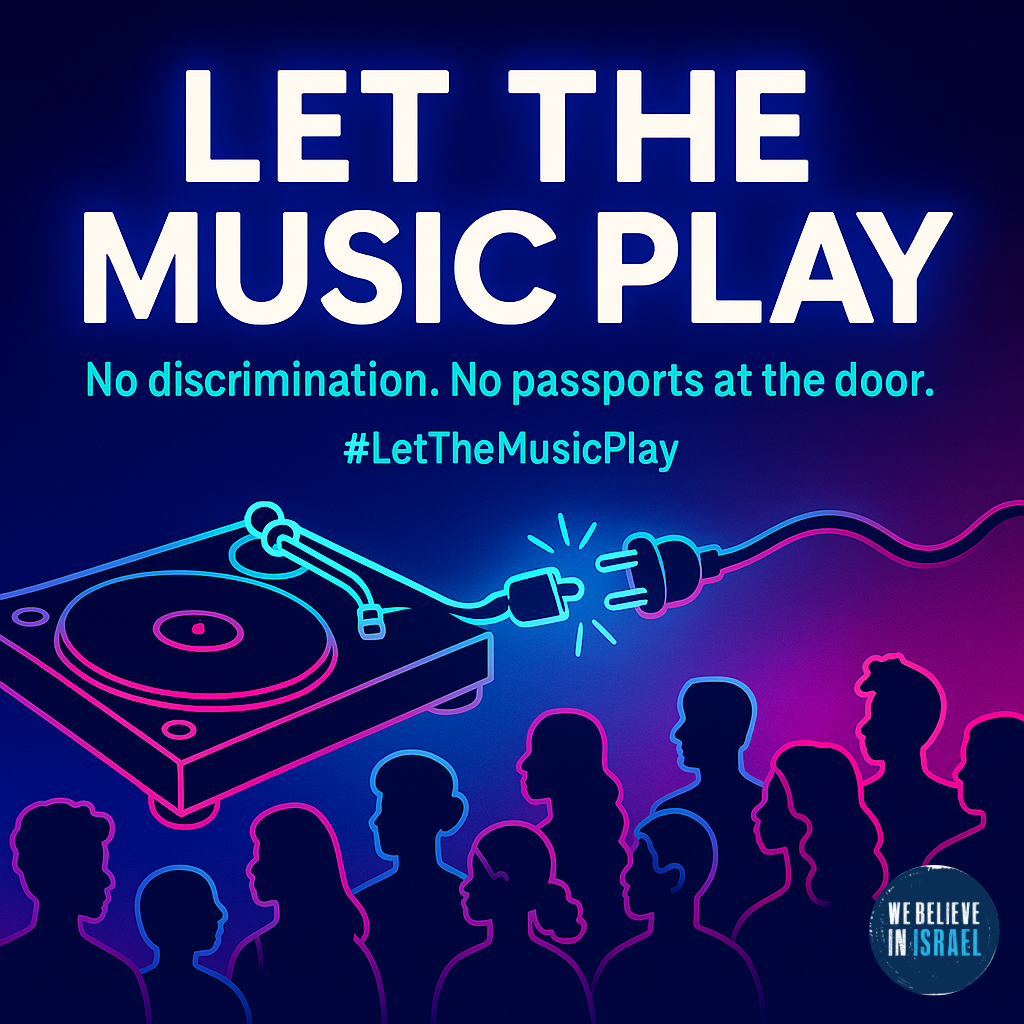
A London promoter has cancelled a set by Roi Perez, a queer Israeli DJ of considerable talent and reputation. The stated reason is not his music—one of the few realms where merit can still, occasionally, prevail—but his nationality and his unforgivable sin of hosting a gathering for survivors of the Nova massacre. Among those survivors were Bedouins and Arab Israelis, people whom the professional empathisers profess to champion until the moment their existence becomes politically inconvenient. Thus, the city that prides itself on pluralism and nightlife—a city that once took pride in resisting censorship and sectarianism—has found a new inquisition, complete with doctrinal tests and ritual humiliations, all performed to the rhythm of an empty dancefloor.
Let’s try to be clear. If you believe, as I do, that boycott is at times a legitimate instrument of moral and political suasion, you still have to ask the first question of ethics and law alike: what is the target? A state? Its rulers? A company complicit in atrocity? Or an individual who neither directs policy nor commands battalions but plays records and, in this case, convened a wake with a beat for the murdered and bereaved—Jews, Bedouins, and Arabs alike? To take aim at a private citizen for the passport he carries or the grief he tends is not “solidarity.” It is the oldest bigotry in a fashionable costume: collective punishment, the illusion of virtue at someone else’s expense.
The promoter’s decision is defended—always by the brave from behind a locked door—on the grounds that “culture is political.” A banality, and something worse than a banality. If everything is political, then nothing is private; every book, gig, joke, and embrace becomes a loyalty oath to the party of the hour. Culture ceases to be a zone of encounter and becomes an arena for denunciation. That, you may recall, is the method of the people who blow up festivals and kidnap concert-goers. If one wishes to be their mirror image, by all means proceed. But spare us the self-flattery that you are “centering survivors” when you are busy slapping the hands of those who actually invited survivors into the light.
About those survivors: the Nova dead and maimed include Arab Israelis, Bedouins, Druze, foreign students, migrant workers, and queer kids who believed (not unreasonably) that a dance floor was a place where life could be briefly lived without the permissions of priests or politicians. What does it tell you that their memorialisation becomes “controversial” when it refuses to erase the Arab or Bedouin in the Israeli, the Jew in the Bedouin’s rescuer, the queer in the Zionist, and the human in all of them? It tells you that the boycott movement is not opposed to simplification; it depends upon it. The flesh-and-blood counterexample must be suppressed lest it spoil the slogan.
Permit me to remind the promoter class of a small matter of law—that tiresome invention without which liberty does not survive a week. In the United Kingdom one may not, if one is providing a service, refuse that service on the basis of race, ethnic or national origin, or nationality. This isn’t a curious footnote for the exam-obsessed; it’s the rule that allows a metropolis to function without Balkanising into antagonistic hostels. If you must curate your line-up by ideology, do so by the content of the performance—ban those who advocate violence or who call for the collective punishment of protected classes. But let us have an end to the charade that nationality-based exclusions are anything other than discrimination. If your conscience demands you practise such discrimination, have the courage to say so plainly and accept the legal consequences.
There’s another word the night-time commissars enjoy: safety. The claim is that hosting an Israeli artist risks public order. How extremely convenient. “Safety” becomes the alibi of the censor and the heckler alike. A venue’s first obligation, if it has any right to the word, is to keep the artist and audience safe from those who would menace them. That means stewards, coordination with police if need be, agreed rules of the house (no flags, no chants, no harassment), and a spine. To cancel the target of intimidation is not safety; it is capitulation. It teaches the loudest and the thuggish that they need only threaten to be rewarded with another scalp. Today the queer Israeli; tomorrow the Iranian dissident who offends the embassy; the Ukrainian who played Crimea in 2012; the Russian who denounced the war but not loudly enough; the Hong Kong poet who marched in the wrong year. The queue at the doctrinal checkpoint lengthens; the culture shrivels.
It is not incidental that this act of moral muscle-flexing comes from quarters that once boasted of being queer spaces. Historically, gay bars, raves and clubs were laboratories of coexistence long before the phrase was minted by the NGO industry. You entered and, for once, were relieved of compulsory identities. Music dissolved the borders that politics so jealously polices. The dancefloor was where refugees from every tribe discovered the civilising enchantment of proximity. If you want a case study in the opposite principle—the idea that identity is destiny and that proximity is treachery—look to the men who shot and burned their way through Nova. They despise mixed crowds, unsupervised pleasure, the sight of women and men dancing together without supervision. They despise the very thought that the body belongs to itself. I suggest it is unwise, and indecent, to imitate their logic with a velvet rope.
The cancelling promoter will protest sincerity and invoke the word boycott with a tremor of self-approbation. Boycott has an honourable history against tyrannies that crush unions, colonise neighbours, or strangle dissent. But it retains honour only if it aims at power and not at the powerless. If you will not enforce your principles against the oil cathedrals and police states whose sponsorship money oils European football, if you will not forgo the pleasures of gadgets built with slave labour or gas extracted by oligarchs, then what you practise is not principle but opportunism. You are brave where it costs you very little—against a DJ, a book event, a film festival—because those targets do not retaliate. Tyrants, inconveniently, do.
I can imagine the promoter’s final defence: we didn’t want trouble. Indeed. That is always the epilogue to a moral defeat. You chose trouble of a different kind. You told a class of artists and audiences—Israeli nationals, Jews, apolitical clubbers who know grief first-hand—that their presence is conditional upon the goodwill of those who hate them. You told survivors that their right to mourn is contingent upon sanitising their identities to suit metropolitan dogma. You told London that its famed tolerance is a weather vane: a gust from the campus quad, an online petition with the scent of Jacobin about it, and we flip the sign from “All Welcome” to “Restricted.”
Here is a workable standard, one that any venue with functioning management can adopt by close of business: no discrimination by nationality, ethnicity, religion, or belief; no political vetting of passports; expel for behaviour, not identity; and put safety first—meaning you plan the protection, you don’t reward the threat. Publish it. Enforce it equally. Live with it. If an artist glorifies terror, incites hatred, or calls for violence, cancel and explain. If an artist plays records, comforts survivors, and brings a crowd together in the only honest communion a city can offer—shared noise and breath—then let them play.
You will be told that “Palestinian voices” demand this cancellation. What a condescension. Palestinians, like Israelis, are not a chorus but a population of individuals. Many of them understand, rather better than their Western ventriloquists, that the civic space which permits a queer Israeli Bedouin to dance beside a queer Palestinian exile is the same space that tyrants seek to burn down. You do the work of those tyrants when you impose your new badges, your new categories, your new quarantines.
The point of a city like London is not that it is innocent. It is that it contains multitudes, and that it insists—sometimes with police, sometimes with custom—that these multitudes coexist. The reason I bang on about this is not abstract. I have seen the alternative. It is the place where only the righteous may dance, where music is vetted for virtue, where mourning is supervised, where the culture is an annex of the commissariat. If that is the paradise you seek, at least have the decency to say so.
Roi Perez should play. The survivors he hosted should be welcomed as honoured guests. The promoter should be ashamed, and the patrons who asked for this petty proscription should be told, civilly but firmly, that the club is not their private militia. Those who would rather chant than dance can take their business to the pavement where politics belongs.
Turn the lights back on. Restore the booking. Post a short, lucid policy: we won’t discriminate, we will keep you safe, and we will not be ruled by threats. Then keep your word. You will not just be defending a DJ. You will be defending the proposition that a free city is not a collection of ghettos but a commonwealth of strangers, and that music—lowly, hedonistic, unpretentious—still knows how to do what politics so seldom can: pull human beings, briefly and beautifully, into time with one another.