
The Nuclear Option for Pickaxe Mountain
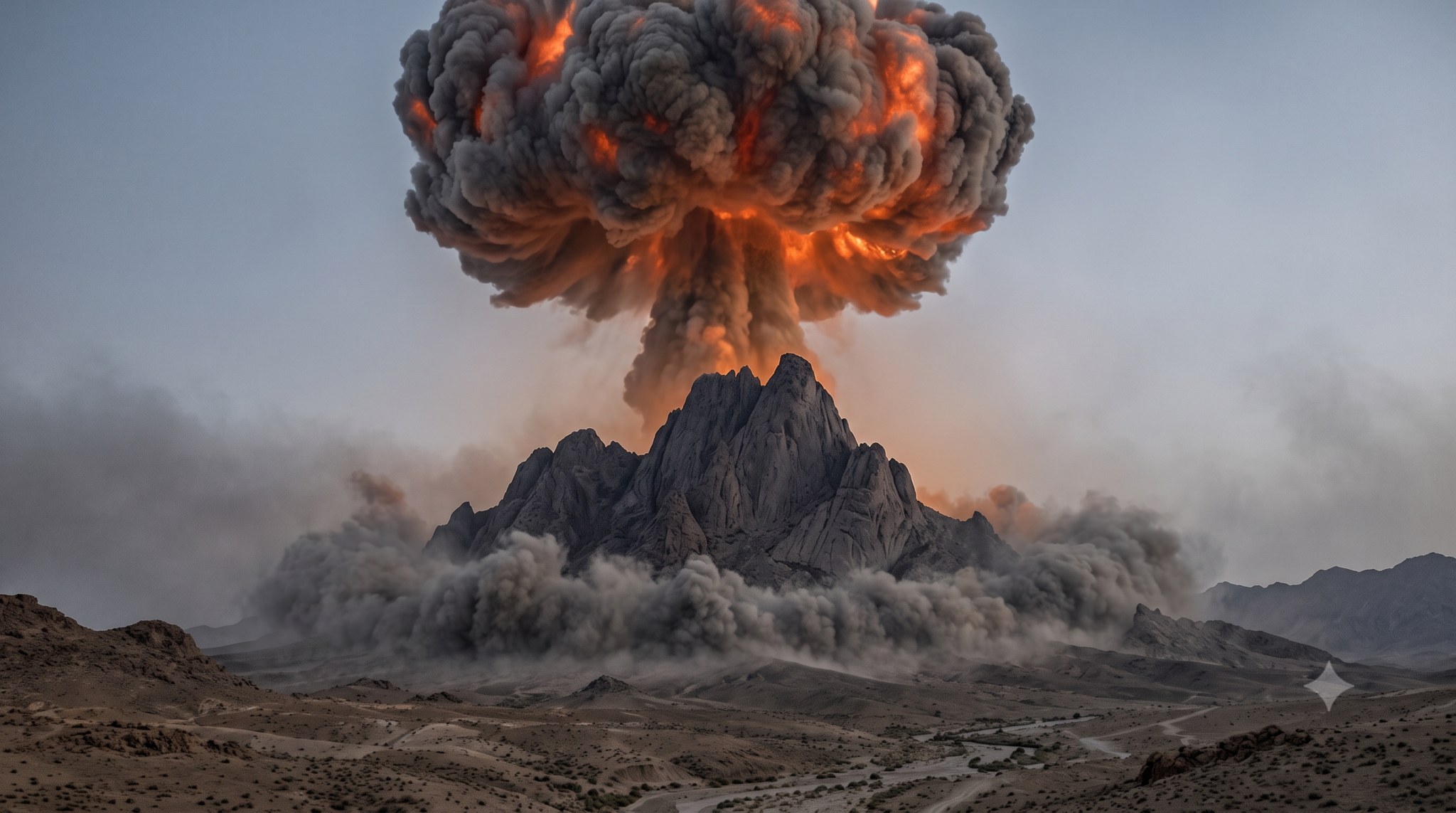
In June 2025, while the Pentagon debated whether GBU-57 massive ordnance penetrators could crack Fordow, two defense officials admitted a deep internal contention: some planners believed only a tactical nuclear weapon could destroy the site. After the White House publicly denied the option and the strike damage became visible months later, analysts concluded the operation had tested the absolute limits of conventional destruction.
The nuclear shortcut was never a fringe theory; it originated inside the building. Now the math returns amplified because Kuh-e Kolang Gaz La, Pickaxe Mountain, sits deeper than Fordow. If granite defeated America’s heaviest conventional bomb at a shallower depth, the nuclear question is unavoidable.
Following that trajectory to its end reveals a logistical dead end. The nuclear imagination is stuck in 1945, and that imagery fails twice over. Consider the mortality figures from that August: Little Boy, at fifteen kilotons, killed roughly 140,000 people in Hiroshima, or about 40 percent of the city, while the more powerful twenty-one kiloton Fat Man killed around 73,000 in Nagasaki, about 27 percent. The difference is terrain. While Hiroshima sits flat, Nagasaki is irregular and mountainous, allowing the hills to absorb what the plain transmitted.
The second lesson comes from a single structure. Virtually everyone within a five hundred meter radius of the Nagasaki detonation died, but the Nagasaki University Medical School Hospital, six hundred meters from ground zero, remained standing because of its reinforced concrete walls. Inside, 43 percent of the occupants died rather than nearly all of them, providing the only empirical evidence of a structure shielding human beings from a nuclear explosion.
Put both metrics together, and the tactical shortcut collapses. If ordinary reinforced concrete kept the majority of its occupants alive six hundred meters from a twenty-one kiloton ground zero, and irregular terrain alone cut a city’s death rate by a third, a tactical warhead will not vaporize Pickaxe. The site is neither mere concrete nor a hillside; it is a granite massif with hundreds of meters of bedrock overhead, excavated by engineers who modeled these exact events. The mountain itself is the armor.
The constraints begin with physics. The 2005 National Research Council study, the defining text on nuclear earth penetrators, calculates that holding a hard and deeply buried target at risk requires roughly a three hundred kiloton weapon for a depth of two hundred meters, and a one megaton weapon for three hundred meters. Furthermore, the physics of ground shock coupling dictate that practical penetration maxes out at a few meters.
This creates an impossible pincer. The tactical variants of the B61 operate in the tens of kilotons, lacking the necessary yield, while a weapon capable of cracking three hundred meters of granite requires up to a megaton, making it effectively a strategic detonation over Iranian territory.
A blast of that magnitude would not be contained to the mountain or the neighboring town of Natanz; its thermal radius and massive radioactive plume would sweep across the province, directly threatening major cities like Kashan to the north or the millions of residents in Isfahan to the south, multiplying the death toll and regional contamination exponentially.
The tactical nuclear bunker-buster is a myth, and the dedicated tool does not exist anyway: the Robust Nuclear Earth Penetrator was never fielded, and the limited earth-penetrating B61-11 remains the only such capability in the inventory. There is no intermediate option.
Assume the likeliest physical outcome: the mountain shakes, access tunnels collapse, and the deep chambers remain completely intact. The original threat is now simply buried under radioactive rubble.
Because the objective at Pickaxe was never altering the geography, but rather destroying the subterranean infrastructure and the enriched material inside, no satellite or aerial sensor can confirm the outcome. Verification requires physical possession, meaning every serious operational plan ends with infantry walking into the mountain.
This is where the nuclear option cancels the ground phase. Nuclear earth penetrators cannot contain their own radiation, as containing fallout requires burial depths of hundreds of meters, a physical impossibility on impact that makes fallout a guaranteed consequence.
Detonating a nuclear warhead to crack the granite permanently denies the ground force required to confirm the internal destruction of the complex, the elimination of its centrifuges, and the burial of any enriched uranium, because a freshly irradiated footprint admits no special operations forces.
The fallout radius dictates the operational cost. The town of Natanz sits kilometers from the complex, and the original National Research Council study explicitly calculated the radiation burden on civilian populations and the American personnel required to operate in the target area.
The catastrophic loss of human life cannot be sidelined; it is a profound tragedy that simultaneously serves as an absolute strategic barrier. A strike guarantees massive acute exposure in the immediate radius, radioactive deposition on regional water sources, and a systemic collapse of provincial health infrastructure.
Here the Nagasaki lesson is unforgiving. The hospital walls saved lives because occupants were already inside, but nobody in Natanz would be. The civilians protected in Nagasaki were sheltered by accident, whereas the population around Pickaxe has no walls and no warning. Detonating a nuclear device to contain fissile material simply achieves radioactive dispersal across the Iranian plateau.
The geopolitical cost outlives the radiation. Since American nuclear doctrine has no provision for a first strike against the enrichment facility of a non-nuclear state, crossing that threshold breaks an eighty-year taboo sustaining nuclear non-use.
That norm and the global effort to stop the spread of nuclear weapons work the same way: both rest on the shared belief that using nuclear weapons in situations never originally contemplated is illegitimate.
Analysts had already warned that military options against Fordow risked incomplete destruction and accelerated Iranian weaponization. A nuclear first strike dismantles the exact framework used to justify the operation, providing every rogue state a permanent precedent.
Ultimately, the nuclear option collapses independently on four fronts: it lacks the physics to destroy the target, it irradiates the objective to cancel the ground verification phase, it exacts an unbearable human cost, and it dismantles the international nuclear framework. The assault on Pickaxe Mountain should be conventional because arithmetic and operational sequence dictate it.
The ultimate goal is not merely taking inventory; it is killing the mountain from within. Special operations forces must secure the deep chambers, wire the infrastructure with explosives, and evacuate before detonation. If the facility holds enriched uranium, that material becomes the poison pill.
Blowing the active cascades apart disperses their radioactive inventory throughout the subterranean complex, rendering the vault uninhabitable for centuries. If the material is absent, destroying replaceable centrifuges is insufficient. The demolition must structurally collapse the deep chambers to permanently deny the geography.
In either scenario, the only weapon that achieves the objective is the one that leaves the mountain accessible just long enough for the men sent inside to set the charges and walk away.