


The October 7 government has abandoned our security, and Gantz is always there to hand them a ladder to climb down
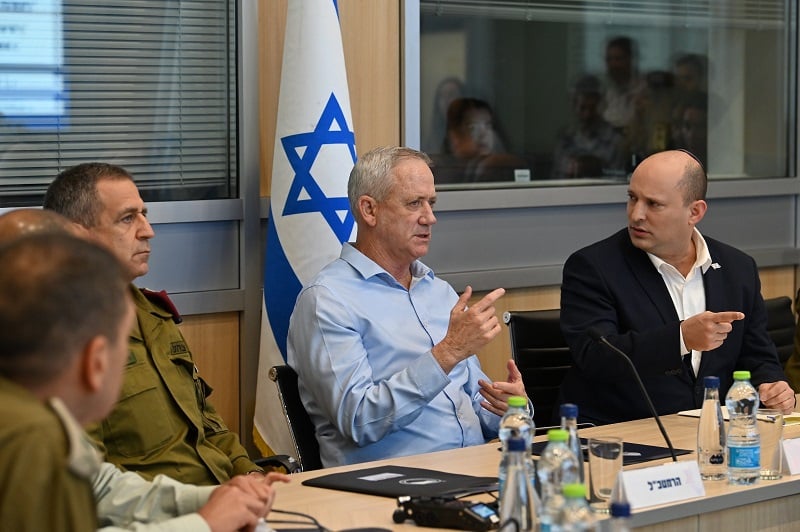
When Netanyahu sacrifices IDF soldiers to cling to power, and Gantz offers him a lifeline under the guise of fake statesmanship, the result is a government that abandons national security, the hostages, and the Israeli public. Anyone who enables this neglect becomes a partner in the disaster. Every extra day this government remains in power is a direct threat to the lives of our soldiers, the hostages, and the country’s future.
After 643 days of fighting and with 50 hostages still wasting away in Hamas tunnels, any reasonable person must ask: Are Netanyahu and his government making decisions based on security, or politics? And what happens when those two clash? This question is especially urgent when viewed alongside the courage of IDF soldiers and the pain of grieving families.
Anyone paying attention to recent political events has heard Netanyahu answer this question himself. In a recorded conversation with Lithuanian ultra-Orthodox Rabbi Hirsch – widely reported in the media – Netanyahu admitted he didn’t fire former Defence Minister Gallant or former IDF Chief of Staff Herzi Halevi because of any failure tied to the 7 October massacre. He dismissed them because they opposed the draft exemption law.
Just a few days ago, the IDF released a statement outlining how it plans to crack down on draft evaders. The first to publicly push back? A Likud spokesperson, who brazenly declared: “I can promise that we will not let this happen under any circumstances.” That response wasn’t just political posturing—it was a direct challenge to the military’s authority.
Every citizen should be asking: How does Likud’s support for the draft exemption law square with the IDF’s urgent need for around 12,000 regular soldiers, right now? Once again, we’re left wondering whether this law is being pushed for the sake of national security or political convenience.
Chief of Staff Herzi Halevi recently told the cabinet that the military campaign in Gaza has effectively reached its limit. So, on what grounds did the cabinet decide to keep soldiers there? The Defence Minister has also made it clear: there’s a fundamental conflict between the two main goals of this war: defeating Hamas and rescuing the hostages. A full military sweep of Gaza would likely put those hostages in even greater danger.
Conversations with sources familiar with the IDF General Staff reveal a growing consensus: most senior officers believe the best way to dismantle Hamas rule is to first secure the release of all hostages in a single phase, even if that means agreeing to a ceasefire and withdrawing IDF forces from Gaza. Only after the hostages are home, they say, should Israel pursue justice against Hamas operatives, particularly those involved, directly or indirectly, in the 7 October massacre.
It’s also crucial to debunk the claim that a ceasefire and withdrawal would prevent Israel from launching future operations or stopping terror in Gaza. That argument doesn’t hold water. Just look at Lebanon: despite a ceasefire backed by France and the US, the IDF continues to operate there regularly and has eliminated over 200 Hezbollah fighters since the ceasefire began.
The current situation is dire. The IDF is stuck in Gaza, not manoeuvring, and our soldiers have become easy targets. A static army is an exposed army. The enemy learns its habits, shift changes, supply routes, watch posts, and uses that knowledge with deadly consequences.
At the most recent cabinet meeting, the IDF shared a chilling statistic: Hamas is seizing control of most of the humanitarian aid entering Gaza. So why does the Israeli government continue to allow it? Even the so-called “Humanitarian Aid Fund” has become little more than an Israeli charade. In reality, an American security company delivers the supplies and leaves. There’s no organised distribution—just a chaotic scramble where the first to arrive take it and make no mistake: the ones arriving first are armed.
I write this after speaking with numerous reservists on the ground who are responsible for securing these operations. They describe a constant sense of danger and helplessness, made worse by restrictive rules of engagement that allow only warning shots, even when facing men with weapons.
And then there are the recent tragedies—the heartbreaking loss of brave soldiers sent into combat in outdated, poorly armoured vehicles. It defies belief that IDF troops are being dispatched on high-risk missions without the proper equipment.
Many are forced to ride in old APCs (Pumas) instead of modern, better-protected Namers simply because there isn’t enough funding. This is especially hard to swallow when you consider that the coalition agreement includes a budget of 5.4 billion shekels. If just 10% of that were redirected toward purchasing Namers, the IDF could eliminate its APC shortage for the next decade.
I could go on with more examples, but what’s already been said makes one thing painfully clear: in Netanyahu’s 7 October government, political survival always comes before national security, and we’re all paying the price.
They’re pushing through the draft exemption law to keep the ultra-Orthodox parties in the coalition. They’re ignoring the Chief of Staff’s clear assessment that the military campaign has run its course, just to appease Ben Gvir and Smotrich. They keep allowing aid into Gaza, even though Hamas is seizing it, to maintain favour with the international community. At every turn, keeping the coalition intact comes first. Everything else—security, strategy, lives—is secondary.
So, I turn to the opposition leaders: you must speak out. Loudly. Forcefully. To prevent more casualties, more funerals, more heartbreak. Imagine if the roles were reversed—what would Netanyahu be doing if he were in the opposition? He’d be making noise every single day. Yet today’s opposition seems passive, cautious, desperate to appear ‘responsible’—and in doing so, it enables this government’s failures.
One figure stands out in particular: Benny Gantz. His recent talk about a unity government reveals what really drives him. Not true unity, but a backdoor into Netanyahu’s coalition alongside the ultra-Orthodox. It’s only a matter of time before we hear of backroom deals to bring Gantz and his bloc into Netanyahu’s sixth government, once again dressed up in the language of “statesmanship.”
Let me be clear: Gantz is a Trojan horse. If offered the Defence Ministry after the next election, he won’t hesitate to join Netanyahu and the ultra-Orthodox again. Consider yourselves warned.
So, to all the Zionist opposition leaders, I say this: now is not the time to be polite. Now is the time to stop the bleeding. Your mission is clear—do everything in your power to bring down this government. The sooner it falls, the sooner Israel can start to heal. Only then can we reset our priorities, fix what’s broken, and begin to undo the damage this government has done.