

Mathematics Teaching Professor, Author
The Oldest Synagogue in New Hampshire: Temple Adath Yeshurun of Manchester
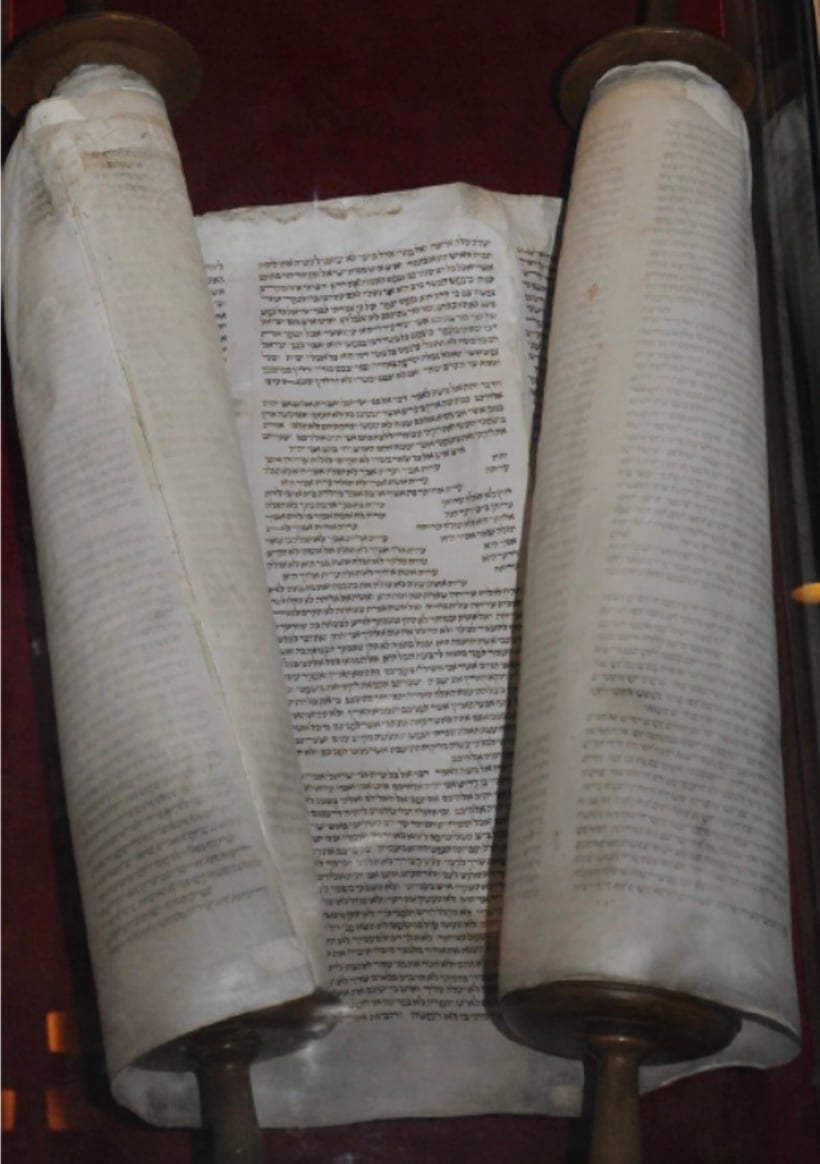
Holocaust Memorial Scroll Czech # 1257 (Source: Alan Kaplan)
Temple Adath Yeshurun (TAY) is the oldest synagogue in New Hampshire and has served Manchester and the surrounding communities for nearly 140 years. As a Reform Jewish congregation, TAY is dedicated to fostering a warm, inclusive community where individuals and families can worship, learn, celebrate, and support one another. Guided by Jewish values, the congregation embraces diversity, lifelong learning, meaningful spiritual practice, and Tikkun Olam, the commitment to repairing the world through acts of kindness, social responsibility, and community engagement.
I would like to thank the esteemed Cantor Harriet Dunkerley for her support and guidance.
Czech Torah # 1257
The Torah scroll displayed in the lobby of Temple Adath Yeshurun is a powerful symbol of survival and remembrance. Known as Czech Torah # 1257, it is part of the Memorial Scrolls Trust of London, which preserves Torah scrolls rescued from Jewish communities in Bohemia and Moravianow of the Czech Republic that were destroyed during the Holocaust.
Dating to the late 1800s, the scroll originally belonged to the synagogue in Mladá Boleslav, where it served a thriving Jewish community until the Nazi occupation. A small group of dedicated Czech Jews worked to preserve the region’s Jewish heritage by rescuing Torah scrolls and other sacred objects from synagogues that had been closed or destroyed. These artifacts were brought to the Jewish Museum in Prague, where they were cataloged and safeguarded.
Torah Scroll # 1257 was among the thousands preserved.
In 1942, more than 1,000 Jews from Mladá Boleslav and the surrounding area were deported to the Terezín Ghetto and later to Nazi extermination camps. The curator of the Jewish Museum in Prague was also deported to Terezín and then Auschwitz. By the end of the Holocaust, more than 80,000 Jews from the Czech lands had been murdered, leaving only a small remnant of the once-thriving Jewish community.
After the war, the scroll was transferred to London through the Memorial Scrolls Trust. In 1974, Rabbi Emeritus Arthur Starr arranged for Torah # 1257 to become part of Temple Adath Yeshurun. That same year, a devastating fire destroyed much of the synagogue’s sanctuary. Because the Torah was displayed in the lobby, it survived.
Today, Torah # 1257 stands as both a sacred Torah scroll and a lasting memorial to the Jewish communities lost in the Holocaust.
Religious Events
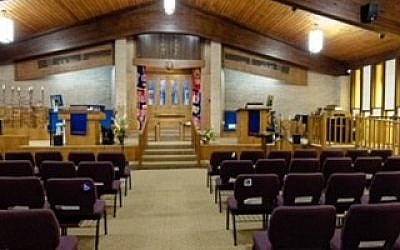
At Temple Adath Yeshurun, Shabbat is a time for worship, community, and celebration. All Friday Shabbat services take place in TAY’s beautiful sanctuary and begin at 7pm except the first Friday of each month when there is a family-friendly Shabbat service which begins at 6:00 p.m. and is followed by a community potluck dinner. The service uses a Siddur that is especially appropriate for families with religious school aged children, and all who have birthdays that month are celebrated.
Temple Adath Yeshurun is honored to rejoice in life’s joyful milestones and provide comfort during times of loss. Our Spiritual Leader is available to officiate and guide families through weddings, baby namings, brit milah, funerals, B’nai Mitzvah and other significant life events.
A B’nai Mitzvah at Temple Adath Yeshurun marks an important milestone in a young person’s Jewish journey as they are called to the Torah. Students begin Hebrew studies in 3rd grade and study intensively in preparation for their Mitzvah Service, working with Torah coaches and TAY’s Spiritual leader in preparation to lead the community in prayer, chant from the Torah and Haftarah, and share words of Torah during their Saturday Morning Service.
Recently Temple Adath Yeshurun and neighboring Temple Israel combined their Religious Schools to form the Jewish Learning Collective of New Hampshire, a dynamic, engaging and diverse learning environment bringing together Reform and Conservative Jewish Families across Manchester to provide a best-in-class Jewish Education for their children. Programming begins in kindergarten and continues through 8th grade and into high school with Confirmation and Madrichim opportunities for older students.
Sisterhood
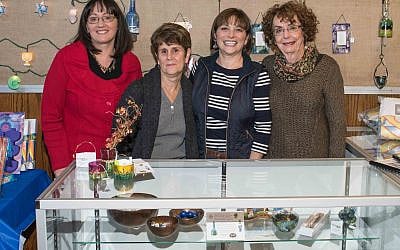
The Sisterhood of Temple Adath Yeshurun has long played an important role in strengthening congregational life through worship, service, education, and community. Sisterhood members enhance synagogue life by sponsoring programs, supporting special projects, hosting events such as the joint Sisterhood and Brotherhood Shabbat and the Second Night Passover Seder, decorating the bimah with food for donation for the High Holy Days and managing the Shabbat Onegs after services.
The group also partners with TAY’s Lifelong Learning Committee, Current Events Group and others to offer educational and social programs, including book discussions, special guest speakers, and gatherings that reflect the values of Reform Judaism. Through community service initiatives such as Women of Faith and Neighbors Feeding Neighbors, Sisterhood members put Tikkun Olam, repairing the world, into action.
Brotherhood
For more than 50 years, the Brotherhood of Temple Adath Yeshurun has supported the congregation, the Jewish community, and the greater Manchester area through service, fellowship, and educational programs.
The Brotherhood sponsors many popular annual events, including the Chanukah Party, Purim Carnival, Deli Night, candidate breakfasts, the Samuel Sugerman Scholarship, and the “Man of the Year” award. Members also volunteer at regional youth events and organize educational programs on a variety of topics.
A longstanding tradition is the Brotherhood’s Christmas Mitzvah Program, during which volunteers serve the community on Christmas Eve and Christmas Day by helping at local hospitals, delivering Meals on Wheels, assisting at New Horizons Soup Kitchen, and supporting veterans. Through these efforts, the Brotherhood exemplifies the Jewish values of service, compassion, and tikkun olam.
Learning
Temple Adath Yeshurun and Temple Israel of Manchester are proud to partner in the Jewish Learning Collective of Manchester, a collaborative religious school serving students in kindergarten through eighth grade and beyond.
Through engaging classes and hands-on experiences, students explore Jewish traditions, values, history, and identity in a welcoming and inclusive environment. The program encourages meaningful connections among students, families, and the broader Jewish community while inspiring the next generation to live joyful Jewish lives. The Jewish Learning Collective is open to both synagogue members and non-members.
Temple Adath Yeshurun adorns itself to the notion that Jewish learning is a lifelong journey and that education is not only for the young. TAY believes that everyone has the opportunity and responsibility to continue growing as knowledgeable and engaged Jews. The Lifelong Learning Committee offers a variety of programs throughout the year, including ongoing Torah study on select Shabbat mornings, an annual Introduction to Judaism course, Basic Hebrew for Adults, and seasonal classes exploring topics such as Jewish history, Halacha, and books of the Tanakh.
Special educational programs and opportunities for adults to celebrate their Jewish journey, including Adult B’nai and B’not Mitzvah programs are also offered. A newly organized Mid-East Dialogue Group, a Social Justice Committee and a Current Events Discussion Group hold regular events for the TAY community and the greater community at large.
Historical Backgrounds
In 1693, the future United States was a wild patchwork of small British colonies, Spanish outposts, and Native American lands. There were no 50 states yet. Life was mostly rural, focused on farming, and ruled by the wilderness.
New Hampshire in 1693 was a rugged, isolated English frontier. Its dense forests and rocky soil made farming hard. Settlers lived near the ocean in towns like Portsmouth and Dover, depending on fishing, timber, and fur trading to survive. The area was also a dangerous war zone plagued by conflicts with Native Americans.
It was in that year, 1693, that the first recorded Jewish settlers arrived in New Hampshire; they were William Abrams and Aaron Moses. They arrived in the seacoast town of New Castle and later moved to Sanbornton. Later, in 1789, Abraham and Rachel Isaac moved to Portsmouth. They opened a popular waterfront store called “The Cheap Shop”.
Between 1693 and 1880, the Jewish population in New Hampshire was very small. Earliest records show a handful of traders and merchants arriving in towns like Sanbornton, New Castle, and Portsmouth. The population began to grow rapidly right after 1880 due to a massive wave of Eastern European immigration.
Jews first arrived in Manchester, New Hampshire, in the 1880s. A small group gathered for religious holidays in 1862, but J. Wolf is the first recorded permanent Jewish resident, arriving around 1880.
By 1892, the Jewish community of Manchester, New Hampshire, was small but growing, with approximately 21 Jewish working men forming a close-knit community. Many were immigrants from Eastern Europe who worked as peddlers, small merchants, and tradespeople while building new lives in New Hampshire. That year, the community hired its first rabbi, Rabbi Peter Axel, to provide religious leadership and guidance.
The first synagogue was located at 895 Elm Street before later moving to Central Avenue. Records from the time list nine heads of Jewish families among the community’s members. The dedication and perseverance of these early families laid the foundation for organized Jewish life in Manchester.
Shortly afterward, Manchester’s Jewish community celebrated its first recorded Jewish wedding on March 19, 1893. On that Sunday evening, Rebecca Pines and Samuel Rosenblum were married at Knights of Pythias Hall on Hanover Street, in what was likely the first Jewish wedding held in the city. The event received significant attention in The Manchester Union, which described the ceremony under the headlines “According to Mosaic Law,” “Interesting Ceremony in the Local Jewish Colony,” and “Wedding Feast and Merry-Making Follow the Nuptials.”
The celebration reflected the growing presence of Jewish life in Manchester. The Jewish community gathered in large numbers, and the ceremony followed traditional customs, including the raising of a wedding canopy and blessings led by Acting Rabbi Peter Axel. The wedding became an important milestone in the history of Manchester’s Jewish community.
Between 1893 and 1899, Manchester’s Jewish community grew into a bustling, working-class hub of Eastern European immigrants. Centered in the Cheetham Hill and Strangeways districts, many of the residents worked in the garment and tailoring trades.
Which brings us to 1899.
In 1899, the United States was a rapidly growing industrial nation. The country had 45 states and was led by President William McKinley. The nation was expanding its global reach. It had recently won the Spanish-American War and gained new territories like Puerto Rico and the Philippines.
In 1899, New Hampshire was transitioning from an agricultural society to an industrial giant. Massive mill towns powered by rivers dominated the economy, while rural family farms and logging operations saw a decline.
By1899, Manchester, New Hampshire, was a roaring industrial giant dominated by the Amoskeag Manufacturing Company. Known as the “Queen City,” it boasted the largest cotton textile plant in the world. Thousands of immigrant workers powered massive brick mills, and the Merrimack River drove the city’s booming economy. The city was a bustling and crowded place with about 57,000 residents.
In 1899, Manchester, New Hampshire was home to a small, close-knit Jewish community of Eastern European immigrants. Most worked as peddlers, tailors, or small merchants. They gathered in rented halls for worship and organized groups to help the sick and bury the dead.
It was in that year, 1899, that New Hampshire passed legislation allowing religious organizations to incorporate. Adath Yeshurun was officially incorporated at 197 Central Street on January 4, 1900, following its first recorded meeting. The congregation had already been active throughout the 1890s, including the purchase of cemetery land on South Beech Street in 1896.
Adath Yeshurun’s early years were marked by frequent moves among rented spaces in central Manchester. Incorporated in 1900 with 17 members, the congregation purchased a building at 94 Laurel Street in 1902.
As membership grew, High Holy Day services were held in rented halls until the need for a permanent synagogue led to a fundraising campaign in 1910. Construction began in 1911, and the new Central Street synagogue opened on September 23, 1911.
The synagogue included a sanctuary, religious school, kitchen, social hall, and space for community activities. Its 1912 dedication celebrated the growth and achievements of Manchester’s Jewish community, with support from members and local leaders.
Adath Yeshurun’s Central Street synagogue served the congregation for nearly fifty years as a center for worship, education, and community life. Bar mitzvahs, social events, and women’s organizations such as the Sisterhood strengthened congregational ties. Despite financial struggles during the 1920s and 1930s, members like Edward Chase and Abraham Machinist provided important leadership and support. Abe Machinist later helped unite the divided Jewish cemetery, strengthening cooperation between Manchester’s Jewish congregations.
Today, Temple Adath Yeshurun remains a lasting symbol of Manchester’s Jewish heritage, reflecting more than a century of faith, community, and dedication. Now housed in its magnificent mid-century building designed by the preeminent synagogue architect, Percival Goodman, at 152 Prospect Street, TAY is excited to begin a new chapter welcoming Cantor Harriet Dunkerley as their new Spiritual Leader.
With deep historical roots and eyes pointed toward the future, Temple Adath Yeshurun continues to welcome and serve the Manchester Jewish Community in all its colorful tapestry of combinations. From its beginnings among Jewish immigrants in the late 1800s to its continued presence today, the congregation has preserved traditions while adapting to the changing needs of its members and the city they call home.
Contact Information:
Temple Adath Yeshurun 152 Prospect St, Manchester, NH 03104
Phone: (603) 669-5650
Email: office@taynh.org
Website: https://taynh.org/