


Mathematics Teaching Professor, Author
The oldest synagogue in North Carolina, Temple of Israel, Wilmington
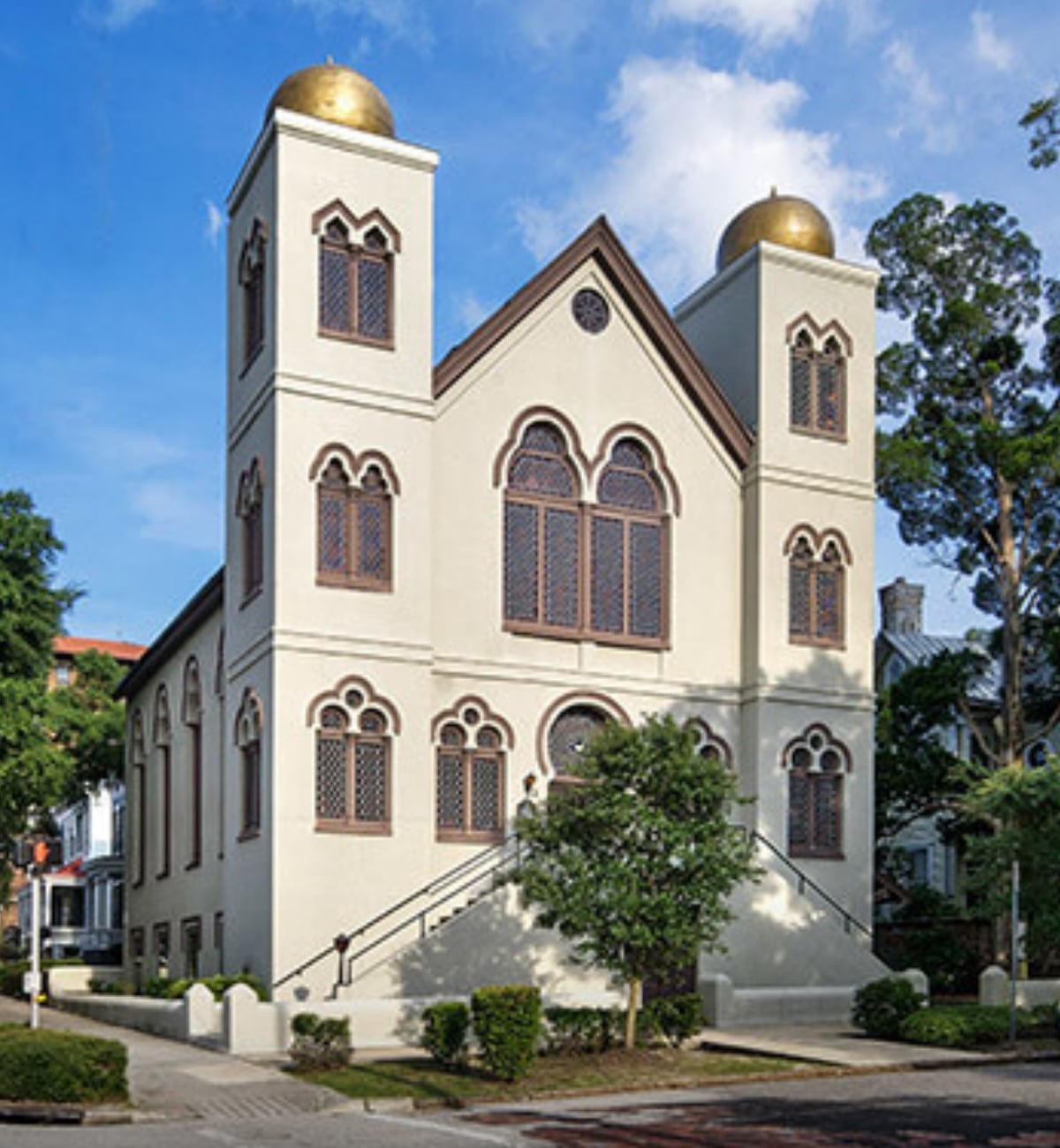
Temple of Israel in Wilmington, NC (Source: Temple of Israel, Wilmington North Carolina)
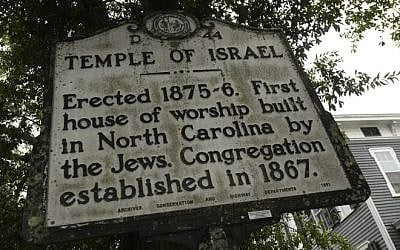
The Temple of Israel is a Reform synagogue located at the corner of Fourth and Market Streets in Wilmington, North Carolina. Dedicated on May 12, 1876, it is the oldest synagogue in North Carolina and one of the earliest Reform congregations in the American South. As the first Jewish house of worship in the state, it holds a central place in North Carolina’s Jewish history.
I would like to thank Vice President Miriam Brooks for her support of this article.
Synagogue
Temple of Israel, built in 1876, is the oldest synagogue in continuous use in North Carolina and one of the oldest in the United States. Designed by Samuel Sloan, it blends Greek Revival and Moorish Revival styles, featuring horseshoe arches, twin towers with golden onion domes, and an ornate sanctuary chandelier. The synagogue is a contributing property in the Wilmington Historic District.
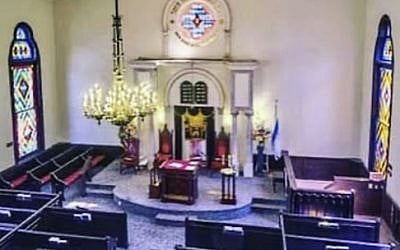
Inside the Temple of Israel sanctuary, visitors can admire many original furnishings that reflect the synagogue’s rich history and traditions. Highlights include a centuries old chandelier believed to have come from Landau, Germany, the original Moorish style pews, and the raised bimah with its historic lectern.
The eastern wall features the Ark, which houses three Torah scrolls, including one used at the synagogue’s 1876 dedication, beneath the Ten Commandments and the inscription, “Know Before Whom Thou Standeth.”
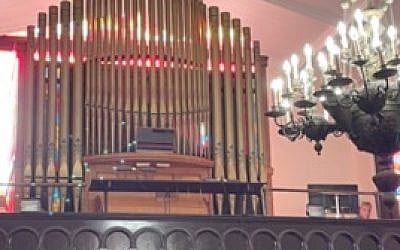
The original Ner Tamid, Eternal Light, geometric stained glass windows, a mid 19th century Judenstern, Sabbath lamp, and the rare 1906 Pilcher-Tracker organ further preserve the synagogue’s architectural beauty and religious heritage.
Culture and Religious Activities
Temple of Israel holds worship services every Friday evening and on Jewish holidays. Meetings, adult lifelong learning education, weekly Torah study, community dinners, and other social events take place in the nearby education and administrative building. The synagogue also hosts public concerts featuring local and regional professional musicians, with its historic sanctuary celebrated for its exceptional acoustics.
Temple of Israel offers religious school for all ages through the Rabbi Sidney H. & Jane H. Brooks Jewish Academy. The Academy is an independent school, attended by children from the Conservative congregation and Temple of Israel, and open to all Jewish students in the greater Wilmington area regardless of congregational affiliation. It provides small K to 7 classes, Hebrew School for Bar and Bat Mitzvah preparation, and opportunities for community service. Jewish teens in grades 8 to 12 can participate in BBYO, which offers leadership, social, service, and regional activities.
The Temple of Israel has a Men’s Club that hosts guest speakers, supports the Temple’s religious school and the local Meals on Wheels program, builds the Temple’s sukkah, and organizes field trips to places of interest throughout the Wilmington area.
Women of the Congregation
Women have played a central role in Temple of Israel since its earliest days. As early as 1867, they supported the Wilmington Hebrew Congregation, and in 1872 founded the Ladies Concordia Society, building on the earlier Harmony Club. Beginning in 1877, women organized the synagogue’s social and fundraising events, including the annual Purim Festival, an Ice and Snow Carnival in 1891, and a 1892 Columbian themed bazaar commemorating the 400th anniversary of Columbus’s arrival in the Americas.
Today LCS, the Temple’s Sisterhood, continues to host social events, educational opportunities, fundraisers, and an annual women’s retreat all in support of the Temple.
Historical Background
Sephardic Jews first settled in North Carolina in the early 18th century. By the 1790s, a period of early national growth and the expansion from 13 to 16 states, Jewish merchants and traders began arriving in Wilmington from larger port cities.
By 1852, Wilmington’s Jewish community had established a Hebrew Burial Society, followed by the opening of a Jewish cemetery in 1855. On the eve of the Civil War, Wilmington was North Carolina’s leading port, and many local Jews, like other Southern residents, served in the Confederate Army. As the Union blockade reshaped commerce, the city became a major center for blockade running and cotton exports, attracting additional Jewish merchants and doubling the city’s Jewish population between 1860 and 1865.
In 1872, Ulysses S. Grant was serving as President of the United States and won re-election over Horace Greeley, who died shortly after the election before the Electoral College vote, a unique event in U.S. history. That same year, as the nation expanded westward and established Yellowstone as the world’s first national park, Wilmington was North Carolina’s largest city and a thriving post Civil War port.
That same year, 1872, the city’s growing Jewish community of about 200, primarily German-Bavarian immigrants, founded Temple of Israel. This was the first permanent Jewish congregation in North Carolina. Forty families organized the Reform congregation, established the Ladies Concordia Society, and recorded their first meeting minutes on December 8, 1872. German immigrant Solomon Bear was elected the congregation’s first president.
Starting with a groundbreaking in May 1875 and completed in 1876, the Temple of Israel building was designed by Philadelphia architect Samuel Sloan in the Moorish Revival style.
Which brings us to 1876.
In 1876, as the United States marked its centennial under President Ulysses S. Grant and expanded to 38 states, Wilmington, North Carolina was a major post-Civil War port city in the final year of Reconstruction. Its economy was shifting from antebellum naval stores like tar and turpentine toward a broader mercantile and maritime trade.
That same year, 1876, Wilmington was home to a thriving community of mostly German-Jewish immigrants. The congregation reached a major milestone with the dedication of Temple of Israel on May 12, 1876, the first synagogue constructed in North Carolina, marking a defining moment in the state’s Jewish history.
By World War I, Temple of Israel members were fully integrated into Wilmington society, with individuals such as Esther Mendelson contributing to the Red Cross and Wilmington native Arthur Bluethenfield honored after his death in service and later commemorated by the naming of Bluethenfield Field in 1928.
Then in September 1940, Rabbi Mordecai Thurman delivered a public lecture and review of Mein Kampf at the Hanover High School auditorium in Wilmington, drawing an audience of about 700 people. The event introduced listeners to translated excerpts of Hitler’s writings and offered critical discussion of his ideology.
The Temple of Israel remains a historic and active center of Jewish life in Wilmington, North Carolina, preserving more than a century of religious tradition, education, and community engagement. As the oldest synagogue in the state, it continues to connect past and present through worship and cultural programs, standing as both a landmark of architectural heritage and a living institution shaped by generations of congregants.
Contact Information:
Office: Reibman Center for Kehilah, 922 Market Street, Wilmington, North Carolina 28401
Phone: 910-762-0000
Email: office@templeofisraelnc.org
Website: temple-of-israel.org/