


The One Promise That Must Never Be Broken
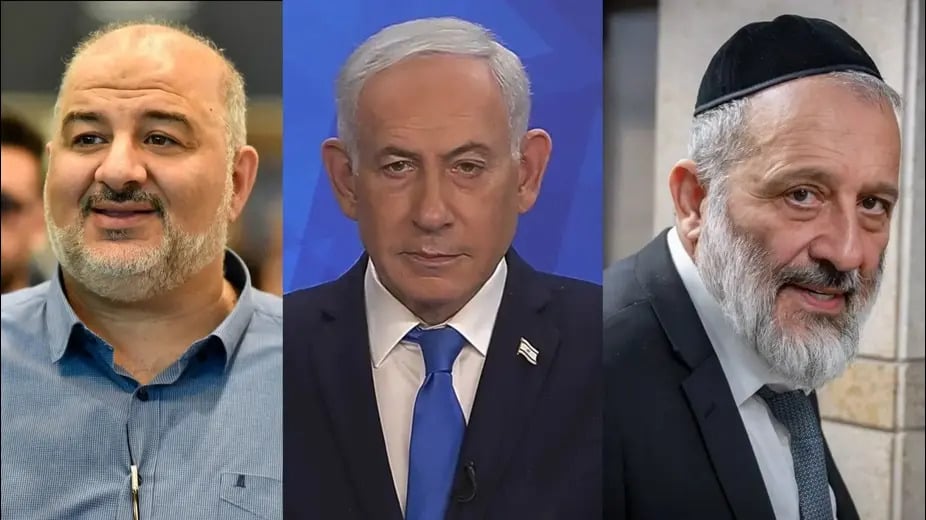
The leaders of the anti-Netanyahu bloc face a defining choice: stick to their campaign promises or compromise in order to replace the government. Between a unity government and another election, the option of forming a government with the support of Arab parties remains on the table.
Jewish history is filled with people who stood by their word to the bitter end. The Zealots in Jerusalem kept their promise and fought to the last, burning the city’s grain stores. Eleazar ben Yair did the same on the cliffs of Masada. They remained faithful to their commitments until the very last moment. And then they committed suicide, individually and collectively. In recent days, since the election, I have heard political commentators and certain politicians repeating this narrative, this time from within my own camp: We promised voters we would not sit with this person or rely on those parties, so we must not move an inch.
There is no greater folly. “Replacing Netanyahu” was also a promise, and it was the biggest one of all. It was the promise that sent voters from our bloc to the ballot box. Those who now insist on keeping every minor promise will find themselves with no promises fulfilled, and no country left to govern.
This column is addressed to all of us, but especially to four people: Yair Golan, Gadi Eisenkot, Naftali Bennett, and most of all, my friend Avigdor Lieberman, who keeps insisting on what he will not accept, while saying far less about what he is willing to do. Gentlemen, you now hold in your hands the decision that will determine whether Netanyahu continues to rule Israel. In other words, whether the State of Israel still has a chance of surviving as a Jewish and democratic state.
A Unity Government and the Scorpion and the Frog
Let’s talk numbers, because they don’t lie. Netanyahu’s bloc has 53 seats. Without United Torah Judaism, which has already announced that it is not in anyone’s pocket, that number drops to 46. Your bloc has 48. The Arab parties have 19, eight of them belonging to Ra’am.
This leaves three possible paths, two of which lead to essentially the same place.
The first is a unity government with Netanyahu. We all know the fable of the scorpion who asked a frog to carry him across the river, promising he would not sting her. Halfway across, he stung her, and they both drowned. “It’s in my nature,” he explained. A scorpion will always be a scorpion. Just ask Benny Gantz. Everyone who has joined a government with Netanyahu in recent years has emerged politically shattered, with his stinger firmly lodged in their back.
The second path is another election, in March or April, and that is the end of the story. Until then, Netanyahu remains caretaker prime minister, unchecked and without restraints. Anyone who wants to know what the next election will look like need only look at the one that has just ended.
On election morning, police raided the homes of Ra’am activists in the Negev. Information about the suspicions against them was released and briefed to the media throughout the day. The Likud was quick to shout that the election was being stolen from it, possibly picking up a few votes along the way. Only later did it emerge that the information had come from Netanyahu’s acting chief of staff and, according to reports, had been passed directly to the police in a phone call. Four suspects are already on their way to being released for lack of evidence.
Now imagine another election campaign, with this man still in office, operating without restraints, the police continuing to serve him, and the Shin Bet alongside them, an organization he has already begun seeking to bring under his control. This is a dictatorship in the making.
Meanwhile, another six months under a caretaker government means another six months of sanctions drawing closer, with a prime minister proposing a “crypto economy” to circumvent them. When the Bank of Israel warned that “cryptocurrencies cannot serve as a route for circumventing sanctions,” he responded that he would continue doing “what I think.”
Don’t kid yourselves that the next round will look any different. We need to face the bitter truth, however painful it may be: not one of you won seats from the other side this time. The campaigns simply shifted votes from one party to another instead of expanding the bloc, and no one came up with a winning strategy. This is a battle for adults, not political children. In a few months, you will be running against the same Netanyahu, with the same divided bloc, only this time he will organize his own camp more effectively. And what will you have gained? You will have kept every single promise. Congratulations.
That leaves the third path: an agreement with Mansour Abbas, with the Arab parties supporting the government from outside, and perhaps the ultra-Orthodox parties as well. The arithmetic is simple: 48 seats plus Ra’am’s eight members equals 56, compared with Netanyahu’s 53, or 46 without United Torah Judaism. If the Joint List abstains, a government can be sworn in, even without Lieberman if he insists on keeping his promises all the way to ruin. It will not be anyone’s dream government, far from it. But it will be a government capable of halting the decline and putting the country back on track.
I know this is complicated. But Arab citizens are not guests in this country. They make up one-fifth of Israel’s population. They are an integral part of its economy, healthcare system and police force. They are the doctors treating your parents, the pharmacists, the nurses and the police officers. Without them, this country simply cannot function. You can disagree with them and oppose their positions, just as you would with any other political partner. But you cannot rely on them in the emergency room and reject them in the Knesset.
The public has already understood this. For months, Netanyahu warned that Eisenkot would form a government with Abbas. The public heard him, took that possibility into account and voted anyway. According to a poll conducted by the aChord Center at the Hebrew University on election night, 61 percent of voters in the anti-Netanyahu bloc preferred a government led by Eisenkot with Ra’am. Another poll conducted in light of the election results confirmed those findings.
And what about Netanyahu himself? In 2021, he was prepared to form a government with Abbas. According to Smotrich’s own testimony, he was the only one who stopped him. What was acceptable to a crook trying to remain in power should be acceptable to those trying to replace him.
The 1992 Coalition: Shas in Government, Arab Parties Supporting It from Outside
We have been here before. In 1992, we built a blocking majority with Rabin, with external support from Hadash and Mada, and brought Shas into the coalition. We did not ask anyone’s permission, and we were not afraid. I remember all the outcry from within our own camp, the claims that we were turning Rabin into Likud B, and the countless opinion pieces accusing us of leading the country to ruin. I remember it all. But we had a goal, and we knew how to set priorities. That is how we won. And that is how the government that brought us the Oslo Accords and peace with Jordan came into being, a government that invested more in the education system than any other in Israel’s history.
So here, ladies and gentlemen, are your three new red lines: No government led by Netanyahu. No rotation agreement that would keep him in power. No new elections.
All the other red lines from your campaign can be put aside for a while, and at least one of them must be. Stop equivocating, stop apologizing, and stop dancing to Netanyahu’s tune, allowing him to decide who is acceptable and who is beyond the pale.
When the alternative is Masada, compromise, postponement and pragmatism are not only permissible, they are necessary. Netanyahu has already finished climbing the Snake Path and is standing at the top, on the cliff. Anyone who wants to jump with him is welcome to do so, but they will have to do it without us.