Black Belt Champ Turns Rabbi, Author/Speaker
The One State Solution (4/4)
 Recently, I began sharing chapters from a manuscript in progress. It’s working title is: The One State Solution: Making Sense of the Israeli Conflicts and How to Fix it.
See post one, here.
See post two, here.
Chapter 3: Abraham The First Jew –
Fighting Polytheism (1)
Chapter 3: Abraham – The First Jew
Fighting Polytheism (1)
To trace the origins of the Jewish people, one must begin with Abraham—the first Jew. His life marks the inception of monotheism and the defiance of a world steeped in idolatry. Abraham’s journey was not merely personal; it was revolutionary.
Early Life in Mesopotamia
Abraham was born in 1812 BCE in Ur Kasdim (Ur of the Chaldees), near modern-day Nasiriyah in southern Iraq. At the time, Mesopotamia was a mosaic of independent city-states, each ruled by kings who often claimed divine authority. These kingdoms spoke different languages and worshipped distinct pantheons.
During the Middle Bronze Age (circa 2000–1800 BCE), Mesopotamia flourished as a cultural and economic hub between the Tigris and Euphrates rivers. The region encompassed present-day Iraq, Syria, Turkey, and Iran, and was renowned for its legal sophistication and expansive trade networks linking it to Canaan, Egypt, and Anatolia.
Ur Kasdim, under the Ur III dynasty, was a major religious and administrative center. Temples served as both spiritual sanctuaries and economic engines. The society was deeply religious, with devotion to a complex pantheon of deities:
| Deity | Domain |
| Anu | Sky and heavens |
| Enlil | Air and storms |
| Enki | Water and wisdom |
| Ninhursag | Earth and fertility |
| Utu/Shamash | Sun and justice |
| Ishtar | Love and war |
Nimrod and Abraham’s Birth
Abraham’s father, Terach, was a nobleman and idol merchant under King Nimrod, a ruler whose power extended beyond politics into spiritual dominion. Abraham’s mother was Amathlai bat Karnevo.
According to Midrashic tradition, Nimrod’s astrologers predicted that Terach’s newborn son would defy the king and reject idolatry. Nimrod ordered the infant’s execution. Terach, unwilling to comply, substituted another child, who was killed in Abraham’s place. He then hid Abraham in a cave for ten years (Genesis Rabbah 38:13).
Then, to save his life, Terach then hid Abraham in a cave for the first ten years of his life.
Who Was Nimrod
Noah, who built the ark, had three sons.
Their names were:
- • Shem (progenitor to semites, including the Jews)
- • Ham (progenitor to Africans and Canaanites)
- • Yofet (progenitor to Asians and Europeans)
Ham begat Kush.
Kush begat Nimrod.
The name Nimrod, is rooted in the Hebrew מרד (marad), meaning “to rebel.”
Nimrod was “a mighty hunter before the Lord” (Genesis 10:8–10), a euphemism for his conquest and dominion. He was:
- • A defiant challenger of divine authority
- • A charismatic unifier of disparate peoples
- • A persecutor of monotheists, especially Abraham
- • The architect of Babel and its infamous tower
He founded cities such as Erech, Accad, and Calneh in the land of Shinar.
The Tower of Babel
Nimrod’s most audacious project was Babel, where he built the Tower of Babel (Genesis 11:1–9). This was no mere architectural feat—it was a declaration of rebellion. The tower symbolized humanity’s attempt to usurp divine authority and forge a legacy rooted in pride.
The builders sought:
- • Unity: “Let us build ourselves a city and a tower with its top in the heavens.”
- • Fame: “Let us make a name for ourselves.”
- • Control: “Lest we be scattered across the earth.”
But this ambition defied God’s command to “fill the earth.” In response:
- • God confused their language, halting construction.
- • He scattered them, fracturing their unity.
- • The city was named Babel, from בלבל (balbel), meaning “confused.”
The episode stands as a cautionary tale: human greatness, when divorced from humility, leads to fragmentation—not glory.
The building was rooted in pride and rebellion. Nimrod sought to unify people under his rule and elevate human achievement above divine authority. The tower wasn’t just a construction project. It was a symbol of defiance. An attempt to reach the heavens and challenge God’s sovereignty.
Nimrod aimed to create a legacy built on human strength and ambition. Pursuing a “false Eden”—a man-made utopia—ignored the divine purpose of spreading across the earth and living in humility. Nimrod turned unity into arrogance, and ambition into idolatry.
Abraham’s Awakening
Emerging from hiding, Abraham initially conformed to societal norms, worshipping celestial bodies. But his intellect led him elsewhere. He observed the sun set, the moon fade, and stars vanish. These forces, he reasoned, must be governed by something greater (Genesis Rabbah 39:1).
Through rational inquiry, Abraham concluded that a single, omnipotent Creator governs the universe (Maimonides, Hilchot Avodat Kochavim 1:3–4).
The sages liken his discovery to a man who sees a lit house and asks, “Who owns it?” The owner replies, “I am the owner.” So too, God revealed Himself to Abraham (Genesis Rabbah 39:1).
Challenging Idolatry
A transmitted Torah tradition recounts how Terach left Abraham in charge of the idol shop. When a customer sought to buy an idol, Abraham asked his age. “Sixty,” the man replied. “Woe to a man of sixty who worships a one-day-old statue,” Abraham said. The man left, humiliated.
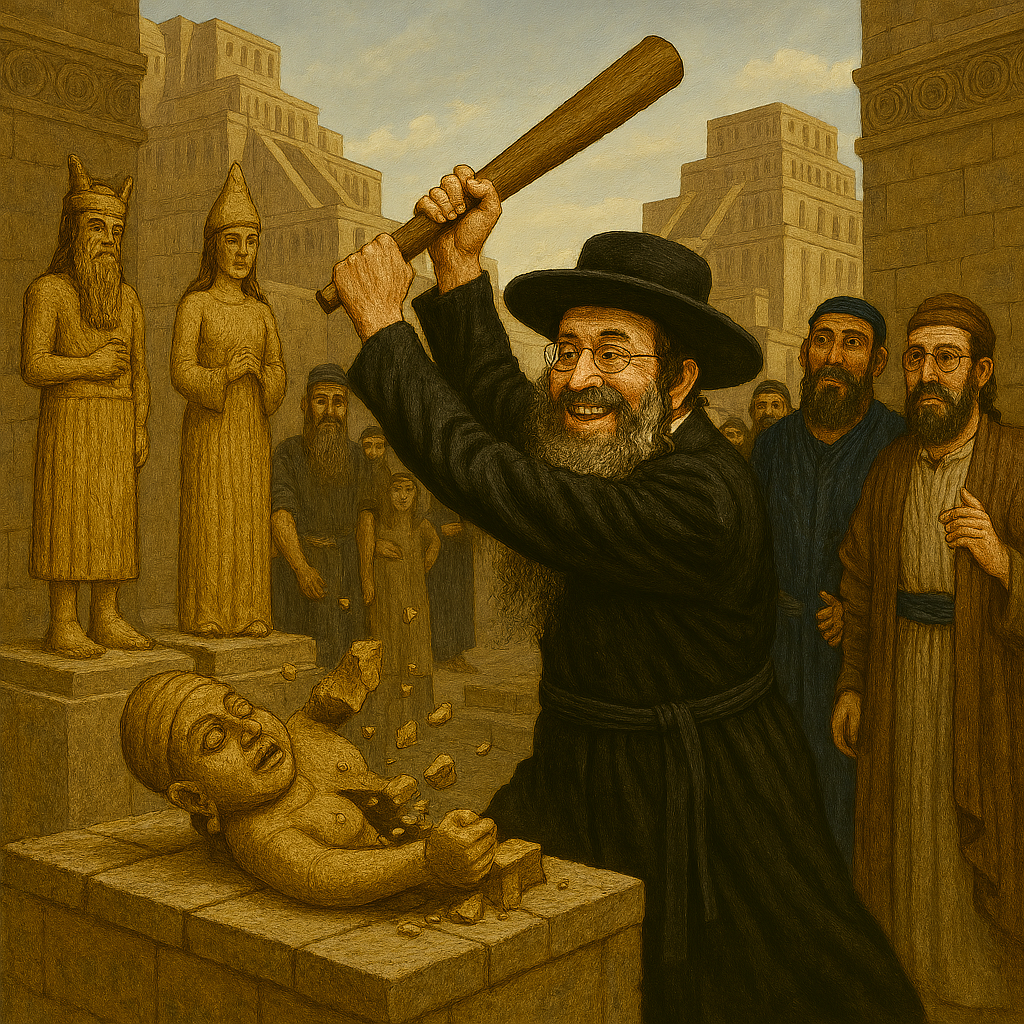
On another occasion, Abraham smashed all the idols and placed the stick in the hand of the largest one. When Terach demanded an explanation, Abraham claimed the large idol destroyed the others. “They can’t do anything!” Terach protested. “Then why worship them?” Abraham replied.
Public Monotheism and Persecution
By age forty, Abraham began preaching monotheism publicly. At fifty-two, he was arrested and brought before Nimrod in Kasdim (Midrash Tanchuma, Lech Lecha 6; Genesis Rabbah 38:13).
Nimrod challenged him: “Worship fire.” Abraham replied: “Water extinguishes fire.” Nimrod conceded. Abraham continued: “Clouds carry water.” Nimrod agreed. Abraham added: “Wind scatters clouds.” Nimrod nodded. Abraham concluded: “Man withstands wind.”
Infuriated, Nimrod declared, “I worship fire. I’ll throw you into it—let the god you worship save you!” Abraham was cast into a fiery furnace—and survived.
Haran’s Fate
Abraham’s brother Haran was not so fortunate. After witnessing Abraham’s miraculous survival, Haran declared allegiance to him. But his conviction came too late. Nimrod cast Haran into the same furnace, and he perished (Genesis Rabbah 38:13).
This is the meaning behind “And Haran died in the lifetime of his father Terah” (Genesis 11:28).
It is a stark contrast: Abraham stood firm. Haran hesitated—and paid with his life.
Journey to Canaan
Around age seventy, Terach departed Ur with Abraham, Sarah, and Lot, settling in Charan (near modern Şanlıurfa, Turkey). Terach died there, never reaching Canaan. His departure was likely influenced by Abraham’s teachings and the political threat posed by Nimrod, who had already killed Haran.
Abraham had faced death and defied the most powerful polytheistic regime of his time. Now, he would confront an even greater challenge: spreading belief in one God—and unknowingly becoming the forefather of a new nation.
The Jews.
Next, Abraham will face trials in establishing a new nation, based on following G-d’s commandments. As we will see in the next chapter.