

Practical Spirituality - Slow and Steady
The ‘Orthodox Atheist’ or… SkullCap Optional
*Orthodox Jews didn’t choose to be called “Orthodox.” The Reform movement gave them the name as an insult — meaning stuck in the old ways. They wore it as a badge of pride, and centuries later it still defines them.
Today I call myself an “Orthodox atheist,” or a “Post-denominational” Jew – or even more accurate – simply a “Jew” because I’m also reacting to reactionaries. Except my reaction isn’t about Reform or pork at rabbinical banquets. It’s about a little piece of fabric on my head, and what it has — and hasn’t — come to mean.
There’s a great Woody Allen joke:
“I went to this bar that hosts topless rabbis — no skullcaps.”
Like all great jokes, it hides a deep truth: you can be a fully observant Jewish without a head covering. What? Yes.
And today, to test what that felt like… I went out without one.
Not to make a spectacle of it, but simply because I wanted to feel the breeze washing over the dome of my balding head… so I could write this very essay with some lived experience.
The concept of learning esoteric or abstract concepts via osmosis – meaning via the lived experience of them – is what the Jews really meant (I think) with the statement “Na’aseh v’nishma” — in English – we will do and (then) we will understand. And of course that is why it was so special – and a prerequisite for the Jews even recieving Torah.
Unlike others who question their ability to fulfill God’s commandments, the Jews realised that the Deity who had freed them, who controlled every aspect of Creation – the One Abraham had taught them about – unseen but All-Knowing and All-Powerful – could NEVER be really understood by us – as we are mere mortals after all. So… instead of saying “we can’t fulfill the commandment “Do not murder” as our very ethos is that of Warrior Esau… or perhaps we cannot fulfill the commandment “Do not steal” as our ethos is one of unbridled generosity – “What’s mine is yours… and therefore… what’s yours if mine… and I can simply take it.
The Jewish reasoning is simple, and why I am quite literally an Atheist who is fully aware that the Creator exists, has Will and Intent, Supervises us, Loves us, and guides us in every moment. In other words, I try to follow that first paragraph in the Code of Jewish Law. But I also believe – that our beliefs are only relevant when they determine our speech or actions, I also feel strongly that oftentimes – it is our very adherence to Torah which unfortunately moves us to destroy it – by denying other Jews their own free-will path, their own quest to discover God.
And I am not even mentioning the obvious… the “70 paths (faces) of Torah”. Or Hillel/Shammai – or the differences between the tribes in Biblical times, including some very fundamental “religious” differences.
Torah provides room for a true “rainbow” coalition – as long as our “philosophies” do not become the hardened arteries of an old, fragmented and disabled people… thinking that slapping at its own face doesn’t hurt. We… the Jewish People, have too much history and too much inherent greatness to allow that to continue.
Shopping Without a Uniform
It felt remarkably freeing to go about my shopping without feeling that people saw me as a Jew, but rather as just another Aussie‑Australian, fair dinkum mate.
Suddenly, all the antisemitism that simmers in the background of Australian life didn’t matter. Nobody looked at me with suspicion or hatred.
Yes, I have a white beard. Yes, I look a bit like Jewish Santa. And even with a bare head I look very “Jewishy.” But without the kippah, nobody minded. Nobody reacted. We were all just shopping together. Because although to myself I was making a “statement” with my naked-chrome-dome appearance, to them I was just another bloke, trying to find the instant coffee I like.
How lovely.
I’m not saying everyone should start going without a yarmulke. But if we’re going to cover our heads — which is a beautiful custom — can we at least do it with a bit of style? A chapeau. A beret. A cowboy hat. Even a turban. What the world sees on your head does not matter – only how it makes YOU feel.
The real idea of a head-covering in Torah is remember that God is in front of us (or on top of our heads…) in every moment. This way we will remember the mitzvot, and make less mistakes.
Why must we cling to the one head covering – the “Red Hat” that mediaevil priests forced Jews to wear exactly so we would “stand out” and all would say – there goes a Jew – seed of the unholy one. Why have we adopted their hatred and this badge of shame of the middle-ages and turned it into a symbol of pride for 2025?
If you are truly proud to be Jewish, wonderful. But pride doesn’t require shouting it from rooftops or wearing a uniform designed by your enemies. You can live proudly and people will sense it.
You don’t need a t‑shirt that says I’m a Jew. You just need to live like a Jew. That’s what we’re meant to do. That is when we truly understand the transcendent power of Mitzvot. Na’aseh – V’nishmah.
Orthodox — A Reactionary Word
Since I call myself an Orthodox atheist, let’s pause on that word Orthodox.
It didn’t start as a self‑description.
In 19th‑century Germany, it was the Reform Jews who first used the word “Orthodox” — and it wasn’t a compliment. They meant old‑fashioned. Antiquated. Stuck in the old ways.
The Reform movement, inspired by Protestant reforms, wanted a modern Judaism: vernacular prayers, organs in synagogue, suits instead of long coats.
They even served delicious crispy bacon at rabbinical graduation banquets — most famously at the Trefa Banquet of 1883, with its shellfish and other non‑kosher delicacies.
That scandal didn’t just shock the traditionalists — it gave rise to the Conservative movement, which sought to adapt but not abandon core practices.
The “Orthodox” — then just Jews who continued traditional observance — eventually adopted the label as a badge of pride.
But here’s the irony: Orthodox Judaism has “Orthodox” in its very name because it reacted to the Reform. Just being “Jewish” back then assumed Torah observance. The non-religious, much like much of modern Israel – felt no need to create a false and new-fangled form of Torah. They lived it. They knew it was true – and did not need a deconstructionist university PhD. to interpret the Bible for them.
So here I am — an Orthodox atheist — reacting not to Reform Judaism, but to the calcification of customs that have lost their meaning.
Growing Up Without Orthodoxy
Until I was fifteen, I didn’t even know there was such a thing as “Orthodox Jews.”
I had lived in Los Angeles since I was nine, but when I wandered into Orthodox neighbourhoods and saw men in little hats, I assumed they were rabbis or the children of rabbis.
After all, the rabbi at my Conservative synagogue wore one occasionally – and certainly was not “observant” by any means. He worked at a Conservative Syngogue they called “Temple Sinai” with no sense of irony – in that the very word “Temple” was a main reason Conservative broke from the reformers – those German Jews who proclaimed “Berlin is our Jerusalem” and “we are Germans first and Jews second” and who attempted to replace the Temple in Jerusalem with their gaudily decorated churches in Deutcheland – the FatherLand. Any “Conservative” Rabbi who knew even just a touch of their own history would never call their shul a “Temple!”
It wasn’t until I became religious as a teenager that I learned what the kippah was for. And it wasn’t until decades later that I realised I’d been sold a bill of goods.
The yarmulke, the yarei malka — “fear of the King” — was explained to me as a symbol of always keeping the Creator before my eyes. A beautiful idea if we use it as mentioned at the beginning of this essay – to live with a continued awareness of God.
But here’s the problem: a piece of fabric on your head that causes other people to have opinions about you is not the same as cultivating a constant inner awareness of God. In simpler terms – it is not what “Shaviti HaShem Lnegdi Tamid” means.
In fact, it can intrude on the privacy of your relationship with the Creator.
Fear of Heaven vs. Fear of People
This is where Maimonides comes in. He teaches that there are three pathways to love God:
- Marvelling at creation (like Einstein, or a child looking at the stars)
- Appreciating the wisdom of the Torah
- Recognising the blessings in your own life
Contemplating any of these fills a person with love for the Creator.
And then — he says something curious. The very same contemplations that lead to love can also bring fear, as one realises their own smallness in the face of creation, wisdom, and unearned blessings.
Love and fear of God, in other words, are not opposites — they are ends of the same spectrum.
But fear of God depends on first having love of God. If what you feel is fear without love, it’s not fear of God — it’s just anxiety.
And the word for fear, yirah, also means sight — clarity. True fear of God comes from a clear perception of the Divine, not from social pressure or fear of how you look in shul.
Which brings us back to the kippah.
If you’re afraid your yarmulke isn’t the right colour, or your hat brim isn’t quite right, or people will notice you don’t know the Hebrew — that’s not fear of God. That’s fear of people.
And fear of people is the surest way to miss the whole point of prayer.
Orthodox Atheism: Belief Means Nothing Without Action
This is why I call myself an Orthodox atheist.
Because I believe — with all my heart, marrow, and bones — that what we believe does not matter one whit until it takes form in action.
Belief, by itself, has no value. Not to me, not to society, not even — dare I say — to the Creator.
You can think terrible thoughts, even murderous ones, but if you don’t act on them, you haven’t harmed anyone. The mind is where those thoughts are meant to be worked out.
Sometimes bad thoughts are even sent from Heaven — like a pop quiz from a teacher — to see if you’ve really been paying attention.
Judaism calls a righteous person not someone who never fails, but someone who fails and gets back up. Sheva yipol tzaddik v’kam — “The righteous person falls seven times and rises.”
Seven is a complete cycle. You can fall seven times this year, seven times next year. What matters is you get up each time.
That’s what teshuvah is. Not medieval “repentance.”
Just learning from your mistakes.
The righteous are not those who never err. They are the resilient — those who learn, shed old skins, and grow.
Coda: Mr. Jew
And I should confess: my shopping trip wasn’t what really motivated this essay.
I had already decided to skip the yarmulke before I stepped into Woolworths – for all the reasons mentioned above.
But what got me thinking today about that came from reactions to my YouTube channel.
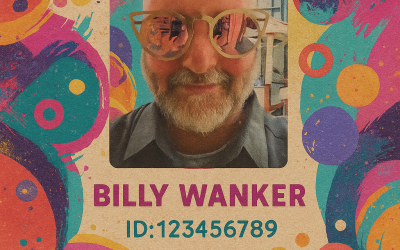
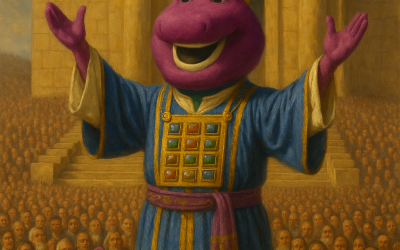
On it lives a character I created called Mr. Jew — who claims to be both the Messiah and Willy Wonka, and to have deposited the first human embryos on Earth over 6,000 years ago in the deep heart of Africa when it was still Pangaea.
He’s childlike. He can’t understand this backward world. As the Talmud says, this is the Olam HaSheker — the world of lies. He tries to light a cigarette and naively assumes one lights the filter and inhales through the raw tobacco end… his reasoning? “That seems to be where the flavour is.”
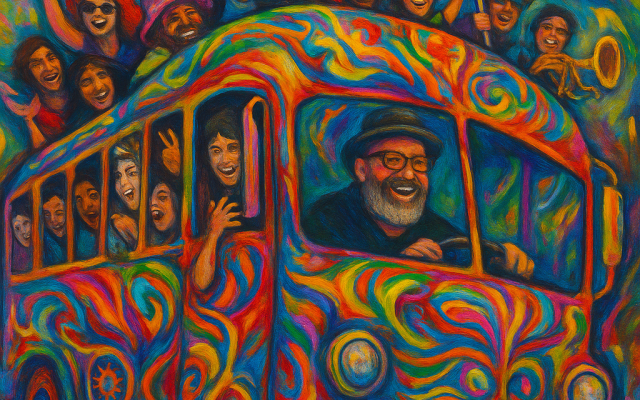
 Mr. Jew comes from the planet Further (yes, Ken Kesey also came from there) in a psychedelic VW bus, usually landing in the ocean near Australia. He abandons the bus and walks to shore — using snowshoes or tennis rackets to walk on water, since of course he can’t walk on water without them.
Recently, I’ve gotten flak — even from family — that Mr. Jew might make people antisemitic.
After all, his name is Mr. Jew, and he says outrageous things.
One relative feared people might watch him and think all Jews are crazy.
I didn’t respond at the time, but here’s what comes to mind now: They think that anyway.
So I’d rather they think of us as crazy in a sweet, daft way — maybe even funny, with something interesting to say — than as the children of Satan plotting world domination at Davos.
If they think Mr. Jew is harmless, great.
If they think he’s crazy, fine.
If they think he’s funny but his point about public hospitals is worth considering — then I’ve accomplished my goal.
You may love Mr. Jew.
You may hate him.
As the person behind him, I couldn’t give two shits.
If you want to see for yourself, Mr. Jew lives here: Kind Guitars / Torat Chaim on YouTube.
https://www.youtube.com/@TTCToratChaim
