
The People Have Done Their Job. Now It’s Time for Our Leaders to Do Theirs.
Yesterday was a remarkable day for Israeli democracy.
At a time when so much of the conversation about Israel focuses on division, political instability and the challenges facing our democratic institutions, millions of Israelis did something that should make us enormously proud.
They voted.
And they did so in extraordinary numbers.
With turnout provisionally reported at 77.7%, compared with 70.6% in the previous election, Israel has recorded its highest participation in a general election since 1999. To put that into perspective, the last time the United Kingdom achieved turnout this high was all the way back in 1992. In the United States, we have to go back an astonishing 130 years, to the presidential election of 1896, before women had secured the right to vote nationwide, to find turnout above this level.
After everything Israel has experienced over the past several years, it would have been understandable if some people had simply given up on politics. If they had concluded that their vote would make little difference, or that the political system was incapable of responding to their concerns.
But that is not what happened.
Instead, nearly eight out of every ten eligible Israelis took the opportunity to have their voices heard.
Whatever our political affiliations, whatever we think of the parties or their leaders, and whatever government eventually emerges, this is something we should celebrate.
The Israeli public remains deeply engaged in the future of its country. And that is an enormous strength.
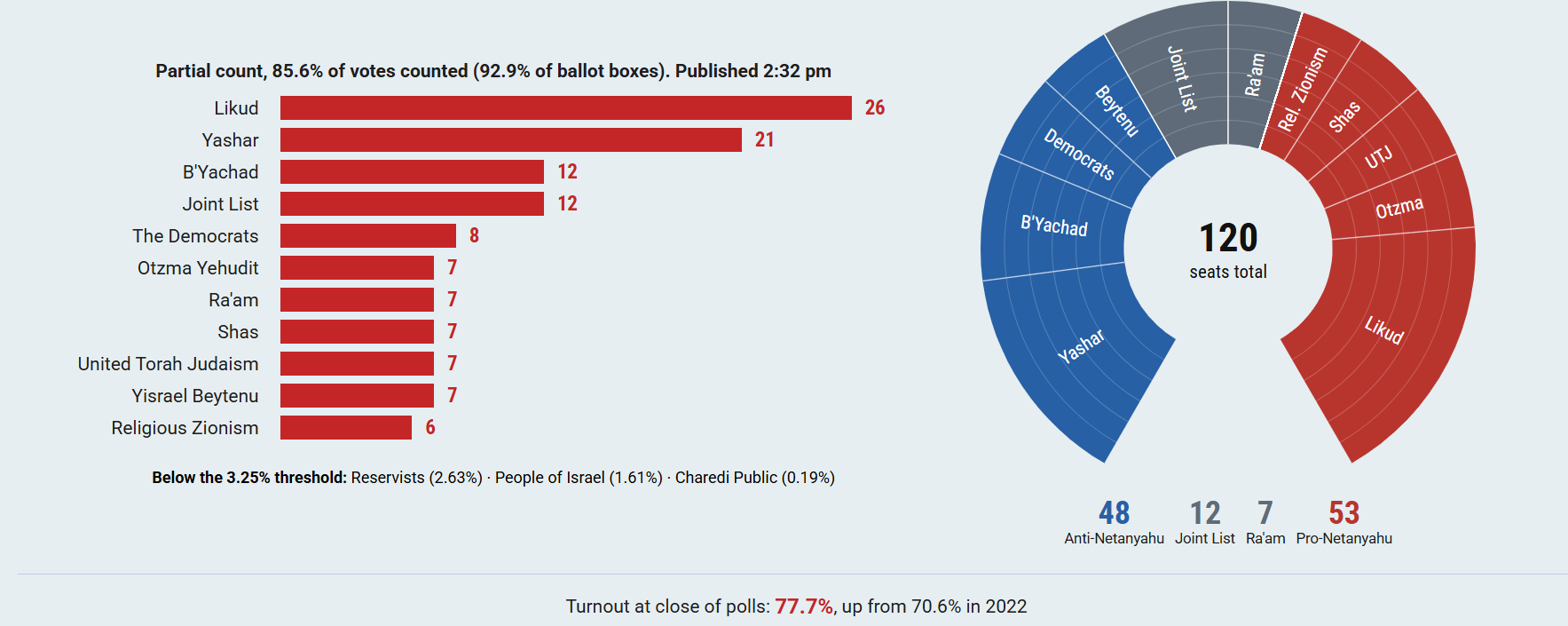
As I write this, the votes are still being counted. But the emerging picture is of a Knesset in which neither the Jewish-led parties supporting Benjamin Netanyahu nor those seeking a change of government have secured a clear majority of their own.
The final distribution of seats may still change, but unless the picture shifts significantly, forming a government will be difficult.
There will undoubtedly be politicians declaring victory, commentators analysing which parties performed better or worse than expected, and considerable discussion about which political bloc has the stronger claim to govern.
But I think there is a more important point that risks being overlooked.
A difficult election result is not a failure of democracy.
Democracy is not designed to guarantee that one political party or bloc receives the outcome it wants. It is designed to give people the opportunity to express their preferences and choose their representatives.
And that is exactly what happened yesterday.
The electorate has not delivered a simple answer. But that does not mean it has failed to deliver an answer at all.
It has elected a Knesset that reflects the different priorities, identities, concerns and aspirations of Israeli society.
That may make governing difficult. But surely the responsibility of our elected representatives is to respond to the electorate we actually have, rather than the electorate they might have preferred.
It is less than 24 hours since the polls closed. The votes are still being counted, coalition negotiations have not even begun in earnest, and there is certainly no reason to assume that another election is inevitable.
But I have a nagging concern about where we might be heading.
That, despite the extraordinary participation we witnessed yesterday, our political leaders may ultimately find it easier to return to the electorate than to make the difficult compromises necessary to form a government.
It is a concern shared by President Isaac Herzog, who said earlier today: “We must do everything we can, certainly after yesterday, to avoid another round of elections.”
I sincerely hope that warning is heeded.
Between April 2019 and November 2022, Israelis went to the polls five times. We know from that experience that repeated elections do not necessarily resolve political deadlock.
Sometimes they simply reproduce it, with slightly different numbers and slightly different parliamentary arithmetic.
And I worry that another election now could achieve very little.
After turnout of 77.7%, what exactly would we be hoping to accomplish?
Would we really expect millions of Israelis to fundamentally reconsider their political beliefs over the coming months? Would another campaign suddenly bridge the divisions that have developed within Israeli society?
Or would the main political blocs remain broadly where they are today, with each side hoping that a slightly lower turnout, a marginal shift in support or a party falling below the electoral threshold might finally deliver the parliamentary majority it needs?
I find the prospect of another election fought primarily in the hope of such an outcome deeply uninspiring.
Of course, public opinion can change, and there are circumstances in which returning to the polls becomes unavoidable. But after such an extraordinary demonstration of democratic engagement, surely our starting point should be to make the result we have received work.
The public has done its job. It is now time for our politicians to do theirs.
And perhaps the most important thing for our political leaders to recognise is that none of this should come as a surprise.
For months before the election, opinion polls consistently suggested that neither the pro-Netanyahu nor the anti-Netanyahu bloc of Jewish-led parties would secure the 61 seats needed to form a government independently.
Indeed, much of the past decade has demonstrated just how deeply divided Israeli politics has become. Political debate has increasingly revolved around one individual, Benjamin Netanyahu, and whether parties are prepared to govern with him, rather than solely around the policies and visions they wish to advance.
The result is that, even before a single vote was cast yesterday, it was difficult to see how either bloc could form a government without someone making a significant compromise.
I have said to friends for some time that I suspect compromise will ultimately be the way out of our political deadlock. Indeed, my prediction before the election was that, sooner or later, one or more political leaders would have to reconsider positions they had previously described as non-negotiable.
My concern is about how long it might take us to get there.
I worry that some leaders may feel unable to make those compromises so soon after an election, believing that doing so would be seen as betraying the voters who supported them. Yet after another election, perhaps two, producing broadly similar results, those same compromises might suddenly become politically acceptable.
I hope I am wrong. I hope our leaders will surprise us by demonstrating the courage to explore difficult possibilities now, rather than waiting until further political deadlock makes those choices unavoidable.
Of course, commitments made during an election campaign matter. Voters have every right to expect their representatives to take them seriously. But when the result was broadly foreseeable, and the alternative may be another prolonged period of political instability, surely there is also a responsibility to consider what compromises might be possible.
There are several potential routes.
A government could be formed with the participation or external support of Arab parties. Parties that campaigned against Netanyahu could consider entering a broader coalition with Likud. Alternatively, members of Likud could decide that a different leadership arrangement would make a wider coalition possible.
Each of these possibilities would require substantial compromises, and each would have significant political consequences. Some may prove unacceptable to the parties involved, and others may be impossible to sustain.
I am not advocating one particular arrangement over another. Nor am I suggesting that political leaders should abandon their fundamental principles or disregard the commitments they made to voters.
But I do believe they have a responsibility to examine these possibilities seriously.
Because the challenge facing them is not simply to find a way of achieving everything they promised during the election campaign.
It is to decide which principles are genuinely non-negotiable, which political positions might be open to compromise, and how they can use the mandate they have received to provide stable, responsible government.
That is what leadership requires.
Leadership is not simply about pursuing your preferred outcome when circumstances make it easy. It is about taking responsibility when circumstances make it difficult.
And sometimes, the most courageous decision a leader can make is to recognise that the country needs something different from what their party originally hoped to achieve.
A week ago, in my previous Times of Israel blog, I reflected on Israel entering the fourth quarter of its first century. Drawing on my experiences leading FZY, a pluralist Zionist youth movement, I wrote about four principles I believe are essential for our future: respect, education, putting the greater good first, and ensuring everyone feels they belong.
At FZY, we encourage young people with different beliefs and perspectives to listen to one another, challenge ideas respectfully and recognise their responsibility to the wider community. We do not expect them always to agree, but we do expect them to work together.
Governing a country is infinitely more complicated than leading a youth movement. But surely we should expect at least the same willingness to listen, respect differences and make difficult decisions from those entrusted with leading Israel.
Compromise is too often portrayed in politics as weakness. A leader who changes position is accused of surrendering, while a party that works with its opponents risks being accused of betraying its voters.
But there is a difference between abandoning your principles and accepting that you cannot achieve everything you want.
And there is a difference between making a compromise because it is politically convenient and making one because it is in the best interests of the country.
I worry that our political leaders may eventually reach these same conclusions, but only after another election or two have made the need for compromise impossible to ignore.
If that happens, what will we have gained?
Months, perhaps years, of additional political uncertainty. Enormous financial costs. Further frustration among the electorate. And potentially an even greater erosion of trust between different parts of Israeli society.
All to arrive at a compromise that might have been possible today.
Whatever government eventually emerges, it will have a responsibility to all Israel’s citizens, not simply those who voted for its constituent parties. It must recognise that those who disagree with it remain equally entitled to feel that Israel is their home.
As I wrote last week, an election determines who has the authority to govern. It does not determine who deserves to belong.
And perhaps that is why yesterday’s turnout matters so much.
Israelis have demonstrated that they care deeply about the future of their country. After years of trauma, uncertainty and division, they have not turned away from the democratic process. They have embraced it.
That does not mean Israeli democracy is without challenges. High turnout alone cannot tell us whether our institutions are sufficiently strong or our political culture is as healthy as it should be. But it is a powerful reminder that the public remains engaged and determined to shape Israel’s future.
The electorate has delivered a result that reflects the divisions within our society. Those divisions cannot simply be wished away, and another election is unlikely, by itself, to resolve them.
The challenge now is for our political leaders to demonstrate that they are capable of governing a country in which people hold different views, have different priorities and disagree profoundly about its future.
That will require difficult decisions. It will require courage. And it may require some leaders to accept outcomes that fall short of what they promised or hoped to achieve.
It is still very early. There is every reason to give our elected representatives the opportunity to explore the possibilities, negotiate and find a workable solution.
But I hope they approach those conversations recognising that compromise may not be a sign of political weakness. It may be precisely the leadership this moment requires.
And I hope that when we look back on this election, we will remember it not only for the extraordinary turnout, but as a moment when our leaders found the courage to make difficult decisions without first needing another election to convince them that compromise was necessary.
Yesterday, the people of Israel showed up for their country.
Now it is time for their leaders to show up for them.