
The People Who Would Not Bow: Judaism’s 3,000-Year Rejection of Tyranny
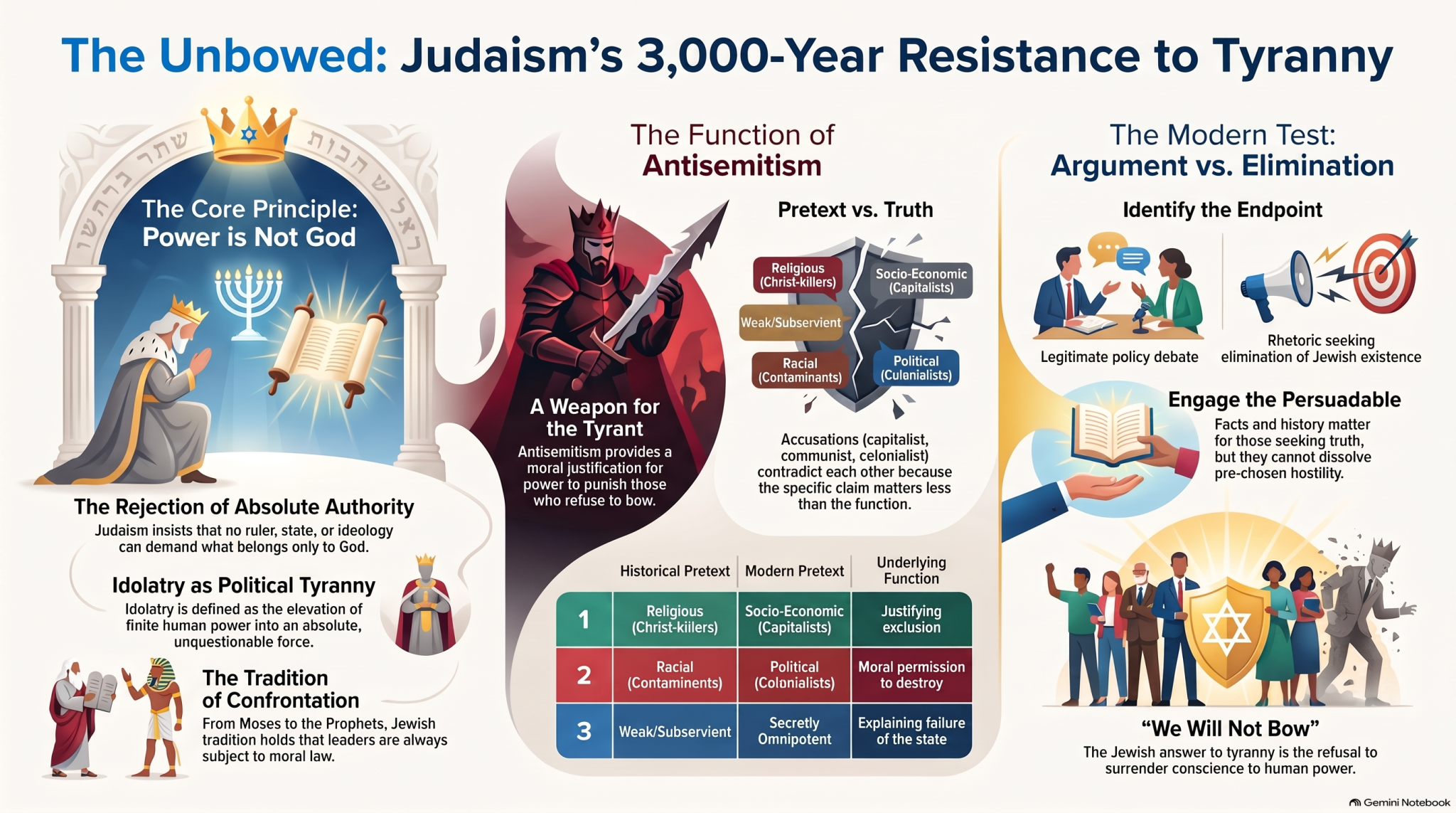
For three thousand years, Judaism has carried an idea so embedded in its stories, laws, and arguments that it’s easy to overlook: the refusal to bow to human power when that power demands what belongs only to God.
Judaism has commandments, rituals, theology, an extraordinary intellectual tradition. But beneath all of it lies something more elemental — a repeated insistence not to confuse power with truth, or the ruler with God. That may be one of the most consequential ideas Judaism has given civilization.
The story begins with Pharaoh — not merely an Egyptian king, but absolute political power personified: the ruler who decides who lives, who works, who exists. Moses doesn’t defeat Pharaoh by becoming a stronger Pharaoh. He confronts him with a different proposition: let my people go. This is not a demand for better treatment. It is a rejection of the premise that any human being holds ultimate authority over another people’s destiny. The Exodus becomes Judaism’s founding argument about power: there are things a ruler may not legitimately demand, because there is an authority above the state.
The pattern recurs throughout Jewish history. Nathan confronts David. Elijah confronts Ahab. Jeremiah confronts the Jerusalem establishment. No prophet asks permission before telling a king he is wrong. The king may command armies and wealth, but not the authority to define morality.
The king is not God. The state is not God. The nation is not God. The ideology is not God. And a man speaking for God is not God.
That last distinction matters most. Judaism doesn’t merely reject the tyrant who claims divine status outright — it resists the person who claims his authority comes from God and therefore cannot be questioned. A prophet may speak in God’s name without being God. A rabbi may interpret Torah without being God. A leader may invoke God without becoming God. This is why idolatry is a deeper prohibition than one against statues: it is the elevation of something finite into something absolute, demanding unconditional obedience. Political tyranny is a form of idolatry. So is religious authoritarianism. Judaism has spent three millennia resisting both.
The Jew as the Unbowed
Seen this way, antisemitism takes on another dimension. It is prejudice and hatred, certainly — but it has also served a political function: justifying the punishment of a people whose existence represents limits on the power of the powerful.
The accusation shifts with the circumstances — Christ-killers, usurers, conspirators, racial contaminants, capitalists, communists, cosmopolitans, colonialists, illegitimate occupiers — and the accusations often contradict each other: too separate, yet too assimilated; weak, yet secretly omnipotent. The content changes; the function stays constant. A society names a group to explain its grievances, and that naming grants moral permission to exclude or destroy them.
Antisemitism doesn’t require a consistent accusation. It requires a justification — and when one is discredited, another replaces it. This is why answering every antisemitic claim on its own terms is an endless exercise: if the hostility never depended on the accusation’s truth, disproving it won’t end the hostility. The capitalist becomes the colonialist; the colonialist becomes the apartheid architect; and the cycle continues. Facts still matter — but expecting them to dissolve a hostility that was never about facts is a category error.
The Modern Test
This distinction matters in the argument over Israel and Zionism. There are legitimate political arguments — about government, policy, settlements, occupation, the conduct of war, Palestinian rights, the region’s future. Jews should not fear such arguments; a tradition built on arguing with kings, even with God, hardly fears political debate.
But political argument and eliminationist rhetoric are not the same thing. The question isn’t which slogan is used — it’s what endpoint is being sought. An argument that a policy should change can be examined and debated. An argument for a different political arrangement, however disagreeable, is still an argument. But when the desired endpoint is Israel’s elimination, when terrorism against civilians is justified, or when the destruction or expulsion of Jews is the argument’s necessary conclusion, the vocabulary — “colonialism,” “apartheid,” “occupation” — has stopped being a subject of debate and become a justification for an outcome already chosen.
The test: if the grievance were removed, would the advocate accept the resulting Israel? Yes, and there’s an argument to have. No — no arrangement in which Israel exists as a Jewish state would ever satisfy the demand — and the argument has revealed something past the grievance. The endpoint is the tell.
Engagement Is Not Surrender
None of this means Jews should stop arguing. Many people — students, journalists, ordinary citizens — absorb distorted narratives without being committed to Jewish destruction. Facts, history, and persuasion still matter to them. Declaring every criticism of Israel antisemitic, or every critic an eliminationist, would destroy the very distinction that gives the argument its credibility.
So two things must be held apart: engage the argument when there is one to engage, but don’t expect defeating an argument to defeat a hostility for which the argument was only a pretext. That distinction changes Jewish life’s psychological posture. Answering an accusation exists to establish truth, persuade the persuadable, and protect Jewish interests — not to make antisemitism disappear. Jews should not live dependent on the approval of those who have already decided Jewish existence is illegitimate. The Jewish people survived not because their enemies were eventually persuaded of their innocence, but because they refused to disappear.
The Tyrant Needs an Enemy
Antisemitism can be understood not merely as hatred but as a weapon of tyranny. The tyrant needs an enemy, an explanation for failure, permission to suppress resistance — and Jews have been a useful target because Judaism carries an idea tyrants cannot comfortably tolerate: there is a moral authority above the ruler. Pharaoh, Nebuchadnezzar, Antiochus, Rome, the medieval church, the totalitarian state, no modern movement — none gets the final word simply by having the power to enforce its claim.
This isn’t the whole explanation for every episode of antisemitism; economics, religion, nationalism, and ordinary prejudice all play their part. But the pattern recurs: when political power demands total allegiance, Judaism’s refusal to make power absolute becomes threatening — and antisemitism supplies the story that makes punishing that refusal feel justified.
The New Battle Over the Narrative
There is also organized political influence and foreign funding to reckon with. Substantial foreign money, including from Qatar, has flowed into American higher education; Iran’s financial support for Hamas, Hezbollah, and Palestinian Islamic Jihad is well documented. These facts deserve scrutiny — but scrutiny isn’t accusation. That foreign governments directly finance campus protests is a harder claim: funding flows into universities where anti-Israel activism is prominent are documented, but the causal link to specific protest movements remains contested. A strong argument doesn’t need a weak factual claim. The better questions are broader — who benefits, who funds, what’s the evidence — and they should be asked consistently of Qatar, Iran, Israel, and everyone else. The goal isn’t replacing one conspiracy theory with another; it’s insisting narratives be examined, not inherited.
The Jewish Answer
If Jewish identity is defined mainly as the people who must constantly explain themselves to their accusers, Jewish existence becomes permanently reactive — every accusation an emergency requiring a rebuttal. That is exhausting.
There is another way to understand it: Judaism as the civilization of a people who, for three thousand years, have refused to accept that human power is ultimate. This doesn’t make Jews uniquely virtuous — they’ve shown the same capacity for ambition, corruption, and error as anyone. It means something simpler: Judaism carries a memory of resistance to the deification of power. The Exodus says Pharaoh is not God. The prophets say kings can be judged. The Torah places even the king beneath the law. And the tradition of argument insists no human interpretation can close the conversation by declaring itself absolute.
So the answer to antisemitism can be neither endless pleading for acceptance nor a refusal to hear legitimate criticism. It has to be harder than both: know the difference between an argument and a pretext. Answer the argument. Expose the pretext. Persuade the persuadable. Confront those who seek destruction. And never surrender the principle in the act of defending it.
For three thousand years, the Jewish answer to tyranny has been remarkably consistent: we will not bow.
Perhaps that is the deepest meaning of Jewish survival — not that the Jews outlasted those who sought to destroy them, but that they preserved an idea tyrants find intolerable: no government, empire, ideology, or collective — however powerful — has the right to demand that another human being surrender conscience to power.
The tyrant is not God. The king is not God. The state is not God. The ideology is not God. And a man speaking for God is not God.
The Jew does not have to be fearless. The Jew does not have to win every argument. The Jew does not even have to persuade the tyrant.
The Jew has to remember that the tyrant is not God.