London based entrepreneur, cybersecurity analyst doing a PhD in AI
The Perfect Engineer
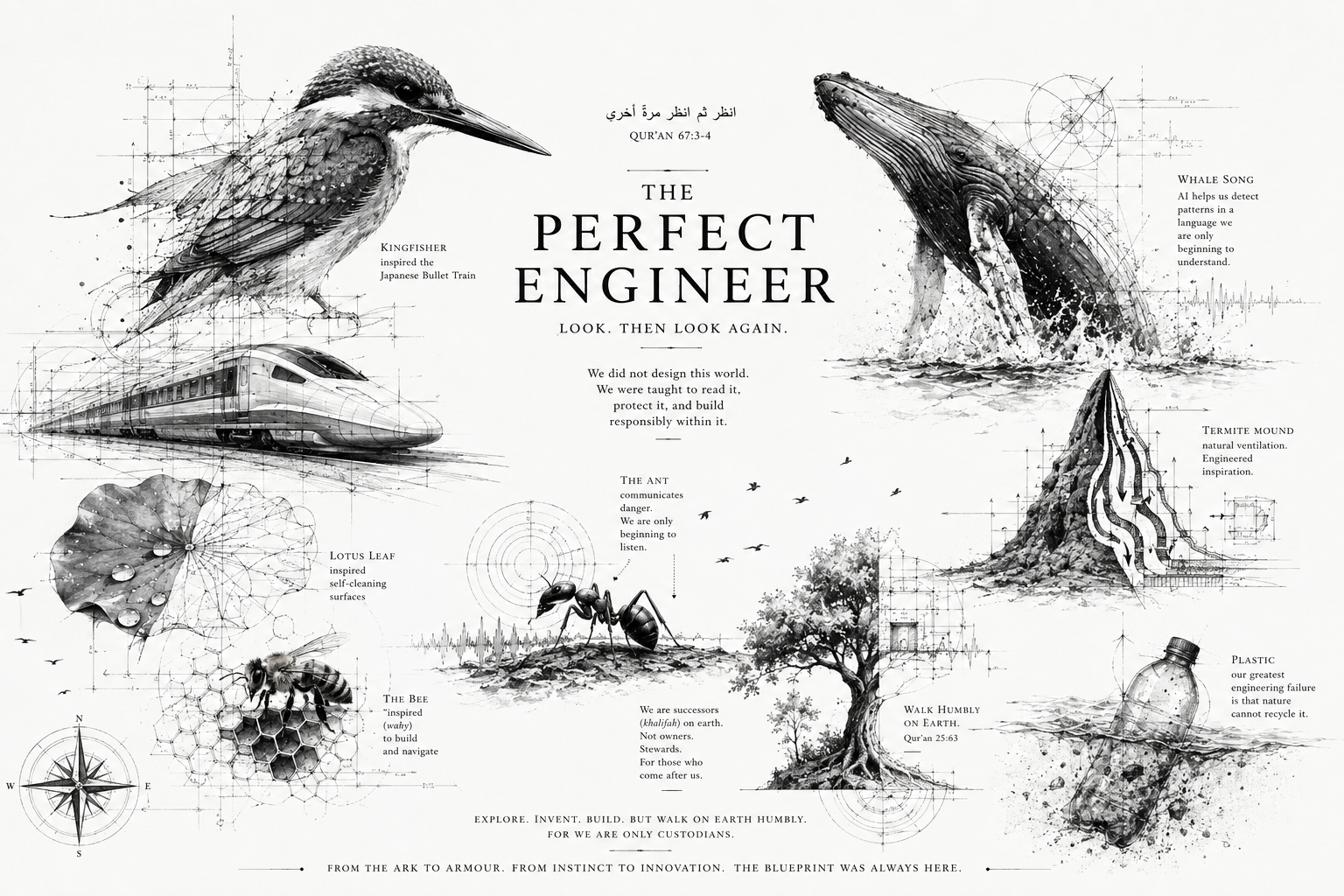
The Perfect Engineer
Unravelling the Creation of God Through Biomimicry
There is something wonderfully humbling about Velcro.
In 1941, Swiss engineer George de Mestral returned from a walk to find burrs clinging stubbornly to his clothes and his dog’s fur. Most of us would have pulled them off and forgotten about them.
De Mestral looked closer.
Under magnification, he saw tiny hooks on the burrs catching loops in fabric and hair. That observation eventually produced the hook-and-loop fastening system we know as Velcro.
Humanity invented something new by paying attention to something old.
The engineer was brilliant.
But the engineering principle was already there.
That distinction tells us something profound about science, technology and faith.
For Jews, Christians and Muslims who believe that the natural world is ultimately the work of God, biomimicry can become more than an engineering technique.
It can become a form of reading.
We read revelation through words.
We read creation through observation.
And sometimes creation contains blueprints.
Look. Then Look Again.
The Qur’an contains a remarkable challenge:
“You do not see in the creation of the Most Merciful any inconsistency. So return your vision: do you see any breaks?”
Qur’an 67:3
Then:
“Then return your vision twice again. Your vision will return to you humbled while it is fatigued.”
Qur’an 67:4
The verses concern the coherence of creation, particularly the heavens. They are not a scientific textbook.
But the intellectual posture is unmistakable:
Look carefully. Then look again.
That is also where science begins.
The scientist observes again.
The engineer measures again.
The inventor notices what everyone else walked past.
Biomimicry is, in one sense, organised attention.
Nature Was Engineering Before Us
The history of engineering is full of moments when humanity looked at nature and discovered that a solution was already there.
Japan’s high-speed Shinkansen once faced a tunnel-pressure problem. Engineer Eiji Nakatsu, also a birdwatcher, looked to the kingfisher, whose elongated beak helps it move rapidly from air into water with little splash. That biological form influenced the redesign of the train’s nose.
One of humanity’s most advanced transport systems had something to learn from a bird.
The pattern repeats.
Lotus leaves inspired self-cleaning surfaces.
Gecko feet inspired dry adhesives.
Shark skin inspired specialised surfaces.
Humpback whale flippers influenced aerodynamic research.
Spider silk fascinates materials scientists.
Termite mounds have inspired thinking about passive ventilation and cooling.
Artificial neural networks, while not replicas of brains, took part of their original conceptual inspiration from networks of biological neurons.
Bill Gates once expressed the same astonishment through the language of computing:
“DNA is like a computer program but far, far more advanced than any software ever created.”
— Bill Gates, The Road Ahead
Gates was making an information analogy, not a theological argument.
But for the believer, the analogy raises an obvious question.
If highly sophisticated software leads us to admire its programmers, what should we make of biological information systems sophisticated enough to produce the programmers themselves?
The Bird Did Not Need a PhD
Living creatures possess capacities human beings spend generations trying to reproduce.
A migratory bird does not study navigation.
Yet some species cross continents and oceans.
A spider does not study structural engineering before building a web.
A bee does not obtain a degree in aeronautics.
An ant does not attend logistics school.
Biology is more complex than simply calling all of this “instinct”. Animals learn and adapt. Genetics, neural circuitry, development and environment interact.
But the deeper point remains.
Life comes equipped with remarkable capacities.
The Qur’an says:
“Do they not see the birds above them spreading and folding their wings? None holds them up except the Most Merciful.”
Qur’an 67:19
This does not compete with aerodynamics.
For the believer, God is not an alternative to physics. God is the Creator of the universe in which physical laws, atmosphere, anatomy and life exist at all.
Human beings spent generations learning to fly.
The bird arrives in a world in which flight is written into its body.
Solomon and the Ant
Then we come to one of the Qur’an’s most intriguing accounts of the natural world.
Solomon declares:
“O people! We have been taught the language of birds…”
Qur’an 27:16
Then his army approaches a valley of ants:
“Until, when they came upon the valley of the ants, an ant said, ‘O ants! Enter your homes, lest Solomon and his armies crush you unknowingly.’”
Qur’an 27:18
Solomon understands.
And smiles.
This particular episode, Solomon understanding an ant’s warning, does not appear in the biblical accounts of Solomon in Kings and Chronicles. It is distinctive to the Qur’anic narrative.
The detail is striking because modern entomology has shown that ant communication is far richer than a simple model of insects following pheromone trails.
Ants communicate through multiple channels:
chemical signals,
touch,
movement,
substrate vibrations,
and, in many species, stridulation.
Stridulation occurs when specialised body structures are rubbed together to produce vibrations or sounds.
A 1965 study of leaf-cutting ants reported that ants prevented from moving freely stridulated. More importantly, the ground-conducted signal functioned as a distress alarm: nearby workers were attracted, and when a signalling ant was buried, nestmates began digging.
Functionally, the message was something like:
Something is wrong.
Come here.
Help.
This does not mean ants possess human language with nouns, verbs and grammar.
It does not tell us exactly what physical mechanism Solomon perceived in the Qur’anic miracle.
But it does establish something important.
Ants really do transmit context-dependent information, including distress signals.
The anthill was never silent.
We simply lacked the instruments to hear much of the conversation.
The Qur’an does not describe Solomon merely observing a trail and inferring behaviour. It presents an ant warning other ants of danger.
For centuries, a sceptic could have dismissed such a passage as fanciful.
Today, that dismissal is harder.
The biological reality is no longer conjecture.
The ants are communicating.
That leaves the theological question open, but sharper than before.
How does a text proclaimed in seventh-century Arabia contain this vivid image of an ant communicating danger to its colony, while modern biology much later uncovers sophisticated chemical, tactile and vibrational communication among ants?
Science cannot answer whether the Qur’an is revelation.
But neither can a serious atheist or sceptic simply wave the correspondence away as if there were no phenomenon to explain.
There is a real biological fact here.
And it maps strikingly onto the form of the Qur’anic story.
AI Is Teaching Us to Listen
Modern machine learning makes the story even more interesting.
AI can analyse enormous collections of animal vocalisations and detect recurring structures that would be difficult for individual researchers to process manually.
Researchers are studying whales, birds, primates and other species.
We should be precise.
AI has not produced a universal animal translator.
But it is giving us new instruments with which to listen.
And the Qur’an’s next verse gives the moral frame:
“So he smiled, laughing at her words, and said, ‘My Lord, inspire me to be thankful for Your favour…’”
Qur’an 27:19
Solomon’s response to knowledge is gratitude.
Not domination.
That is a technological ethic worth preserving.
Greater understanding should produce greater responsibility.
The Bee and Guidance Written Into Life
The Qur’an directs our attention to another insect:
“And your Lord inspired the bee: ‘Make your homes in the mountains, the trees, and in what people construct.’”
Qur’an 16:68
The Arabic uses language derived from waḥy, inspiration or communication.
Classical Islamic interpretation distinguishes this divine direction to creatures from prophetic revelation.
Modern biology uses another vocabulary:
genetic inheritance,
neural circuitry,
sensory processing,
learning,
navigation.
Those explanations do not have to compete.
Science asks how the bee behaves.
Theology asks why ordered biological capacities exist at all.
Honeybees communicate information about food through the waggle dance. Its orientation and duration convey information related to direction and distance.
Again, the creature becomes teacher.
Human beings study it.
Then build from what they learn.
From Water, Every Living Thing
Then comes one of the Qur’an’s most arresting statements:
“And We made from water every living thing. Will they not then believe?”
Qur’an 21:30
This is not merely poetic.
Modern biology recognises water as indispensable to all known life.
Every organism we have discovered depends upon water in some form.
Cells use it.
Metabolism depends upon it.
Transport within organisms depends upon it.
Biochemistry depends upon it.
Even when we search for life elsewhere in the universe, one of the first questions scientists ask is whether liquid water exists or once existed there.
That makes the verse extraordinarily striking.
Fourteen centuries ago, the Qur’an linked all living things to water.
Today, every known living system confirms the centrality of water.
How did a seventh-century text know this?
The believer has an answer.
The sceptic may propose observation, intuition or coincidence.
But again, the point cannot simply be dismissed as vague conjecture.
The statement is specific.
And the biological reality is universal across all known life.
This becomes one of the article’s central questions:
How did the Qur’an know that living things are fundamentally bound to water, and how did it portray an ant communicating danger to its colony?
Neither observation proves revelation by itself.
But together they create a serious cumulative question.
No atheist is obliged to become a believer because of these verses.
But no intellectually serious atheist should pretend there is nothing here worth explaining.
Nature’s Circular Economy
There is another engineering lesson embedded in ecosystems.
Human industry has often operated linearly:
Extract. Manufacture. Consume. Discard.
Nature is far more circular.
Leaves decompose.
Nutrients return to soil.
Water cycles.
Carbon cycles.
Nitrogen cycles.
The output of one process becomes the input of another.
Nature is not literally waste-free. Ecosystems contain toxins, accumulation and inefficiencies.
But the degree of circularity is extraordinary compared with much of human industry.
That gives engineering a better question.
Not merely:
How do we make this?
But:
What does it become next?
Our Plastic Testament
Plastic shows what happens when engineering solves one problem while ignoring the full lifecycle.
Plastic is extraordinary.
Light.
Cheap.
Durable.
Mouldable.
Sterilisable.
It transformed medicine, manufacturing, transport and food preservation.
But its greatest strength became its greatest weakness.
Durability.
An object designed for minutes of use can persist for decades or longer.
Plastic fragments.
It becomes microplastic.
It enters rivers.
Oceans.
Food chains.
And human tissues.
We created a material so persistent that the boundary between our waste and ourselves has begun to blur.
That should disturb the engineering imagination.
We mastered production.
We did not master return.
The next generation of design must think in cycles, not endpoints.
Asimov, Science Fiction and the Tech Bro
Science fiction taught generations of technologists to ask extraordinary questions.
What if machines could think?
What if robots lived among us?
What if humanity colonised other planets?
Writers such as Isaac Asimov and Arthur C. Clarke expanded the imaginable.
Technologists absorbed that instinct.
We see something impossible and ask:
What if I could build it?
That question has produced extraordinary technologies.
But science fiction is not a moral constitution.
It teaches us to ask:
What if?
Revelation asks:
What ought we to do with what we have been given?
We need both.
Imagination without restraint produces power.
Revelation asks whether that power is wise.
Mars Can Wait for the River Too
So by all means, explore Mars.
Search for extraterrestrial life.
Build rockets.
Study the heavens.
But there is something strange about searching distant planets for microorganisms while extinguishing species on the only living world we currently know.
We dream about terraforming Mars while polluting rivers on Earth.
We imagine self-sustaining colonies on another planet while struggling to build sustainable cities on this one.
Space exploration is not the problem.
Neglect is.
A civilisation capable of reaching another planet while poisoning its own ecosystems has become powerful.
It has not necessarily become wise.
Harness the Earth, But Do Not Ravage It
The Qur’an does not ask humanity to become a passive spectator.
It says:
“It is He who made the earth manageable for you, so walk among its slopes and eat of His provision.”
Qur’an 67:15
And:
“He has subjected for you whatever is in the heavens and whatever is on the earth, all from Him.”
Qur’an 45:13
The Qur’anic concept of taskhīr is important.
Creation is made serviceable for human benefit.
Explore.
Travel.
Cultivate.
Engineer.
Build.
Harness.
But use does not mean licence.
The same Qur’an says:
“The servants of the Most Merciful are those who walk upon the earth humbly…”
Qur’an 25:63
That is the balance.
Harness the Earth.
Walk humbly upon it.
The Physical Library We Are Burning
This brings us to the deepest practical implication of biomimicry.
A rainforest is not merely a collection of trees.
A coral reef is not simply something beautiful.
An ocean is not a drain.
They are repositories of biological information.
Every species contains solutions to problems involving survival, chemistry, sensing, locomotion, materials, energy, temperature and communication.
The organism that disappears tomorrow may contain a mechanism relevant to tomorrow’s medicine.
A marine organism may inspire a new material.
An insect may reveal a new robotic strategy.
A plant may perform chemistry whose industrial analogue we have not yet imagined.
Destroying biodiversity therefore carries an intellectual cost as well as an ecological one.
We may be destroying knowledge before learning how to read it.
Imagine discovering a library containing millions of books written in languages humanity had only begun to decipher.
Then imagine setting fire to the shelves.
That is one way to understand biodiversity loss.
And as temperatures rise, ecosystems come under pressure and severe wildfire risk increases in many regions, this metaphor becomes disturbingly literal.
We are burning a physical library.
The Perfect Engineer
This is where the argument resolves.
Biomimicry does not scientifically prove God.
Science explains mechanisms.
Theology addresses ultimate questions of origin, meaning and purpose.
But for the believer, scientific discovery can deepen wonder rather than diminish it.
The kingfisher becomes an engineering lesson.
The termite becomes an architectural lesson.
The lotus becomes a materials lesson.
The bee becomes a navigation lesson.
The ant becomes a communication lesson.
And the Qur’an adds two unusually specific observations:
An ant communicates danger.
Every living thing is made from water.
Those are not abstract metaphors.
They correspond to realities modern science can investigate.
That does not force belief.
But it does force a serious question.
How did a seventh-century text know?
The believer answers: revelation.
The sceptic must offer something better than dismissal.
And from there, the ethical consequence is clear.
If the living world contains information we are only beginning to understand, then destroying it is not merely environmental carelessness.
It is intellectual vandalism.
The environmentalist and the engineer should therefore stand on the same side.
Saving forests, oceans and biodiversity is not a luxury.
It is not PR.
It is not a fashionable afterthought to technological progress.
It is part of technological progress.
Because the next great material, medicine, algorithm or design principle may already exist in a creature we have not yet learned to understand.
The Qur’an tells us that the Earth has been made manageable.
So study it.
Build from it.
Use it.
But walk humbly upon it.
And if every known living thing depends upon water, then protecting water is not merely environmental policy.
Many scientists, like me, may be scratching their heads thinking how does a book written 1400 years ago in Arabia know every living thing depends on water. And we still haven’t found any living thing not dependent on water.
It is protecting the physical basis of life itself.
That is where engineering and gratitude meet.
Not in abandoning technology.
In becoming worthy of the world from which technology learns.
Footnote :- AI tools were used to assist primary research and writing of this article. To reduce plastic waste from disposable razors, I started a 3D printed razor brand – Nahl.shop.
Related Topics
Related Posts