The performance society produces its own Mitzrayim
“The performance society produces its own Mitzrayim.”
Not with visible chains, but with induction, exhaustion, and anxiety.
And this is precisely why freedom must be reread today: as freedom from induction.
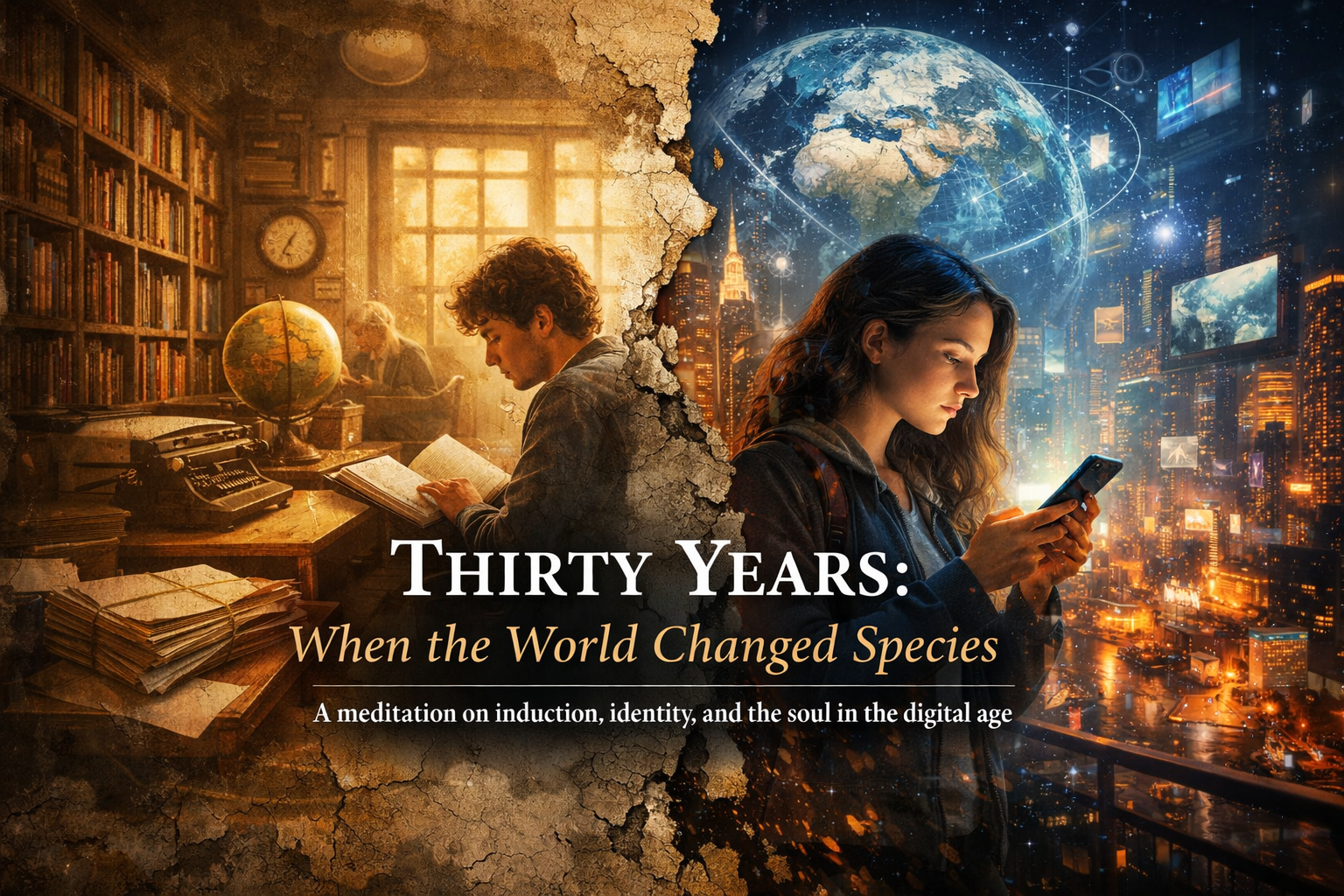
Thirty Years: When the World Changed Species
An essay on induction, identity, and the soul in the digital age
It was not a slow evolution. It was a leap.
If we look at the last thirty years honestly, we encounter an uncomfortable truth: we have not simply lived through an era of “changes” — we have lived through a change of world. Not cumulative progress, not a string of useful innovations, but a platform shift. As if civilisation had shed its skin… and the old one still clung on in places, like something we have never fully managed to peel off. That is why the feeling is so strange: we live in the new world, and yet we still think with reflexes from the old one.
Sometimes a single scene is enough to understand it.
In the 1990s, searching for information meant: getting up, going to a library, opening an encyclopaedia, asking questions, waiting. If you wanted to know something about a distant country, it was entirely possible you would not know that same day. And that was normal. Ignorance was still a natural condition of being human. You could live with a gap without falling apart. The world still had opacity.
Today, a single gesture is enough: open your phone, type a word — and within seconds you have maps, articles, videos, opinions, figures. The entire world offers itself as an immediate answer. And we celebrate that as freedom, efficiency, progress. But the cost of that speed is subtle:
We no longer learn through time.
We learn through reflex.
We no longer go through a process.
We consume the result.
And without noticing it, this shift re-educated the soul.
Those born in the 1970s or 1980s learnt to live in a world where there was still a clear boundary between reality and representation. Life was life: streets, books, the other person’s face, silence and waiting.
Waiting for a letter was a bodily experience. Real waiting: days or weeks without knowing, without confirming, without controlling. Absence had density. There was distance — and distance was part of love, trust, and human mystery.
Today we send a message, and if no reply comes within minutes, anxiety appears. Not because the person has vanished, but because the nervous system has been trained not to tolerate emptiness. Emptiness became a threat. Silence became a “fault”. Waiting became unbearable.
Here begins the new Mitzrayim.
Not as a prison made of walls — but as a prison made of stimuli.
Not as coercion through violence — but as control through attention.
Because the deepest transformation was not only technical. It was ontological. It changed the way we exist.
Life Has Moved into the System
The administrative skeleton of the old world still survives: institutions, paperwork, schools, churches, universities. But the vital system has shifted. Life no longer happens “out there”; it happens online. And this network is not merely a channel. It is an ontological medium — a condition of existence.
First it was a tool.
Then it became an environment.
And finally it became the place where reality happens.
In only a few decades, the internet stopped being an instrument and became an atmosphere. With the smartphone, the human being integrated a permanent external organ: an extension of attention, memory, identity and desire. No one asked permission. No one explained the cost.
It simply happened.
And yet — for the sake of fairness — not everything is dark. There was a real gain. Knowledge was democratised in a way previously unimaginable. Communities that were isolated found voice and network. People with rare diseases, who once lived like exceptions without mirrors, could finally find each other, share information, support one another. Movements that were once invisible gained public existence. The network — at its best — expanded the dignity of many.
But the question is not whether there was progress. There was.
The deeper question is:
What kind of structure emerged alongside it?
The Architecture of Induction
At a certain point, technology stopped being an object and became a subject.
It was no longer “a tool we use”. It became the medium that uses us — or more precisely: the medium that reorganises us.
First, what changed was the visible layer: instant communication, permanent maps, endless music, invisible payments, unlimited access. Everything appeared as convenience. But beneath that mask, a new structure of power was growing. Because power no longer depends only on territory or capital; it depends on something more intimate and final:
human attention.
Today, domination consists in inducing behaviour and governing perception.
The rise of algorithms was a silent turning point. In the past, you searched for the world; now the world searches for you. It suggests a video. It offers a headline. It plants outrage. It directs you towards a desire. It trains you. It categorises you.
And it does this with unprecedented precision, because it does not feed on ideas — but on data: habits, biological rhythms, micro-emotional reactions.
The network knows you better than you know yourself.
So here is the question that defines our age:
How much of what I “want” today is truly my own… and how much is induced?
This is not rhetorical exaggeration. It is a structural description.
In the language of Shemot:
Pharaoh is no longer only a king — he is a system.
He does not primarily control the body, but attention.
And whoever controls your attention controls your life.
The human being has ceased to be a subject who uses tools, and has become an organism living inside systems designed to modulate it. Freedom remains as a concept, but everyday life has become a space of induction — a permanent laboratory.
And yet — again, dialectics — this architecture is not only oppression. It also enables coordination, efficiency and rapid responses to crises. Today we can warn of natural disasters within seconds. We can organise large-scale aid in record time. We can share medical information globally.
The same network that induces can also save.
The drama is not in the network itself.
The drama lies here:
The human being has not yet developed the inner maturity that matches the power they have created.
Editable Life and the Irreducible Body
At the same time, science has made its own leap. Genomics translated DNA into code. Biotechnology turned it into manipulable material. With CRISPR, life stopped being untouchable and became editable.
And when life becomes editable, the ethical boundary becomes fragile — because human desire has no natural limits: where it can advance, it advances.
The body itself entered the circuit of reprogramming. The brain is measured. The mind is modelled. Dopamine is administered through a screen. We believe we decide, when often we are merely reacting to invisible architectures.
But here something irreducible appears:
The body resists.
It becomes ill.
It ages.
It hurts.
It exhausts itself.
It cannot be fully turned into software. The body is the last reminder of reality. You can live a week in simulation — but sooner or later the body demands truth: sleep, food, touch, rest, presence.
In this sense, the body becomes:
a teacher,
a boundary,
a compass.
Identity: from “I Am” to “I Present Myself As”
Perhaps the most brutal shift is not scientific or technological, but cultural.
In the twentieth century, identity was something one received and cultivated. Today it is something one produces and displays. It is no longer root, but performance; no longer inheritance, but construction. We have moved from “I am” to “I present myself as”.
This brings real freedom: breaking old forms of oppression, opening space, naming what used to be forbidden.
But it also brings a brutal price: the collapse of belonging and tradition.
Without ground, anxiety becomes chronic.
And loneliness becomes epidemic.
We are connected with thousands… but we belong to no one.
Belonging used to mean being held by something larger than you — family, place, memory, shared reality. Today it often means being seen by strangers, interpreted through a feed, and held by no one. Visibility has replaced shelter. Expression has replaced inheritance. And the human soul, which needs more than connection, begins to starve.
Nevertheless, the generational story is not as simple as nostalgia would have it. Digital natives are not only victims. They possess a kind of wisdom that we do not: technical intuition, adaptability, rapid pattern recognition, a natural understanding of networks. Many recognise manipulation more sharply than we assume.
The question is whether this intelligence will become consciousness… or remain merely a survival strategy.
Perhaps this is the real generational difference:
Older people remember the old world.
Younger people know how to navigate the new one.
The task is to unite memory and navigation.
Ontological Risk: When Narrative Replaces Fact
From there, the central symptom emerges: polarisation. It is not simply that we think differently — we live in different realities. Each informational bubble is a closed world in which truth is no longer a shared horizon, but a tribal weapon. The word has separated itself from reality.
This is not sociological.
It is ontological.
Our relationship with truth has changed. There used to be propaganda, yes — but it rested on the foundation of a relatively stable reality. Today reality is malleable. It is remixed and aestheticised until it becomes indistinguishable from simulation. Fact loses authority in favour of narrative.
And precisely at this point, Artificial Intelligence appears.
Not as “just another breakthrough”.
But as the final rupture.
Because generative AI is not only software: it is a semantic co-agent. It can produce discourse, seduce, imitate, replace cultural production. When language stops being the anchor of the human, we enter a dangerous zone:
an era in which a person can be surrounded by voices without a soul — and still feel accompanied.
The system no longer only feeds you content. It can speak to you. It can mirror you. It can simulate empathy. And when a machine can imitate understanding, the Exodus becomes harder — because the chains feel like comfort.
A painfully honest image belongs here:
A teenager today can spend hours talking to a screen.
Not necessarily out of stupidity.
But out of hunger for presence.
The tragedy is that the system can offer “dialogue” — without offering bond.
“But I’m Happy Like This…”
And someone will say, entirely understandably:
“But I’m happy like this. I’m fine. I enjoy it. It works for me.”
Maybe.
Truly: maybe.
But the question is not whether it entertains.
The question is whether it sustains.
And the deeper question is this:
When everything goes dark, when the flow stops, when there is no artificial dopamine left… is there still someone inside?
There you see whether it is freedom — or Mitzrayim.
Practices for Living Without Giving Up the Soul
This essay could end in diagnosis. It could end in critique. But diagnosis without practice becomes empty poetry.
If we want to inhabit the new civilisation without giving up the soul, we need concrete gestures. Simple. Radical.
1) A fast from induction
One hour a day without feeds, without networks, without scrolling, without suggestions.
Not out of moralism — but out of ontological hygiene.
2) Return to the body
Walking without headphones. Breathing. Sleeping. Eating without a screen. Touching reality.
The body as an anchor against simulation.
3) Non-digital bond
A dinner with no phones on the table. A walk that becomes conversation. A real visit.
The other person’s face as rehumanisation.
4) Slow reading
Fifteen pages without skipping. A book that demands patience.
Attention as a spiritual act.
5) Narrative discernment
Before sharing outrage: three breaths. Ask:
Was this emotion born in me… or installed in me?
6) A real act of silence
Ten minutes without music, without input, without noise.
Not “meditation” as technique — but silence as return to what cannot be manufactured.
This is the Exodus of our time:
not out of a country, but out of an induction.
Freedom today means: taking back one’s own attention.
Taking back one’s own desire.
And dwelling within again, rather than in the feed.
You do not need to leave the system completely.
You need to stop letting it live inside you.
Closing: the sacred challenge
If the twentieth century was the century of the machine, then the twenty-first is the century of consciousness. Not through spontaneous evolution, but through survival. The unconscious does not survive here. The human being who does not awaken becomes raw material for induction.
Paradoxically, technology pushes us towards the spiritual. Only an identity with an inner axis can walk through this current without dissolving.
We stand with one foot in the old world — pain, body, death — and the other in digital simulation.
Perhaps the challenge of our generation is precisely this:
to inhabit the new civilisation without giving up the soul.
This is not a technological problem.
It is a human one.
And at its core: a sacred one.
A question for you
Where do you feel this “new Mitzrayim” most strongly in your own life — and what would a personal Exodus look like?
If this essay resonated with you, share it with someone who needs it — and tell me which line stayed with you.