


The Personalization Trap
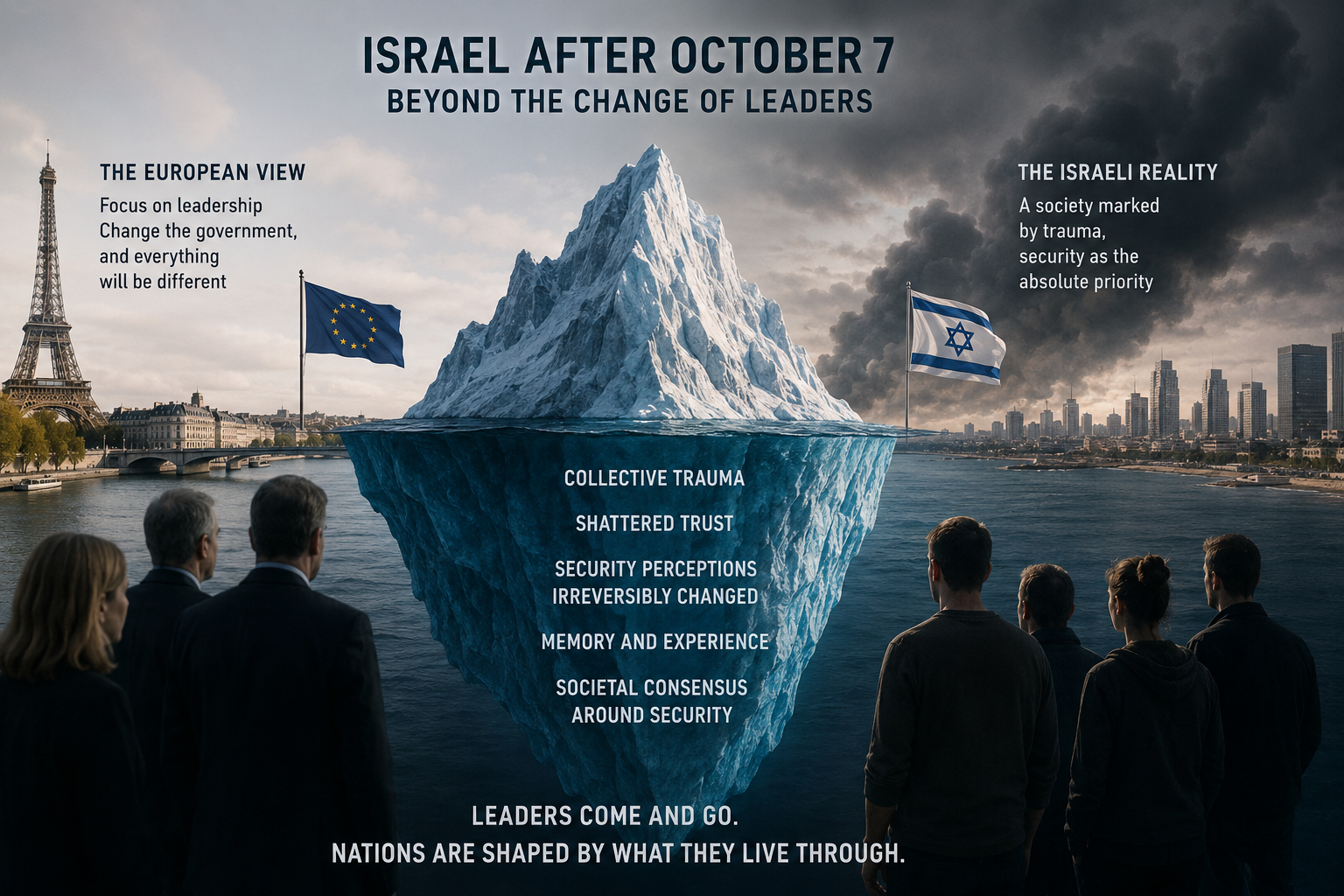
Why Changing Israel’s Leaders May Not Change Israel.
For several months, a narrative has been circulating in certain European media and political circles: that Israel’s main problem lies with its current leaders. A change of government, it is argued, would ease tensions and help restore dialogue with Western partners.
This hypothesis deserves discussion.
Not because leaders are irrelevant. In a democracy, they set priorities and make decisions. But to believe that a political alternation alone would profoundly transform Israel is to see only the tip of the iceberg.
Since October 7, 2023, Israel is no longer exactly the same country.
The massacre perpetrated by Hamas not only triggered a war. It shattered a collective perception. Much of the population saw their trust collapse—in security measures, in the belief that deterrence was enough to contain threats, and in the hope for a lasting equilibrium.
In geopolitics, some events change a government. Others transform a nation. October 7 belongs to the second category.
September 11, 2001, in the United States, or Russia’s invasion of Ukraine in 2022 for Europe, both show how a historic shock can durably alter the perception of security. Governments change faster than societies.
This is what must be observed in Israel. Leaders influence public opinion, but they also depend on it. When a collective trauma changes a population, their room for maneuver shrinks. A government that ignores this risks losing legitimacy.
Israeli politics therefore does not depend solely on the personal convictions of its leaders. It also reflects a society that, since October 7, has given a more central place to national security.
In Europe, Israel has become a domestic political issue. Debates about Gaza, international law, or arms sales occupy a growing share of election campaigns. To simplify a complex subject, it becomes easier to explain tensions by the personality of a prime minister than by the transformation of a society facing a historic shock.
This reading has two limitations.
The first underestimates the weight of collective memory. Robert Jervis( (1940–2021) political scientist renommé has shown how much perceptions and traumas influence strategic decisions. Leaders never reason in a historical vacuum.
The second is to confuse political alternation with strategic change. A change in government may alter diplomatic style, relations with certain allies, or the pace of negotiations. It does not necessarily transform a state’s fundamental interests or its perception of threats.
After October 7, the Israeli perception of vulnerability changed. As long as this remains, priorities will continue to focus on preventing a new trauma.
This does not mean that Israeli society has become homogeneous. Debates remain numerous: the conduct of the war, the future of Gaza, the role of institutions, relations with Washington, or political responsibilities. But they now unfold within a different framework: that of a society that believes its security can no longer be thought of as before.
For Europeans, the issue is therefore less about who will rule Israel tomorrow than about understanding the country that future leader will govern.
Since October 7, it is possible that it is not just the answers that diverge, but the diagnoses themselves.
Some European officials continue to analyze Israel using frameworks from before October 7: resuming the political process, reviving diplomacy, changing the parliamentary majority. By contrast, much of Israeli society believes the absolute priority is to prevent such a trauma from recurring—even if that means making choices seen as excessive in Europe.
Everyone looks at the same event, but draws different lessons from it.
This is where a strategic gap is widening. Europe often believes the problem lies with Israeli leaders. An increasing number of Israelis, on the contrary, feel that Europe no longer grasps the reality of the threats. One side seeks above all a political solution; the other, a security guarantee.
The real challenge will not just be to rebuild a diplomatic relationship between Europe and Israel, but to restore mutual understanding.
For an alliance does not weaken only when interests diverge. It also weakens when partners cease to see the world through shared references.
And perhaps it is this change—silent but profound—that today marks the true geopolitical turning point.