


Rooted in history. Speaking for the future.
The Piece of Paper That Changed My Life
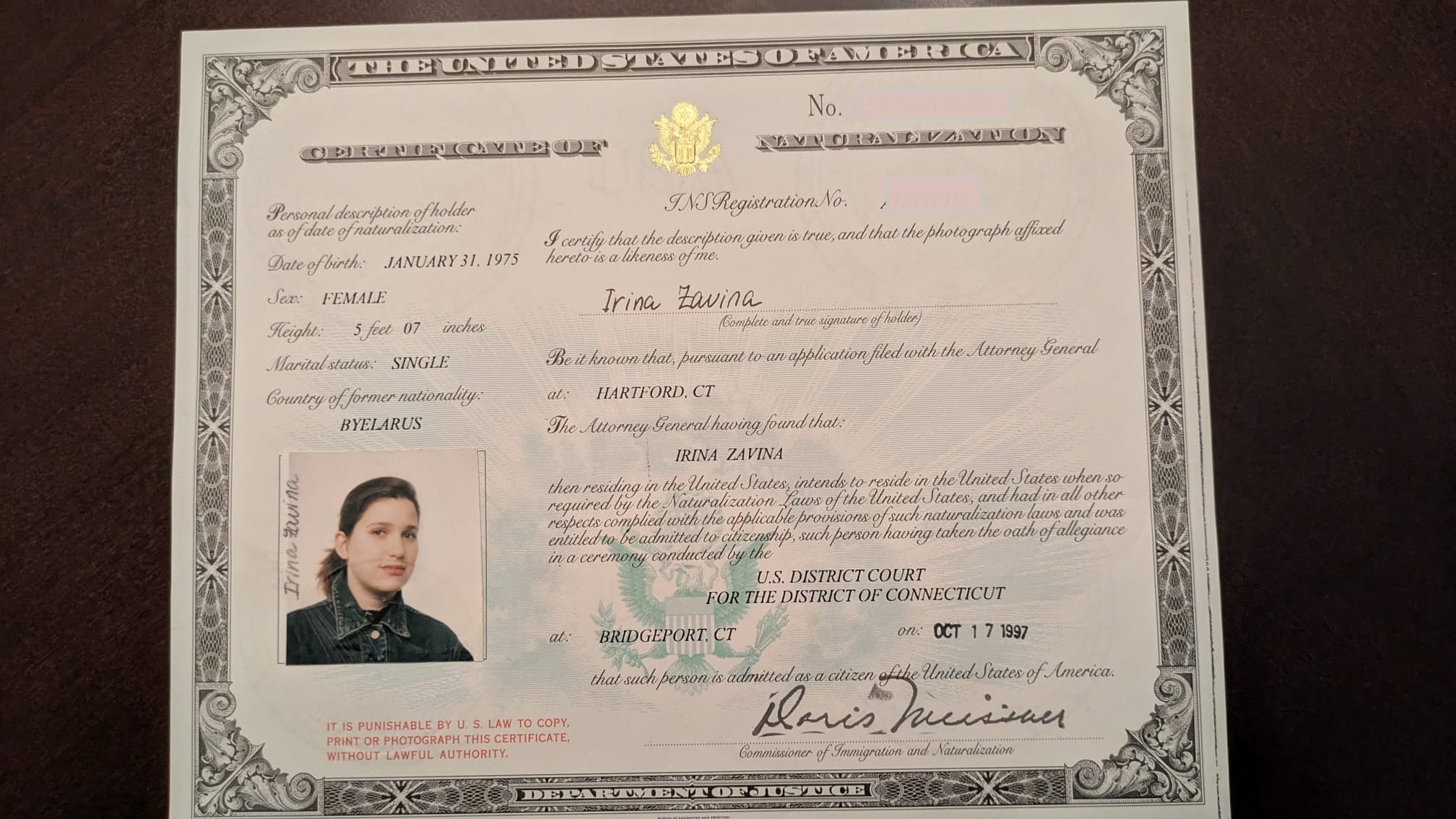
Every Fourth of July, I find myself thinking about a document that sits quietly in a drawer in my home.
My Certificate of Naturalization.
To most people, it’s just a government document. To me, it represents one of the greatest privileges of my life.
As America celebrates its 250th birthday, I’ve been reflecting on what that piece of paper has come to symbolize.
On March 14, 1992, at 17, I arrived in the United States as a refugee from the USSR. Each of us carried two suitcases, spoke limited English, and had little certainty about what the future would hold. What we did have was faith that freedom, even with uncertainty, was worth the risk of starting over.
We left a system where being Jewish carried real consequences, and where opportunity, expression, and faith were constrained. America offered something profoundly different: the freedom to build our lives on our own terms.
America didn’t promise us success.
It gave us the opportunity to earn it.
Everything that followed, my education, my career, my family, and ultimately the chance to build my own business, became possible because this country created opportunities that simply did not exist where I grew up.
Looking back today, I appreciate even more the courage it took my parents to leave behind everything they knew so their children could have a future they could only imagine.
Like every nation, America’s story is complicated.
The American experiment was imperfect from the beginning. Slavery was a profound injustice, and women and many others were denied rights we now consider fundamental. Those truths should never be ignored.
History should be judged honestly. But it should also be judged in context.
When America declared its independence in 1776, much of the world was ruled by monarchies. Individual liberty was limited, political participation was reserved for a small portion of society, and freedom was more often the exception than the rule. Against that backdrop, the idea that government derived its legitimacy from the consent of the governed, rather than from a king, was revolutionary.
America did not immediately extend those ideals to everyone. But it enshrined principles that generations of Americans would later use to challenge injustice, abolish slavery, expand voting rights, strengthen civil rights, and continue the work of building a more perfect union.
That work continues today.
As a Jewish refugee from the USSR, I understand something else as well.
Freedom is far more fragile than many people realize.
The Jewish story is, in many ways, the story of people searching for places where they could live openly, practice their faith freely, and build a future without fear. For millions of Jews, America became that place.
It became that place for my family.
Today, public discourse often focuses on America’s failures. Some of those conversations are necessary. Every healthy democracy should be willing to examine itself honestly.
But gratitude matters too.
Having experienced life under a system where government controlled opportunity, restricted expression, and limited individual freedom, I have never viewed America through the lens of perfection. I have viewed it through the lens of possibility.
That perspective has shaped not only my life, but also my work.
As someone who advises leaders and organizations, I have learned that the strongest institutions are not those without flaws. They are the ones that remain grounded in their founding principles while having the courage to improve, adapt, and become stronger over time.
Perhaps nations are no different.
My Certificate of Naturalization reminds me that America is more than a place.
It is an idea. One that has never been perfect, but one that has always been worth striving toward.
As America celebrates 250 years, I hope we continue to protect that idea, strengthen it, and leave it better for the generations that follow.