
The Pink Sari (le Sari Rose) by Javier Moro
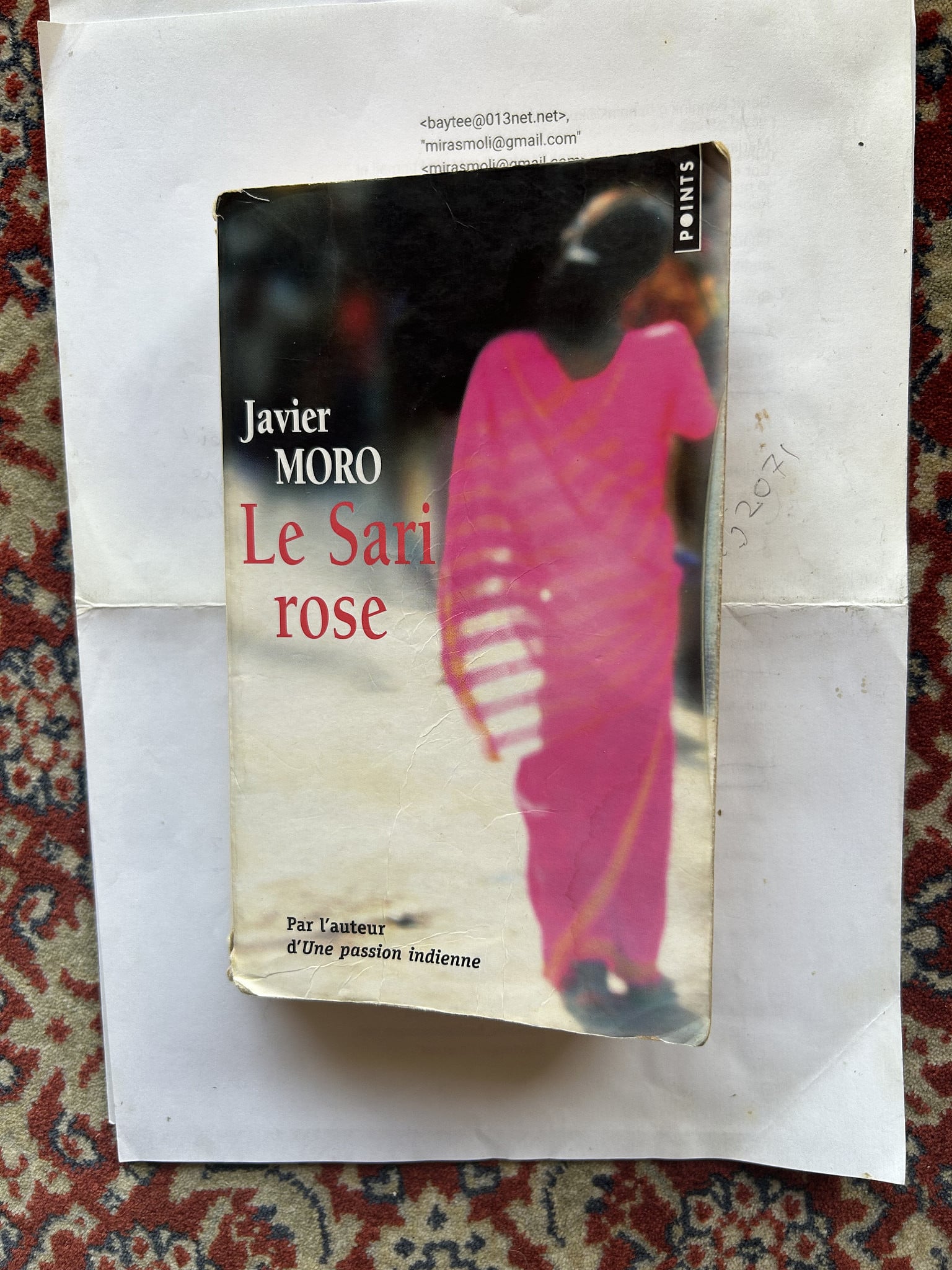
Reading a book about India in French which has been translated from the Spanish original seems a bit crazy. However, when I picked this book up from the shelf in our local pensioners’ club I hadn’t realized what a long journey it had taken to get there. Neither was I aware of the extensive journey on which it would take me. As I read on in this700-page tome I gained insights into the complex history and politics of contemporary India. I am not sorry that I made the effort, and have come away enriched in knowledge and understanding of the enormous effort involved in governing India, the largest democracy in the world. But it is as much a family saga as an account of political developments, and the pink sari of the title has both historical and personal significance in it.
The book begins at the moment Sonia Ghandi is informed of the assassination of her husband, Rajiv, prominent Indian politician and scion of the celebrated Ghandi family which has been inextricably bound up in the history of contemporary India. His grandfather, Jahawarlal Nehru, was a key figure in India’s struggle for independence and became its first president; his mother, Indira, Jahawarlal’s daughter, bore the banner of the family’s political involvement, going on to lead the Congress party and eventually becoming Prime Minister; her sons, Sanjay and Rajiv, were also involved in Indian politics, and it is the saga of that family and its contribution to Indian political life which constitutes the essence of the book. The pink sari of the title was made from the cotton cloth that Nehru wove while jailed by the British colonial power, and it was worn by both Indira and Sonia at their respective weddings.
After the reader has absorbed the situation in which Sonia suddenly finds herself, the book proceeds to describe her youth and background. She was born into a middle-class family in central Italy, studied languages and went to a language school in Cambridge, England to improve her English. While there, she met Rajiv Ghandi, who was studying at the university, and the two fell in love. Their courtship had to overcome many obstacles, not least the objection of Sonia’s family to her relationship with the young Indian. But the two young people would not be deterred, and were eventually married in India. In accordance with Indian custom, Sonia moved into her busband’s family home, which in this case was the home of the country’s Prime Minister, Indira Ghandi. Relations between daughter-in-law and mother-in-law can often be fraught, but those two intelligent women managed to forge a firm bond between them, and the account of Sonia’s acceptance into the household and ability to adapt to the situation provides an insight into their respective characters.
The ups and downs of Indira’s career and the account of her commitment to India’s democracy and the Congress party that was founded by her father form a large part of the book. Her life story provides a thorough grounding in contemporary Indian history and politics and an understanding of the characters involved. During Indira’s term as prime minister her son, Sanjay, was instrumental in introducing the sterilization policy aimed at reducing India’s birth rate, thereby arousing considerable resentment. At the time there were also violent clashes between Muslims and Hindus, with disputes over worship and territory. After Sanjay’s death in a plane accident, pressure was put on Rajiv to enter politics and support their mother. This he did so only reluctantly, knowing that this would mean forgoing his previously tranquil way of life as a working pilot and the ability to enjoy family life.
Rajiv’s death in a suicide terrorist attack left Sonia and their two children bereft. Pressure was then put on Sonia by members of the Congress party to enter politics, irrespective of the fact that she was still regarded as a foreigner. Sonia eventually acceded, feeling the burden of responsibility embodied in the family name she bore. After being made head of the Congress party and gaining a seat in parliament she worked tirelessly to eradicate corruption throughout the country and maintain a policy of laicity and equality before the law. The book ends with an account of the situation in India today, with Sonia remaining a popular figure there even after her retirement from politics.