Poznan’s ‘Neue Synagoge’ was a shul, then a pool. Now it should be a hotel
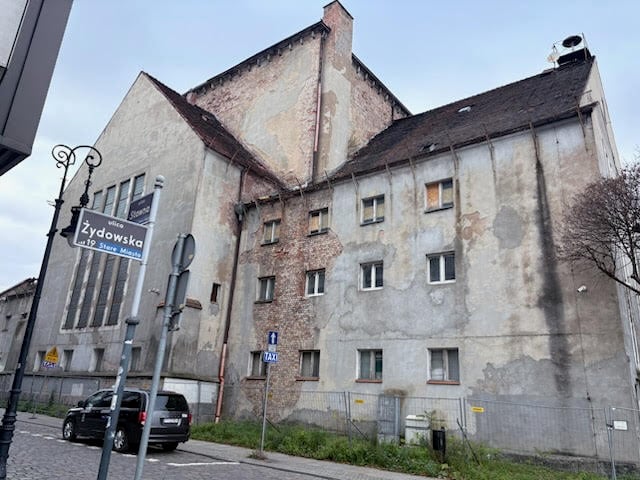
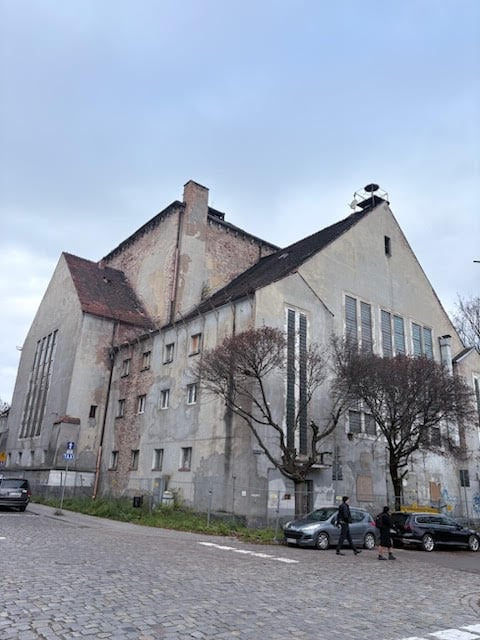
On the edge of Poznań’s Old Town, in western Poland, there is a building that feels too large for the street on which it’s located. It stands on a corner, freestanding and slightly awkward, a pale, heavy block with a steep tiled roof and a blunt triangular front. High up, the geometry of the façade still hints at something that is no longer there: a vast dome that once rose above the city.
Over the glass entrance doors, someone long ago painted two words in Polish: Pływalnia Miejska — “City Swimming Pool.”
If you grew up in Poznań, you may remember the smell of chlorine and wet concrete, the echo of children shouting, the shock of the first jump into cold water. For decades, this was just one of the city’s public pools, a place where you took swimming lessons or went on school trips.
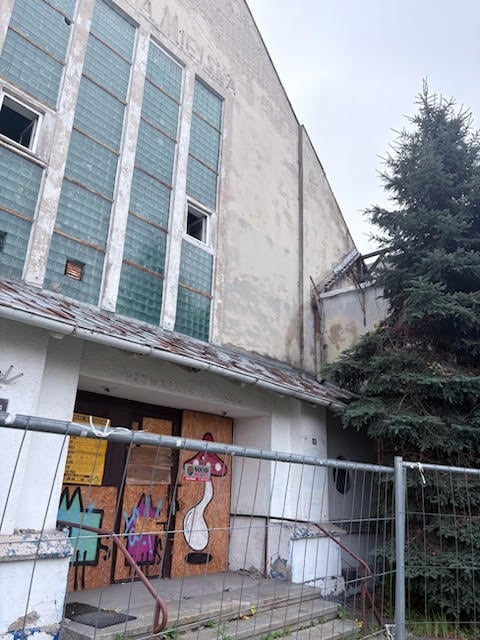
If you were Jewish, or happened to know a little more history, you knew what most visitors did not: that this municipal pool had been built inside what was once one of the most imposing synagogues in Central Europe.
Today, the pool is closed. The building is empty. It is officially listed as a protected historic monument — and at the same time, it is for sale.
Somewhere between those facts lies a question that is not only about Poznań, and not only about Jews.
A million-mark synagogue
The story of the building begins not with chlorine, but with confidence.
In the early 20th century, Poznań was still under Prussian rule. The city’s Jewish community was prosperous and well integrated, involved in trade, professions, and the urban life of the time. They wanted a synagogue that matched their sense of themselves — modern, impressive, anchored.
They hired a Berlin firm, Cremer & Wolffenstein, which had already designed major synagogues in Germany. The architects laid out the new building on a Greek-cross plan: four equal arms around a central space. On top, they placed a huge dome covered in copper. Inside, the synagogue could hold around 1,200 worshipers — 600 men on the ground floor and 600 women in the side galleries. The cost, about one million marks, was staggering by local standards. For comparison: the nearby Imperial Castle of the Kaiser cost five million marks.
Architecturally, the building mixed Romanesque mass with Moorish flourishes, in the style favored by many German synagogues of the time. Inside, oriental motifs and saturated colors were meant to evoke a kind of imagined Jerusalem within a very German urban fabric. The great dome rose higher than the towers of nearby Catholic churches; in the climate of the Kulturkampf, this was not entirely accidental. The synagogue was a prayer space, but it was also a statement.
When it was completed and dedicated in 1907, it was called simply the Neue Synagoge — the New Synagogue. The old one, in the dense streets of the former Jewish quarter, suddenly felt small and obsolete.
A photograph from before the First World War shows the New Synagogue with its dome intact, dominating the skyline. It is not a shy building. It has the kind of self-assured presence that now, in hindsight, looks heartbreakingly vulnerable.
The conversion
Within one generation, that confidence was emptied out.
The German invasion of Poland in 1939 and the establishment of Nazi rule in Poznań were catastrophic for the city’s Jews. The community was dispossessed, deported, murdered. We know the outline of that story. What we often know less about is what happened to the buildings that had embodied Jewish presence.
In the case of the New Synagogue, the Nazis decided not to blow it up. Instead, they did something in some ways more chilling. In 1940, they stripped the interior of everything recognizably Jewish — the ark, the bimah, the scrolls, the furnishings, the decorative program — and converted the building into a swimming pool and rehabilitation center for German soldiers.
Think about that for a moment. A place of Jewish worship was transformed into a place where German soldiers exercised, healed, and relaxed. The dome still towers above the city, but the space beneath it no longer holds prayers. It holds water.
After the war, the city authorities took over the building and, with a continuity that is hard not to read symbolically, kept using it as a municipal pool. The dome was eventually removed. A high tiled roof took its place. The interior was reworked again to fit the logic of a public sports facility.
Generations of Poznań residents swam there without being told what the building had been. You can find people who remember the echo, the light, the slightly strange proportions of the place, but not its origins. The building’s Jewish past became an anecdote, something you might hear from a history teacher or a particularly talkative grandparent.
If you were Jewish in Poland in the late Communist period and afterwards, you knew the story differently. You knew that this pool had been a synagogue, and that its transformation into a site of casual leisure was part of a broader pattern: a landscape in which Jewish cemeteries became parks, slaughterhouses, car parks, apartment blocks; in which former synagogues became warehouses, cinemas, fire stations.
The horror of the Holocaust is never in doubt. But the insult added to injury — the way the built environment was repurposed afterwards — is less discussed.
Legal protection, practical limbo
In the early 2000s, after years of legal and political work, the local Jewish community gained formal control of the building through the Union of Jewish Religious Communities in Poland. On paper, the synagogue-swimming pool was “back” in Jewish hands.
In practice, the situation was complicated. The building is huge, expensive to maintain, technically complex to renovate. The Jewish community in Poznań is tiny, like almost everywhere in Poland. The gap between the scale of the structure and the scale of the community that once filled it could hardly be larger.
For many years, the building did not even appear on the official register of protected monuments. It was too big to ignore, too difficult to handle, too politically sensitive to push. Artists occasionally used the emptied pool hall as a dramatic stage for performances tied to the city’s Day of Judaism or to the Malta Festival. In 2005, the idea of a “Centre for Judaism and Tolerance” in the building was floated.
All of this remained in the realm of projects and prototypes. No stable institutional or financial model took root. The building sat, massive and unresolved, an architectural question mark.
Only in 2024 did the regional governor finally place it under formal heritage protection. Now it is officially recognized as a monument. But protection is not a plan. It slows things down; it does not decide what happens next.
Today, the building is in private hands and on the market again. The asking price, around 35 million zloty (roughly 9 million dollars), reflects both its size and its location near the Old Town. Local planning rules allow three broad futures: a hotel, a residential development with up to 12 floors and some 120 apartments, or a private student residence. In each case, the buyer is obliged to allocate some space inside the building for a “Museum of the Jews of Poznań and Wielkopolska.”
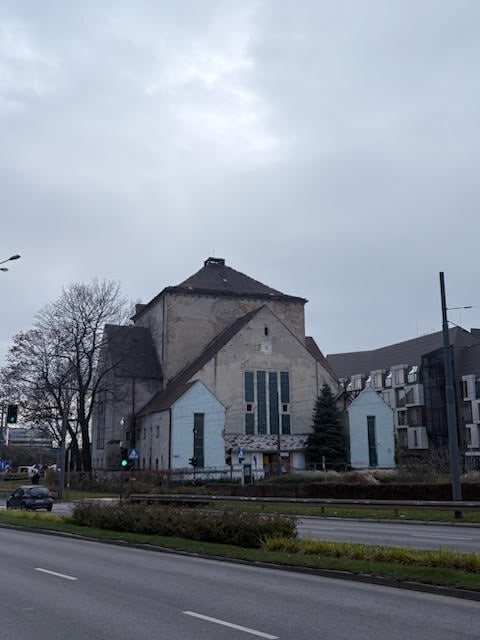
In other words: this enormous former synagogue-turned-pool is now, quite literally, a real-estate opportunity.
What do we owe to buildings like this?
This is not a uniquely Polish story. Across Europe and North America, religious buildings are being sold, repurposed, or left to crumble. The reasons are sometimes financial, sometimes demographic, sometimes political. Congregations move, shrink, age, dissolve. Roofs leak. Heating systems fail. Architects and developers step in.
From one perspective, this is normal. Cities change. Sacred spaces become secular and vice versa. One community’s center can become another’s shell.
From another perspective, something feels different when the building in question is not just any church or synagogue, but one marked by deliberate humiliation and erasure. A synagogue gutted by Nazis and filled with water for German soldiers is not simply “a former house of worship.” It is a crime scene with walls.
What do we owe to buildings like this once they enter the market? What obligations, if any, survive the change of ownership?
There are, broadly speaking, three familiar answers.
The first is: The market decides.
A building is a building; its value lies in its size, location, flexibility, and revenue potential. Heritage rules may add some constraints, but within that framework the job is to find the highest and best-paying use. The past is acknowledged with a plaque or a small exhibition room. Everything else is, as developers sometimes say, “sentiment.”
The second is: Turn it into a museum or memorial.
The building becomes a place of remembrance and education. Its economic logic is inverted: instead of generating revenue, it consumes it. It is justified not by return on investment, but by moral necessity.
The third is: Do nothing.
Out of fear of doing something wrong, or lack of funds, or political paralysis, the building is left in limbo. It deteriorates slowly until the next generation faces the same question, but with fewer options.
All three options have their place. The market will always act. Museums and memorials are sometimes the only ethical choice. Sometimes waiting is better than rushing into a bad solution.
But in cases like the New Synagogue of Poznań, each of these answers feels insufficient.
Treating it as just another development site with an interpretive panel in the lobby would be legal, but deeply unsatisfying. Demanding a stand-alone museum, without any realistic plan for sustainable funding, risks creating an institution that staggers from grant to grant and gradually hollowed-out programming. Leaving the building as an empty monument forever is not a plan; it is a postponement.
There is a deeper problem behind these unsatisfactory options. In the way we talk about buildings like this, we often assume that “memory” and “money” belong in separate boxes. Either we are serious about the past, in which case we must renounce economic logic, or we are serious about economics, in which case the past becomes a matter of interior design.
What if that were a false choice?
A proposal from inside the shell
I am not a neutral observer in this story. I live in Poznań. I walk past the building. I am Jewish. And like many Jews in Central Europe today, I live with a constant double exposure: the knowledge of what was here, and the reality of what is.
At some point, I realized that staring at the building and repeating, “Someone should do something,” was a form of emotional procrastination. So I tried to imagine, as concretely as possible, what “something” might be.
The idea that emerged is simple to state and difficult to execute:
Turn the building into a small, high-end heritage hotel whose business model structurally funds a serious Jewish museum and education center in the same building.
In practice, this would mean creating a non-profit foundation — call it the Heritage NSP Foundation, for New Synagogue Poznań — that acquires the building and holds it in trust. In its legal documents, the foundation would be bound to three obligations: preserve the historic shell in line with conservation rules; operate a museum and educational program focused on Jewish life in Poznań and the wider region; and ensure long-term funding for these functions.
The foundation would then partner with a reputable hotel operator to develop a roughly 60-room, five-star property inside the building. The hotel’s design would be contemporary and discreet. The main volume of the former synagogue — now the hall that once housed the pool — would not be filled with spa facilities or event stages. It would become a quieter, more contemplative space, a “hall of light and memory” connecting the museum and the hotel, open to guests and local visitors alike.
The key is that the relationship between the commercial and non-commercial parts of the building would not be left to goodwill. It would be written into the contracts and covenants. A fixed share of profits, or a long-term lease payment, would flow from the hotel operation to the non-profit side every year. That revenue would cover the museum’s operating budget and, over time, build a modest endowment.
In other words: every room night would help pay to keep Jewish history visible in a place where it was once deliberately effaced.
Is this a perfect solution? No. Is it the only ethical one? Of course not. But it has a few important virtues.
First, it accepts that economic reality is not an enemy of memory, but a condition for its survival. Instead of pitching a fragile museum against the “brutal” logic of the market, it harnesses a carefully regulated piece of that logic to support the institution.
Second, it treats the building as a living part of the city, not as a sealed-off relic. People would sleep there, eat there, talk there. They would see the exhibits not as a static graveyard of artefacts, but in the context of a functioning place.
Third, it creates a model that other communities might adapt. The exact numbers and partnerships would vary, but the principle — a covenant between capital and conscience embedded in the structure of ownership — could travel.
The unease we should keep
When I have described this idea to other Jews, the reactions have ranged from “this is brilliant” to “this is unbearable.” Both responses are valid.
There is something deeply uncomfortable about putting luxury beds and fine dining inside a building whose community was driven out and mostly killed. There is a risk of aestheticizing trauma, of turning a site of humiliation into a backdrop for Instagram. There is also a risk that, once the money starts flowing, the museum side will be gradually squeezed in favor of more lucrative uses.
That unease is not a bug. It is a feature.
If there were a way to “solve” the problem of this building without any discomfort, it would probably mean that we had evacuated the tension between past and present, between Jewish absence and non-Jewish life, a little too quickly.
I would rather live with a model that forces us to negotiate those tensions in the open, with clear rules and shared responsibility, than with a comfortable story in which everything is separated: memory in one building, money in another, Jewish history in a museum, non-Jewish reality everywhere else.
The alternative to taking that risk is not a morally pure utopia. It is, more likely, one of the scenarios we already know: a glorified loft conversion with a tasteful panel about “the rich multicultural heritage of our city,” or a small museum that struggles for breath in a corner of an enormous shell.
We do not have infinite time to make this choice. The building is for sale now. At some point, an offer will be accepted, plans will be drawn, scaffolding will go up.
A test case
I sometimes think of the former New Synagogue as a kind of test that history is giving us.
In one sense, the test is entirely local and practical. Can a small Jewish community, a city government, potential donors, and investors find a way to work together on something this ambitious without either trivializing or paralyzing themselves? Can they build an institution that will still be there in 50 years — not as a monument to our moral excellence, but as proof that we at least tried to take memory seriously as a structural concern?
In another sense, the test is larger. The building in Poznań is not unique. Across Europe, and not only in Europe, there are churches, monasteries, synagogues, mosques, and temples that have survived war and regime change and now sit in the crosshairs of the property market. Many of them carry painful histories. Many of them are too big for the communities that remain. Many of them are too expensive to maintain as they are.
If we can find a way to handle even one of these cases with a little more imagination — to design a future in which economic activity and ethical responsibility are tied together rather than peeled apart — we might learn something useful for the others.
The New Synagogue in Poznań no longer has its dome. The copper is gone. The silhouette is lower, less grand, more guarded. But the mass of the building is still there. The footprint is still there. The memory, even if it is underground or half-forgotten, is still there.
In painting, there is a moment when the canvas is almost complete and only a final, careful stroke remains. That last stroke does not change the drawing underneath, but it can change the entire mood of the work. It can turn a scene from hopeful to desolate, from ironic to sincere.
The synagogue that became a swimming pool is at that moment now. Its history is fixed. What is not fixed is whether we treat it as a heavy piece of real estate with an awkward story attached, or as a chance to write that story into the structure of its future.
Either way, the last brushstroke will be ours.