The Power and the Heartbreak of the Written Word
On Ringelblum’s milk cans, Anne Frank’s diary, and a grandmother who softened her story for the camera
There is a page I cannot stop thinking about.
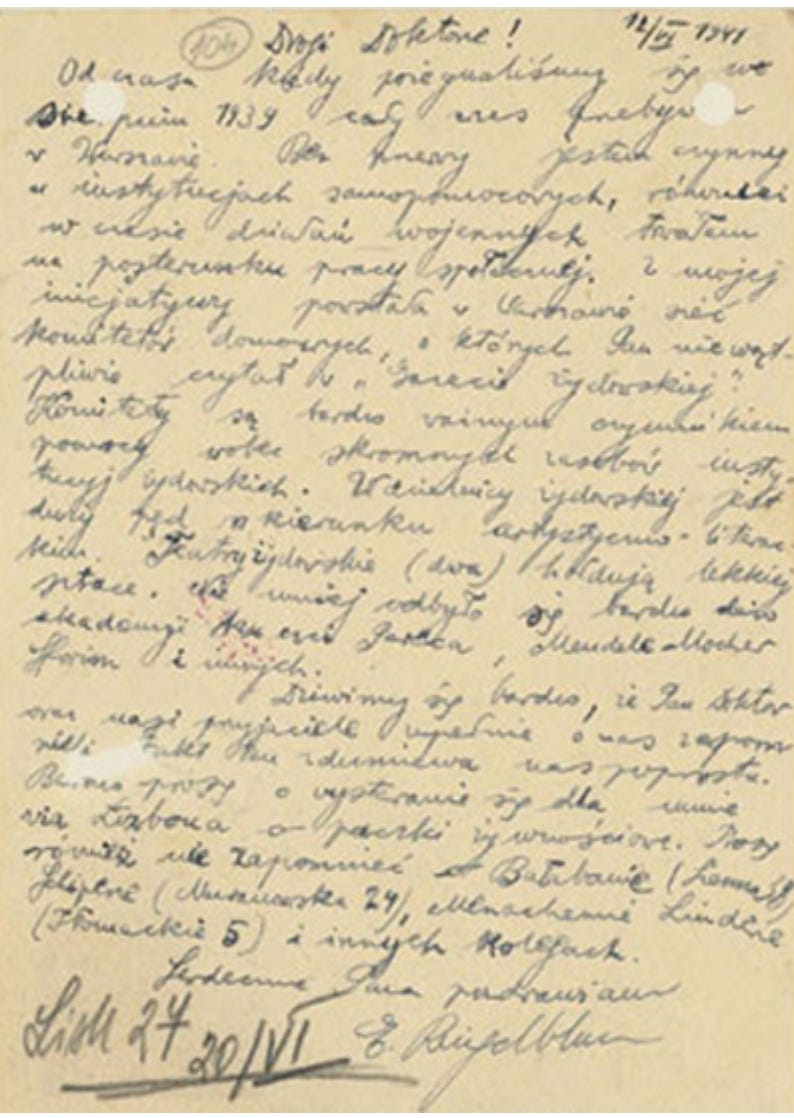
It is dated June 1941. Warsaw. The handwriting runs edge to edge across the paper, fast and controlled. There is much to say, and the world is closing. At the bottom is a signature: E. Ringelblum.
He is writing from inside the Warsaw Ghetto to a colleague in Geneva, reaching across the wall the Germans have built around his city, across the silence they are already imposing on his people, with the only thing he has left.
A pen. A page.
The act of writing it down so that someone, somewhere, will know.
FIVE YEARS LATER…
…men would pull something else out of the ground beneath the wreckage of a building on Nowolipki Street. Ten metal boxes and two milk cans, sealed with tar. Inside were thousands of pages like this one. Diaries. Drawings. Underground newspapers. Wedding invitations. Candy wrappers. Tram tickets. Recipes for what to make from potato peels. The last poems of Władysław Szlengel.
The man who buried them was Emanuel Ringelblum. He called the project Oyneg Shabbos, because they met in secret on Saturday afternoons to write down everything. What the Germans were doing. What the Jews were doing. What it smelled like in the streets. What a mother said to her child before they were taken.
Ringelblum knew what was coming. He knew his people were being erased. And he knew the murderers would try to erase the truth along with them.
So he and his collaborators made a vow:
We will write. We will bury what we write. And we will bury it in such a way that it will be found.
Most of them did not survive.
The archive did.
I think about this when I think about Anne Frank.
She is thirteen, then fourteen, then fifteen, writing in a diary she names Kitty. She writes about ordinary things—crushes, arguments, hopes for the future.
And then she hears a radio broadcast: after the war, diaries will be collected as evidence.
She begins rewriting her own. Not just keeping it, but shaping it.
She understands, with a clarity no child should have, that her words might be the only part of her that gets out.
Three weeks later, the Gestapo comes up the stairs.
I want to tell you what it is like to actually read these pages.
It is unbearable.
Not in the abstract. In the specific.
A schoolteacher records what her students wrote that morning. A man writes down the last joke he heard in a bread line. A child draws a cart used to collect bodies, and someone who knew that child’s name labels it in pencil and puts it in a box.
You read them and watch hope leave the page.
You watch a person understand what is happening to them, sentence by sentence, and decide to keep writing anyway.
This is the heartbreak of writing.
A person can be killed. A people can be killed. A city can be ground into dust.
But a sentence, written down and hidden well, can outlive the empire that tried to silence it.
Edna did not write it down.
She carried it.
She was a child of the Warsaw Ghetto. The youngest decorated soldier in the Polish Home Army. She survived. She came to America. She raised two sons. She danced at our wedding.
I knew her when she gave her testimony to the USC Shoah Foundation, and still she did not tell me what she had survived to get there.
The silence at home is not forgetting.
The silence at home is love.
She told someone else.
Edna sat for the USC Shoah Foundation and gave nearly five hours of testimony. She told a camera what she could not tell her family.
Later, she let her grandchildren record her too.
But what she gave them was different.
A softer version. A bearable version. The shape of a life with the worst of it held back.
Because she would not hand the full weight to a child she loved.
This is what the world does not understand about survivors like her:
The silence at home is not absence.
It is protection.
My job was not to write Edna’s story.
My job was to gather it.
To watch the five hours she gave to USC and listen to what she had never said in her own house. To place her brother’s testimony beside hers. To notice what she softened, what she withheld, and what she let slip in quieter moments. To match her memories to the historical record. To sit with what she kept.
And to sit with what she did not say.
Edna had her own archive.
Photographs. Documents. A book of poems by Szlengel. Objects carried out of a childhood that should not have been survived and kept for the rest of her life.
They were her vow.
I will not write it. I will not say it. But I will not let it go.
I wrote Little Edna’s War in her voice.
Not because I am the witness.
Because she was.
And because she could not say it all at once.
I am not Ringelblum.
I am not Anne.
They wrote from inside the fire.
I wrote decades later, in safety.
What I tried to do was simpler.
To take what Edna gave history, what she gave her family, what she held in silence, and set it down in one place.
To hand her voice forward.
Ringelblum wrote as the world collapsed around him.
Anne wrote as it closed in.
Edna survived, and chose silence for the people she loved.
The heartbreak of writing is that it cannot save the writer.
The power of writing is that it can save the story.
Six million is a number the mind cannot hold.
But a page can hold one voice.
And then another.
And another.
Until the silence breaks.
A life can be taken.
A voice can be silenced.
But a story, once carried forward, does not end.
Janet Bond Brill, PhD, is the author of Little Edna’s War, published January 27, 2026, on International Holocaust Remembrance Day. Order Now