
An Aging Jewish Feminist
The Power of Metaphors: Parshat Ha’azinu
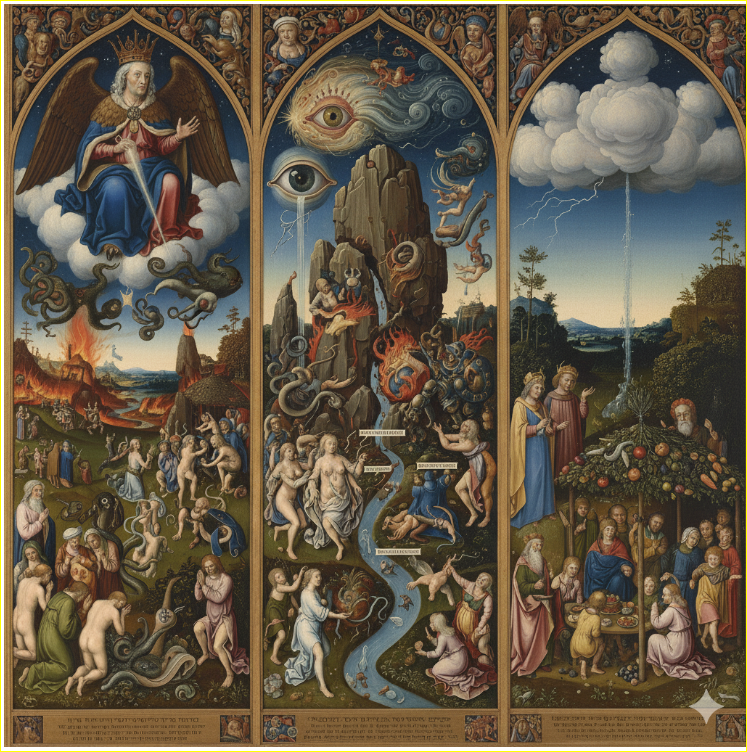
This shabbat we find ourselves between one holiday and the next! Between Yom Kippur, with all of its images of God as King and forgiving Father, and Sukkot, when we celebrate and sit outside in memory of the clouds that God provided for the people of Israel as a shelter, a gift of protection from the sun! Sometimes Parashat Ha’azinu is read before Yom Kippur on Shabbat Shuvah, and sometimes afterwards. This year it is read afterwards.
Deuteronomy 32, “The Song of Moses,” Parashat Ha’azinu, is filled with metaphors for God. In only forty-three verses, God is called Rock, Creator of the world, Warrior, Eagle, Father, Mother, Executioner, and Healer.
(4) The Rock, His work is perfect… a God of faithfulness, without injustice, righteous and upright is He.
(6) Is He not your Father, who created you, who made you and established you?
(11) Like an eagle who stirs up its nest, hovers over its young…
In sophisticated but powerful ways, these metaphors point both to God’s uniqueness and to God’s unknowability. As Moses claims, God is a personal God who gives life and death, who both wounds and heals.
(39) See now that I, I am He, and there is no god besides Me; I deal death and give life, I have wounded and I will heal, and none can deliver out of My hand.
Often God is depicted as an abusive spouse who strikes, seeks forgiveness, and then strikes again: He kills, revives, crushes, and heals!
Parashat Ha’azinu disturbs us with its extreme, contradictory images of the divine. Paradoxically, God is portrayed as both comforting and frightening: the eternal guardian of Israel, who in the end will redeem the people, and the jealous, judging deity who threatens vengeance against covenant-breakers.
The central theological metaphor of Ha’azinu is God as Rock:
The Rock, His work is perfect, for all His ways are justice; a God of faithfulness without injustice, righteous and upright is He.
No fewer than five times the text depicts God as Rock, in order to claim that God is absolutely reliable, free of injustice, the very basis of righteousness and justice. The image of God as Rock evokes associations with strength, refuge, and stability. God is faithful, says Deuteronomy 32, but Israel is definitely not! God is trustworthy, but Israel is unfaithful:
(5) His unworthy children have dealt corruptly with Him, a crooked and twisted generation.
When Moses imagines God as comforter, he uses the image of a perfect, immovable Rock. Commentators see this metaphor as a way of conveying that God’s justice and loyalty toward Israel are fixed and unchanging. Yet, in the context of the song, one could also argue that the metaphor envisions God as a cold stone, an inert, emotionless object incapable of entering into relationship with anyone or anything.
Although God is Rock, the support God provides is conditional: when the people betray or forget Him, they face harsh consequences:
(18) You ignored the Rock who bore you, and forgot the God who gave you birth.
(19) The LORD saw it, and was angered by the provocation of His sons and daughters.
So God hides His face from His unfaithful children:
(20) I will hide My face from them, I will see what their end shall be; for they are a perverse generation, children in whom there is no faithfulness.
(21) They have provoked Me with a no-god, angered Me with their idols. So I will provoke them with a no-people, with a foolish nation I will anger them.
The consequences of God’s wrath are extreme:
(22) For a fire is kindled in My anger, and burns to the depths of Sheol, devours the earth and its produce, and sets aflame the foundations of the mountains.
The structure of the song can be summarized as follows: Ha’azinu describes the rise and fall of God’s people. God finds Israel helpless—
(10) He found him in a desert land, in a howling wilderness; He encircled him, cared for him, guarded him like the apple of His eye.
God nurtures Israel with great attention, so the people flourish:
(11) Like an eagle that stirs up its nest, hovers over its young, spreading out its wings, taking them, bearing them on its pinions.
(12) The LORD alone guided him; no foreign god was with him.
(13) He made him ride on the heights of the land, and eat the produce of the field. He nourished him with honey from the rock, and oil from the flinty stone.
Then Israel abandons God, runs after other deities, and forgets its origins, provoking God’s fury. Israel is punished for its sins, and at the end returns.
God is faithful, but divine blessings are conditional on Israel’s faithfulness. If Israel grows arrogant and assertive, it will pay a heavy price. God supports and loves His people, but He is also their judge. Another message of our parashah: God cannot be fully understood.
Perhaps it is time to reimagine our relationship with God. Instead of describing Him as Rock or Warrior, King or Husband, we might describe God as a parent holding us in caring arms, who feels our pain. We must begin to change how we describe God. We need not rely on the metaphors of our ancestors. We must seek metaphors of our own that depict God in mercy and compassion, not in wrath.
There are, in fact, metaphors in the song that point in this direction—for example, when Moses speaks of God as a mother giving birth and nursing:
(13) He fed him honey from the rock, and oil from the flinty stone.
(18) You neglected the Rock who bore you.
But ultimately, the main problem lies with the anthropomorphic images that describe God as a human being. Perhaps it is time to wean ourselves off images of God as a personal, masculine figure. We need fresh metaphors for the divine.
The poet and liturgist Marcia Falk has created new images drawn from traditional Jewish sources, built out of the elemental foundations of creation (earth, water, wind, and fire): “Eye of life,” “Wellspring of life,” “Breath of all living,” and “sparks of the soul, the unseen inner self.” Through these images she hopes “to help construct a theology of immanence that affirms the holiness of the world and shatters the transcendental lordship of the Master / God / King.”
So what can we learn from Ha’azinu? How does it speak to us today? How can these images lead us toward greater responsibility?
In its announcement of punishment destined for Israel’s enemies, the text says:
(32) Their vine is from the vine of Sodom, their fields from Gomorrah.
Through this metaphor, the song depicts other nations as corrupt and foretells their doom. This reminds us of the time God threatened to destroy those very cities, and Abraham protested in Genesis 18:
(25) Far be it from You to do such a thing—to slay the righteous with the wicked, so that the righteous fare as the wicked! Far be it from You! Shall not the Judge of all the earth do justice?
Perhaps Ha’azinu can be read as an invitation to us to act like Abraham, to protest against indiscriminate destruction. It is an opportunity for direct dialogue and for big questions such as: Where is Your compassion, God—not only for us but for all Your creation? Why terrify us with threats? Will such threats actually turn us away from other gods? Or will they lead us to reject You altogether? Such questions express what it means to be true partners, ready to argue and defy God.
Thus, beyond protest against what we see as unacceptable, this parashah can push us to examine: who is our God? And it can remind us of what is required to build a just society and sustain covenantal relationships.
The same power that God used to bring us out of Egypt—the mighty hand and outstretched arm—is also the hand and arm that sometimes strike us down. This is not the God we would choose to worship. And if God does not repent, then perhaps our partnership must come to an end. What we need today is a theology of protest and ongoing suspicion. We must constantly defy images of God as violent, jealous, and abusive. New interpretations allow us—indeed compel us—to act as mediators between ourselves and our sacred texts, just like the cloud that shielded us from the sun during Sukkot.
Shabbat shalom and chag sameach!
Related Topics