
Russian-American-Israeli Palestinian. Palestine is Israel.
The Power of Self-Selection
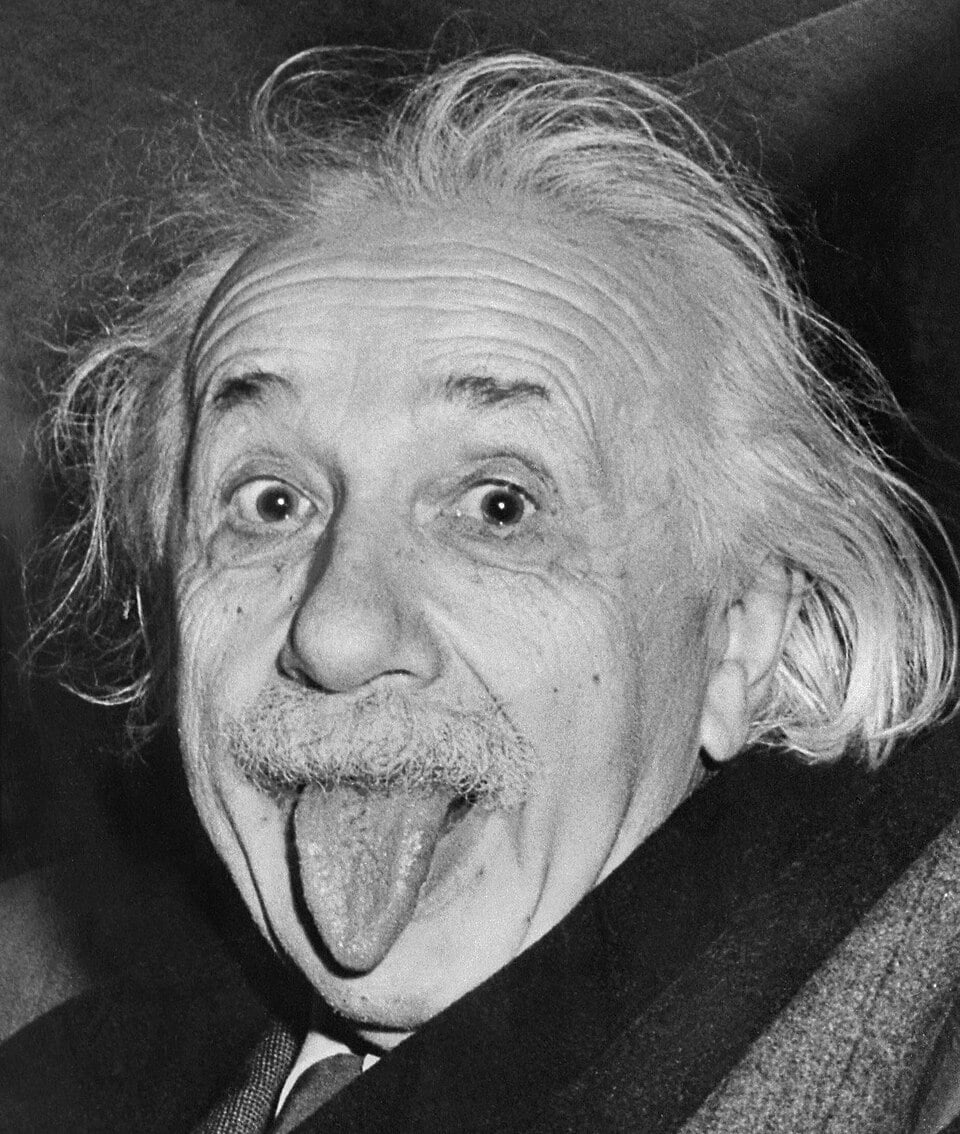
Perhaps self-selection is one of the most overlooked forces in human history. Photo: Albert Einstein sticking his tongue out for photographer Arthur Sasse after his 72nd birthday party on March 14, 1951. Public domain. Source: Wikimedia Commons.
The Hidden Force Behind Success
Why are Jews disproportionately represented among Nobel Prize winners, scientists, entrepreneurs, and intellectuals?
Why did America become the world’s dominant economic and technological power?
Why did Israel transform itself from a poor, newly established state into one of the world’s most innovative economies in just a few decades?
These questions have generated countless explanations.
Some focus on culture.
Others emphasize institutions.
Still others point to geography, economics, or genetics.
Most of these explanations contain elements of truth. Yet I cannot help wondering whether they all overlook a deeper and more fundamental force hiding in plain sight.
What if the key factor is not only what these societies became, but who became part of them?
The Traditional Explanations
Consider the question of Jewish success.
The usual explanations are familiar.
Jewish culture places an extraordinary emphasis on education. Jewish children are encouraged to study. The tradition of Talmudic debate develops analytical thinking and intellectual rigor. Historical restrictions pushed Jews into professions requiring literacy, numeracy, and adaptability.
Some researchers have also explored genetic explanations, treating inherited variation as one possible factor among many in long-term population outcomes.
These explanations are not unreasonable. Taken together, they describe important aspects of how Jewish intellectual traditions and social patterns developed over time.
Yet a deeper question remains.
Why did Jewish culture itself become so resilient?
Why were these traditions preserved across centuries while many other cultures changed dramatically or disappeared altogether?
Why did Jewish identity survive repeated waves of persecution, expulsion, forced conversion, and assimilation?
Now consider America.
The standard explanations are equally familiar.
America benefits from favorable geography, abundant natural resources, a large internal market, strong institutions, constitutional protections, and a culture that rewards entrepreneurship and innovation.
Again, all of these factors matter. They help explain how the system functions and why it produces certain outcomes.
But they describe what happens after the system is in place.
Who were the people willing to leave everything behind, cross oceans, and begin entirely new lives in an unfamiliar land?
Finally, consider Israel.
The explanations usually include education, military necessity, entrepreneurship, technological innovation, and national resilience.
These factors are real.
But they do not fully explain the remarkable achievements of a nation that began under extraordinarily difficult conditions.
A different question emerges.
Who were the people willing to abandon familiar lives, often under difficult and uncertain circumstances, and start over in a land that was still in the process of becoming a state?
Some came out of ideology. Some came out of necessity. Some came because they were expelled. Some came because they believed in Zionism. Yet all became part of a society built by people willing—or forced—to leave one world behind and create another.
Looking at the Wrong End of the Process
Perhaps we have been looking at these questions from the wrong direction.
Most explanations focus on what happened after a population formed.
We should instead ask who became part of the population in the first place.
This brings us to an idea that economists, sociologists, and statisticians know well: self-selection.
Self-selection occurs when membership in a group is not random.
The people who join a group differ systematically from those who do not.
The consequences can be profound.
Consider Silicon Valley.
The engineers, entrepreneurs, scientists, and investors who live there are not a random sample of humanity.
Nor are they even a random sample of Americans.
They are a selected population.
Some arrived because of exceptional ability.
Others because of ambition, persistence, risk tolerance, education, opportunity, or simple luck.
Whatever the reasons, the result is the same: Silicon Valley contains a concentration of people who differ systematically from the much larger population from which they emerged.
This is self-selection.
Most observers would not find this surprising.
Yet we rarely apply the same logic to entire peoples and nations.
Now imagine a similar process operating not over years or decades, but over centuries.
Some assimilate.
Some preserve their identity.
Some stay.
Some leave.
Some take enormous risks.
Others choose stability.
At that scale, patterns begin to emerge.
Selection becomes visible.
The Jewish Selection
For much of history, Jews repeatedly faced difficult choices.
Convert or remain Jewish.
Assimilate or preserve a distinct identity.
Stay and endure persecution or leave everything behind and start over elsewhere.
Many chose assimilation.
Many converted.
Their descendants largely disappeared into surrounding populations.
The people who remained Jewish became the ancestors of today’s Jewish communities.
The point is simple.
The population was not random.
Over centuries, Jewish communities were continuously shaped by people willing to preserve a distinctive identity despite significant costs.
Whether driven by faith, family loyalty, resilience, long-term thinking, stubbornness, courage, genetic predispositions, or any combination of cultural and inherited factors, the process itself was selective.
The descendants of those who repeatedly chose persistence are the Jews of today.
Selection may also have operated within Jewish communities themselves. In cultures that placed exceptional value on scholarship and learning, educated and intellectually accomplished individuals often enjoyed high social status. Families frequently sought such qualities in marriage partners, potentially creating another layer of non-random selection over generations.
If preserving Jewish identity shaped who remained within the community, social preferences may also have helped shape which traits were rewarded within it.
The American Selection
America may represent another powerful example of self-selection.
For centuries, millions of people voluntarily left their homelands to pursue uncertain futures.
Crossing an ocean was not a decision made by random individuals.
It required initiative.
It required optimism.
It required tolerance for risk.
It required a willingness to abandon familiar surroundings and embrace uncertainty.
The people who came to America were often selected long before they arrived.
This pattern continues today.
Consider Indian Americans, one of the highest-earning ethnic groups in the United States.
Does this mean that all Indians possess exceptional economic potential?
Not necessarily.
A more straightforward explanation is that immigrants represent a highly selected subset of India’s enormous population.
The people who successfully immigrate often possess unusually high levels of education, ambition, persistence, and willingness to take risks.
Whether these qualities arise from culture, genetics, or some combination of both, they make immigrants a highly selected subset of the populations from which they originate.
The immigrant population is not a random sample.
It is a filtered population.
The Israeli Selection
Israel may represent the intersection of two separate selection processes.
The first is the Jewish selection process that unfolded over centuries.
The second is Zionism.
The pioneers who left established lives to build a homeland in Ottoman and later Mandatory Palestine were not average members of their communities.
They accepted hardships that many others were unwilling to endure.
They drained swamps.
They established farms.
They built institutions.
They defended settlements.
They transformed an aspiration into a state.
Once again, the population was not random.
The people willing to undertake such a project were not randomly chosen from the populations from which they came.
Israel inherited both layers of selection.
The persistence of Jewish history and the pioneering spirit of Zionism converged in the same society.
Culture, Genetics, or Self-Selection?
Whenever discussions like this arise, people often assume there are only two possibilities.
Either success is explained by culture.
Or it is explained by genetics.
But what if both sides are focusing on the wrong question?
Families pass down both culture and inherited traits.
Parents transmit values, expectations, habits, and traditions.
They also pass on biological variation that may influence intelligence, ambition, persistence, risk tolerance, and countless other characteristics.
These influences interact continuously and are often impossible to disentangle.
Yet regardless of where such differences originate, they do not remain evenly distributed across populations.
Self-selection acts as a filter.
People make choices.
Some migrate.
Some stay.
Some assimilate.
Some preserve their identity.
Some pursue uncertain opportunities.
Others prefer stability.
Over time, these choices reshape populations.
The result is that culture and genetics may help explain variation among individuals, while self-selection helps explain why populations themselves come to differ from one another.
In that sense, self-selection is not necessarily an alternative to culture or genetics.
It is the mechanism that acts upon them.
The key observation is that populations are not static. They are shaped by countless individual decisions accumulated over generations.
Self-selection works in the opposite direction as well. When some individuals leave, others remain. When some preserve their identity, others assimilate. Over time, differences between societies are shaped not only by who moves into certain populations, but also by who does not. The same filtering process that concentrates certain traits in one place can, by definition, also deplete them elsewhere.
The Hidden Force
History is often told through the lens of geography, economics, institutions, culture, and technology.
But before any institution exists, before any culture develops, before any economy grows, there is a population.
And populations are not always random.
They are shaped by countless decisions accumulated over generations.
Who stayed.
Who left.
Who assimilated.
Who persisted.
Who crossed oceans.
Who started over.
Who built something new.
The success of Jews, America, and Israel may not be explained solely by what those societies became.
It may also be explained by who became part of them.
Perhaps self-selection is one of the most overlooked forces in human history.
Related Topics
Related Posts