

Truth Seeker
The Power of We: Inside Tel Aviv’s Anu Museum of the Jewish People
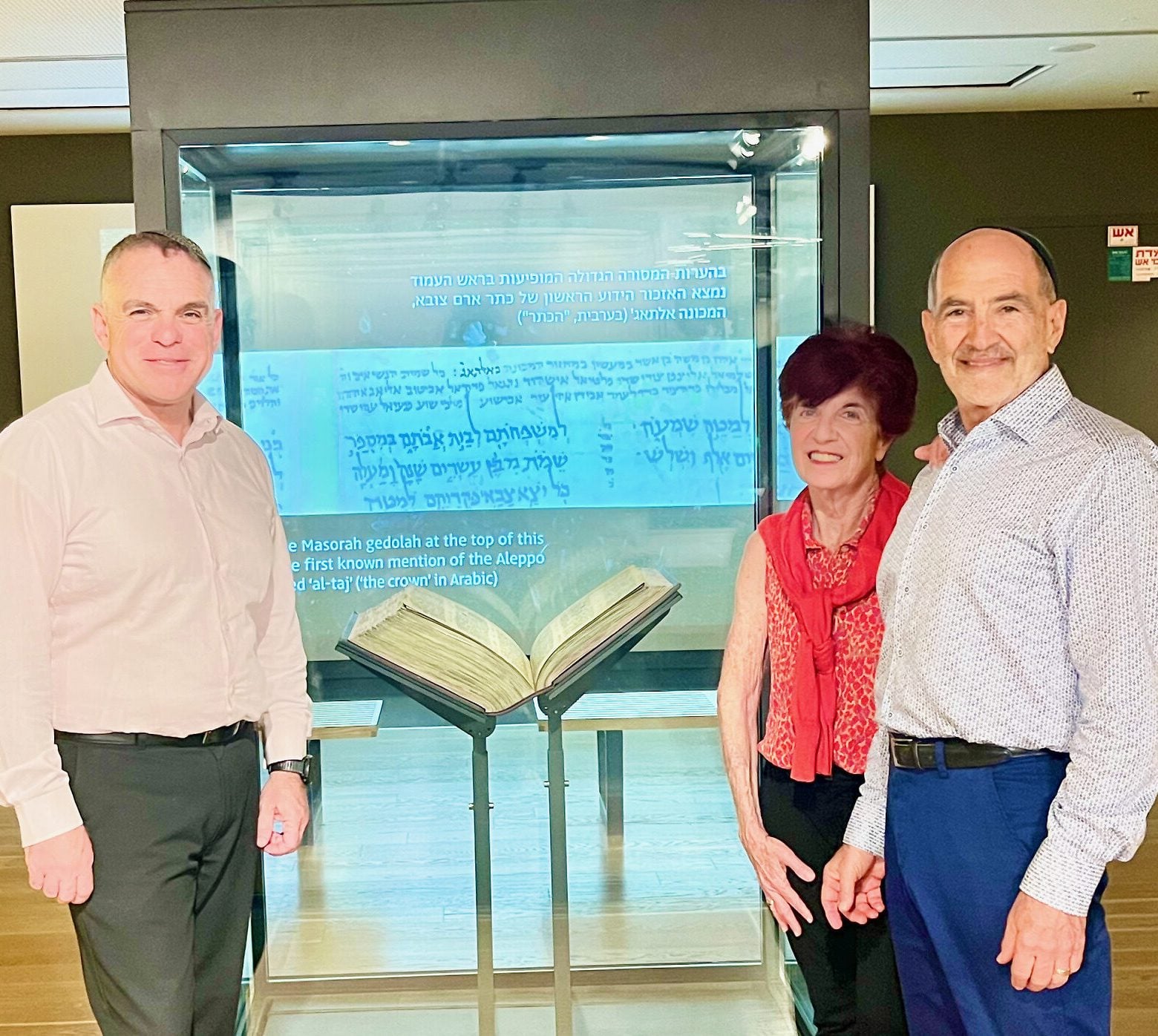
Karen and Marc Rivo standing beside the Codex Sassoon with ANU's CEO Oded Revivi
After voting in Israel’s election, Karen and I headed to ANU for a healthy dose of unity. Tel Aviv’s breathtaking Anu – Museum of the Jewish People portrays our proud history and global impact.
We are ANU. In 2021, after a monumental, $100 million, decade-long transformation engineered by its visionary Board Chair, Irina Nevzlin, the museum evolved into a breathtaking, interactive, high-tech and high-touch celebration of Am Yisrael. The museum added ANU – Hebrew for “we” – as its new brand identity, in Chair Nevzlin’s words, “to embrace inclusion and reflect the diversity and collective spirit of the Jewish people everywhere.”
Karen and I were so completely mesmerized by our first walk through ANU’s high-energy galleries that six hours evaporated before we noticed the museum was closing.
Our latest visit was extra special. We witnessed a miracle of Jewish historical survival, and we met the museum’s CEO, Oded Revivi.
ANU CEO Oded Revivi. Sitting down with Oded, we saw firsthand how the intricate threads of his life mirror the core mission of this vital museum he now leads. Oded was born in Israel, raised during his parents’ years as Israeli “shlichim” (emissaries) in America and Britain, and served as a tank battalion commander and attorney in the IDF. His wife Lisa made Aliyah from Manchester, England, He served for fifteen years as the popular Mayor of Efrat in Judea, building bridges with his Palestinian neighbors and within our diverse Jewish family. He served as the pragmatic, diplomatic face of the Yesha Council, representing Judea and Samaria communities to Washington and the global press.
From his life experiences, Oded understands the diverse perspectives, strengths and tensions within Israeli society and with the Diaspora. He describes the sacred relationships between Israel and the Diaspora with rare intimacy. He understands how to hold the complex and rich tapestry of our Jewish world together.
Oded stepped into the role of CEO in late 2024, at a time when the ground beneath our feet was still shaking. Following October 7th, 2023, while serving as Efrat Mayor, he watched five of his six children in the IDF defending our Jewish homeland. Oded himself is an active army reserve officer.
October 7th left a lot of shattered beliefs and broken hopes,” Oded told us as we discussed the worrisome surge of global anti-Israel and Jewish hatred, and the divisions within our people. “It also catalyzed a profound transformation. All of a sudden, we were seeing a massive wave of ‘October 8th Jews’—people worldwide who were disconnected from their heritage, who suddenly woke up to the realization that a coordinated global campaign was targeting them simply for who they are. The challenge of ANU today is to help us come out of this period stronger and more united as the Jewish people by celebrating our diversity and building on a shared sense of identity.”
The Codex Sassoon. One visible example of our shared identity sits securely on the museum’s main floor. Inside a climate-controlled glass case is the Codex Sasson, the oldest, most complete Tanakh -the acronym for our 24 sacred books of Torah, Prophets, and Writings – in existence, On sheepskin parchment in the late 9th or early 10th century, some 1,100 to 1,150 years ago, a master scribe in Syria wrote our history.
The story of its journey to ANU is nothing short of a miracle. The Codex Sassoon disappeared for over 500 years before it was rediscovered, still intact. The final chapter of its extraordinary journey of survival to its rightful home in Israel, was made possible through a $38 million donation by Ambassador Alfred Moses on behalf of the American Friends of ANU. The Codex was flown to Israel in October 2023 inside the captain’s cockpit of an El Al jet, touching down on October 5th. Then came October 7th.
As the nation descended into war, the Codex Sassoon was rushed into a fortified underground vault. It remained hidden for 20 months while Israel fought for its survival. In May 2025, just before Shavuot, the Codex finally emerged into the light.
Standing before those ancient, beautifully preserved pages, opened to the receiving of the Ten Commandments from Parashat Yitro, the true weight of our current historical moment becomes crystal clear. The Codex Sassoon – our story – survived the collapse of empires, the burning of ancient synagogues, and the destruction of its Syrian city of origin.
Oded observed, “The Sassoon Codex is the soundtrack of our Jewish history.” Tyrants try to destroy us. Bigots try to redefine us. Yet, our history and identity is written clearly and directly onto the ancient parchment of the Codex. We are an ancient tribal group that has survived and thrived with our shared history, homeland, teachings, and religion, which is practiced through a beautiful tapestry of different traditions.
ANU – We are Am Yisrael. In Hebrew, we use one word to describe who we are. It is “Am”—as in Am Yisrael – a global Jewish family with Israel as our eternal homeland. A family does not require absolute political agreement or identical religious practices. A family respects and celebrates our shared history. And stands together.
Today, in the face of Israeli-Jewish hatred, ANU’s message of “we are the people of Israel” with our shared history and destiny, has never been more vital. After touring ANU, IDF Chief of Staff Eyal Zamir said he wanted to make it mandatory training for Israel’s combined armed forces. Today, you see many soldiers walking through the exhibits.
The Codex Sasson teaches us “Am ha’netza, lo mefached mi’derech aruka”. “ The Eternal People are not afraid of a long journey.” ANU reminds us that our shared history is the anchor that prevents us from being swept away by the storms of the present. On your next trip to Israel, cross the threshold of ANU and step into the majestic world of Am Yisrael. You will feel the unity and pride of who we are.