Practical Spirituality - Slow and Steady
The Priestesses of the Covenant
Sarah, Rivka, Rachel, Leah—and the Hidden Mothers—as the Architecture of Israel’s Destiny
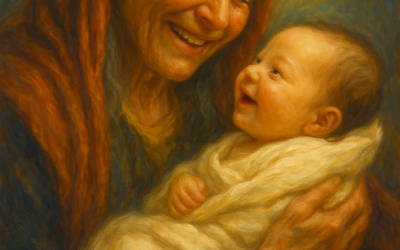
A Tent That Became a Temple
“Behold, she is in the tent.”
When the Torah says this of Sarah (Genesis 18:9), it’s not describing modesty. It’s describing mystery.
Her tent is a temple. Midrash says that while she lived, her lamp burned all week, her dough was blessed, and a divine cloud hovered above her tent — signs that later reappeared in the Mishkan.
Abraham stands outside, greeting travelers, negotiating with kings, pleading for Sodom. Sarah guards the inner sanctum. Together they embody the balance that all Jewish life depends on: he brings holiness into the world; she keeps holiness in the world.
Abraham is the king — outward order, justice, hospitality.
Sarah is the priestess — inward sanctity, presence, continuity.
Without him, holiness is abstract. Without her, it disappears.
Rivka: Restoring the Flame
When Sarah dies, Isaac’s world goes dark. Then Rivka enters his life — and the Midrash says the miracles return: the lamp again burns from Shabbat to Shabbat, the dough again blesses, and the cloud again rests upon the tent.
Isaac recognizes not imitation, but restoration.
Rivka’s holiness is not passive; it’s perceptive. She sees through the masks of her sons and acts decisively to keep the covenant aligned with truth.
If Sarah preserved the Presence, Rivka discerns its direction.
She becomes the mother of judgment — the balance between awe and understanding, form and feeling.
Jacob and the Expansion of Holiness
By Jacob’s generation, the covenant can no longer be held in a single vessel. Holiness now needs plurality.
Rachel, Leah, Bilhah, and Zilpah each carry part of the divine plan, and together they give birth to twelve tribes.
That inclusivity is radical. The children of handmaids — Dan, Naphtali, Gad, and Asher — stand shoulder to shoulder with those of Rachel and Leah. All inherit equally.
Holiness is no longer hierarchical.
It can dwell in rivalry, imperfection, even heartbreak.
God’s Presence now moves through a constellation of tents, not one.
Leah gives us priesthood and kingship. Rachel gives us beauty, longing, and redemption. Bilhah and Zilpah — the “secondary” mothers — reveal that God’s spirit fills the margins just as powerfully as the center. The covenant is now wide enough for the imperfect and the overlooked.
The Paradox of Descent
In Genesis, lineage runs through the father — Abraham, Isaac, Jacob.
But the feeling of covenant — the sense of belonging to God — runs through the mother’s tent.
When the Temple stood, the father’s house gave form.
When the Temple fell, the mother’s lamp kept the flame alive.
That’s why, in exile, Jewish identity followed the mother. The law merely formalized the inner truth already known to Sarah: Presence is matrilineal.
The father provides the framework; the mother preserves the light; and the concubine — the hidden or marginal vessel — provides space for holiness to expand.
This threefold structure — form, presence, and space — becomes the spiritual DNA of Israel.
From Tent to Nation
Sarah’s miracles became the Mishkan’s design:
- The lamp became the Menorah.
- The blessed dough became the Showbread.
- The hovering cloud became the Glory of God.
The matriarchal priesthood didn’t vanish — it scaled.
Miriam’s well carried the Presence through the desert.
Women’s mirrors became the laver of purification.
Hannah’s prayer modeled the Amidah.
Ruth brought Moab into the covenant.
Bathsheba taught kings repentance.
Every generation of women continued Sarah’s work: keeping God close through intimacy, discernment, and endurance.
Hagar and the Widening of Covenant
Even Hagar, often seen as outside the covenant, teaches something essential.
The covenant first narrows — Abraham to Isaac, Isaac to Jacob — so that it can eventually widen without losing shape.
Exclusion was temporary; inclusion is destiny.
By Jacob’s time, holiness is no longer afraid of complexity.
The divine Presence now thrives in a family that includes rivals, half-brothers, and mothers from every rung of the social ladder.
God’s covenant is not about purity of birth but about capacity for presence.
The Equal Share
When the tribes enter the land, the equality is astonishing.
The sons of Rachel, Leah, and the handmaids all receive land. Each tribe different, none lesser.
Israel’s unity is not uniformity — it’s choreography:
different roles, one movement; different banners, one march; different mothers, one Father in Heaven.
From Genesis to Today
In exile, the matriarchal lamp became the soul of Jewish continuity.
The home replaced the Temple. The Shabbat candles replaced the Menorah. The table replaced the altar.
Every Jewish mother became a priestess of presence.
And in our modern return, we rediscover that ancient geometry:
We are a single people made of many mothers and many tribes.
Orthodox, secular, mystic, rationalist — all sparks from the same flame.
Jacob’s family was complicated, and so are we. But the Presence that filled his tents still hovers over ours — whenever we light, bless, and make space for God in our lives.
Coda: The Embryology of a People
The growth of the Jewish people mirrors the growth of a human being.
It began with one embryonic couple — Abraham and Sarah — whose union contained the spiritual DNA of a nation.
Like a living organism, Israel expanded cell by cell:
from one tent to twelve tribes, from families to kingdom, from kingdom to exile and return.
- Abraham and Sarah were the seed.
- Isaac and Rivka, the first heartbeat.
- Jacob’s tents, the spine.
- The tribes, the organs.
- The nation of Israel, the full-grown body.
And though time stretches the limbs and exile scatters the cells, the soul remains whole — still glowing with the same lamp that once burned in Sarah’s tent.
The covenant is alive.
It breathes through every Jew who carries the light forward — in prayer, in justice, in laughter, in love.
© 2025 Jeff S. Turtletaub (“Micha”)
Turtle Island Torah Commons | turtleisland.studio
Related Topics
Related Posts