
The Principal Risk of Hantavirus Lies in Its Long Incubation Period
An unprecedented outbreak at sea
On April 1, 2026, the polar cruise ship MV Hondius departed Ushuaia, Argentina, bound for Antarctica and remote Atlantic islands. Nearly 150 passengers and crew of 23 nationalities were on board. On April 11, a 70-year-old Dutch citizen died aboard. His wife, also infected, died in South Africa on April 26. On May 2, a German woman died on the vessel.
What began as an isolated incident on a vessel now reaches more than twelve countries across four continents. Thirty passengers disembarked at Saint Helena on April 24, ten days before the WHO confirmed the hantavirus outbreak on May 4. The Dutch government puts that figure closer to 40. Health authorities are tracing citizens in the Netherlands, Germany, the United Kingdom, Switzerland, France, Canada, Singapore, the United States, South Africa, and Argentina, among others.
As of May 7, the World Health Organization reports eight cases linked to the outbreak: five confirmed and three suspected, with three deaths. On May 6, health authorities confirmed the virus was the Andes strain, the only hantavirus with documented human-to-human transmission. The ship is sailing toward Tenerife, Spain, expected to arrive this weekend.
Science magazine described the episode as “uncharted territory” for researchers. Until this outbreak, no documented hantavirus cluster had occurred at sea.
What hantavirus is
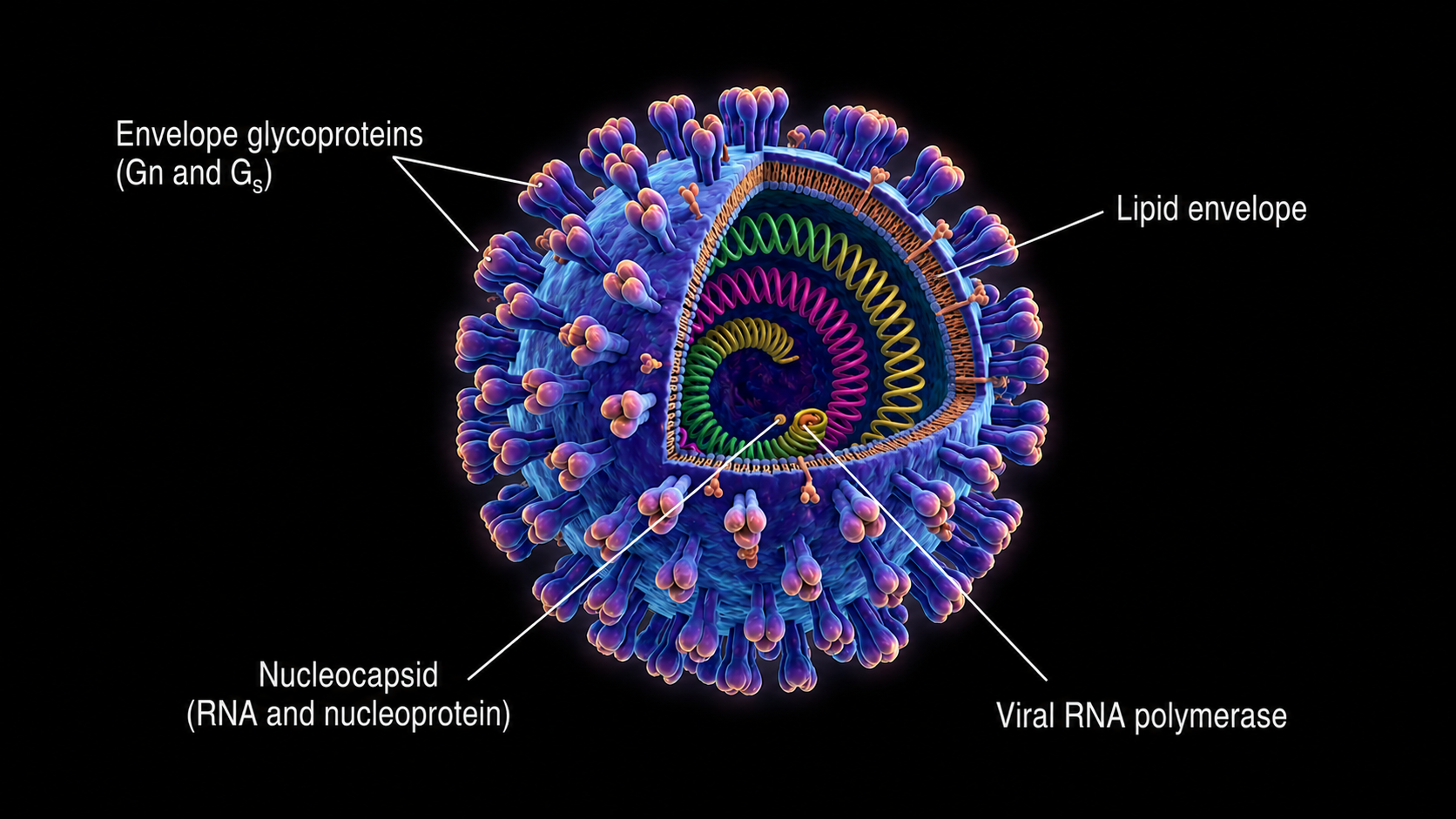
Hantavirus belongs to the family Hantaviridae, within the order Bunyavirales. It is a single-stranded, negative-sense RNA virus with a segmented genome encoding the nucleocapsid, surface glycoproteins, and viral polymerase. Old World hantaviruses, present in Asia and Europe, cause hemorrhagic fever with renal syndrome (HFRS). New World hantaviruses, present in the Americas, cause hantavirus cardiopulmonary syndrome (HCPS). The Andes virus belongs to this second group and is endemic to cordilleran regions of Argentina and Chile.
The natural reservoir is the sigmodontine rodent Oligoryzomys longicaudatus. Transmission to humans occurs principally through inhalation of aerosols from dried rodent excreta in enclosed or semi-enclosed spaces. The Andes virus carries an unprecedented feature among hantaviruses: it can transmit from person to person, but only under conditions of extremely close and prolonged contact, such as sharing a bed, sexual intimacy, or direct caregiving.
The incubation period ranges from 7 to 39 days, with a median around 18 days. The disease evolves in two phases. A prodromal phase of three to five days presents with fever, chills, myalgia, and gastrointestinal symptoms. The cardiopulmonary phase begins abruptly with cough, dyspnea, and rapid hemodynamic deterioration, leading to pulmonary edema, acute respiratory distress syndrome, cardiogenic shock, and multiorgan failure in severe cases.
Historic mortality from Andes virus ranges between 30 and 40 percent, with higher figures in patients without timely access to intensive care. No specific antiviral is approved for HCPS. Ribavirin has shown no utility. Management remains supportive: mechanical ventilation, hemodynamic support, and, in centers with access, extracorporeal membrane oxygenation (ECMO). No commercial vaccine exists.
Where exposure likely occurred
On May 6, Argentina’s Health Ministry published the index patient’s complete itinerary: the Dutch couple spent four months traveling through Argentina, Chile, and Uruguay on a bird-watching trip before boarding the ship. They arrived in Argentina on November 27, 2025, spent 40 days driving through the country, entered Chile on January 7, 2026, crossed to Uruguay on March 13, and returned to Argentina on March 27, boarding the ship on April 1.
Tierra del Fuego, where Ushuaia is located, has never recorded a confirmed hantavirus case since mandatory epidemiological notification began in 1996. The known endemic zones for Andes virus concentrate in the Andean regions of Neuquén, Río Negro, and Chubut in Argentina, and in southern Chile.
Calculating backward from symptom onset around April 6 through the documented 7-to-39-day incubation range, the most probable exposure window spans late February through mid-March. By elimination, the exposure occurred in southern Chile. The four-day final stay in Argentina before boarding falls within the minimum incubation window and lies outside the endemic zones. Uruguay sits within the temporal window but lacks documented Andes virus circulation. Chile alone satisfies both the biological window and the ecological prerequisite. Their incubation period was at least 24 days, calculated from the day they left Chile to symptom onset, and possibly longer if exposure occurred earlier in their Chilean stay. Either way, this exceeds the standard 14-day quarantine window still applied by many national authorities.
Why pinpointing location matters epidemiologically: the distribution of virus-contaminated rodent material is dynamic and spatially dependent. Oligoryzomys longicaudatus maintains variable population densities across seasons and years.
The contamination of a specific hiking trail or bird-watching site depends on where precisely the index patients ventured and when the rodent population in that microhabitat was at risk of shedding. If the couple visited a particular excursion site in southern Chile, knowing which one becomes crucial for understanding whether the virus may still be present in that location, whether other travelers face ongoing exposure risk, or whether the site’s rodent ecology has shifted.
But without exact coordinates of their daily excursions, reconstructing the precise exposure source becomes nearly impossible. What public health investigators can do, however, is bracket the geographic and temporal window. The Andean cordillera region between Chile and adjacent Argentine endemic zones, during late February to mid-March, defines that bracket. Greater precision may remain unattainable.
What matters epidemiologically is that the index couple traveled internationally for four months, became infected during the final weeks of that trip, and boarded the ship while still asymptomatic or in very early prodrome. The infectious window of Andes virus is concentrated in the prodromal phase, particularly the first day of fever, as documented in the 2018-2019 Epuyén outbreak in Argentina (Alonso et al., NEJM 2020). Whether the couple transmitted to others before boarding remains unknown. What is documented is the dispersal that followed: the index case died on April 11, ten days after boarding. By April 24, thirty passengers disembarked at Saint Helena, scattering across at least twelve countries before the WHO confirmed the outbreak.
Transmission beyond the household
Secondary transmission of Andes virus has historically been documented in household and healthcare contexts. But this outbreak reveals transmission in settings previously less emphasized. The ship’s doctor, who attended the index patient without full protective equipment, became infected. He did not live with the patient. He visited clinically. This is consistent with healthcare worker risk, but it demonstrates that transmission occurs in occupational medical contexts, not solely in intimate household settings.
More strikingly, the Dutch health ministry announced on May 7 that a KLM flight attendant who had contact with the deceased Dutch woman during boarding of a Johannesburg-Amsterdam flight on April 26 is now symptomatic and hospitalized in isolation. The passenger was removed from the aircraft before takeoff due to clinical deterioration and died in South Africa hours later. If confirmed, this would represent the first documented infection in a person who never boarded the MV Hondius, with transmission occurring during brief contact in an aircraft cabin rather than sustained proximity.
The virus does not require a household to spread. Historically, transmission was documented under prolonged close contact: shared beds, sexual intimacy, direct caregiving. A confirmed KLM case would lower that threshold significantly. Brief proximity in a confined cabin would have sufficed for transmission. The implications would extend beyond cruise ships to any setting where an infected person sheds virus near others, even briefly: a clinic, an airplane, a waiting room. Until laboratory confirmation arrives, this remains a hypothesis raised by an alarming clinical presentation, not an established epidemiological fact.
The incubation period as epidemiological vector
Here lies the principal epidemiological risk of Andes virus in a globally connected world. The incubation period does not follow a predictable timeline. This variability creates a dual epidemiological threat that standard analysis often misses.
Consider first the shorter end. The ship’s doctor, who attended the index patient without sustained proximity, became infected. The KLM flight attendant, exposed briefly in a cabin on April 26, is now symptomatic on May 7. Only 11 days later. This is incubation at the rapid end of the spectrum. Infected individuals show cardiopulmonary symptoms while still in transit or immediately upon arrival in distant cities. They transmit to household members, healthcare workers, and close contacts before isolation protocols activate. The window for prevention exists but is measured in days, not weeks.
Contrast this with the extended range. The Dutch couple traveled for four months through South America before boarding the ship. They dispersed passengers and crew worldwide. Thirty disembarked at Saint Helena, roughly 40 at various ports, all while remaining asymptomatic. Some of those dispersed passengers may themselves be in weeks 2 or 3 of their incubation windows right now, traveling unaware across international routes.
The result is not a pattern of sustained exponential transmission. It is a pattern of serial clusters distributed geographically. Some clusters form rapidly at a virus-carrier’s destination, within days of arrival. Others seed themselves weeks later, after silent passage through multiple countries. Each cluster is self-limiting in scale. One to three secondary cases typically, but high in mortality. The paradox is epidemiological: an incubation period that is sometimes short and sometimes long is more dangerous than one that is predictably either.
What the world must do now
The lesson from COVID-19 is not that all novel viruses follow the same trajectory. It is that early detection, isolation, and aggressive contact tracing matter before small clusters become large ones. In COVID, populations tolerated weeks of confusion about transmissibility and risk. During those weeks, exponential growth happened. With Andes, the mathematics are different. With a case fatality rate of 30 to 40 percent, the system does not fail from thousands of mild cases. It fails from dozens of severe ones requiring simultaneous intensive care. Even in a first-world hospital, a cluster of severe cases can overwhelm ICU capacity within days. In middle-income countries, fewer intensive care beds exist, and staffing is stretched. In low-income countries, many hospitals have no ICU at all. For those patients, intensive care is simply unavailable.
The World Health Organization and each country’s health system must now apply the epidemiological measures that were delayed at the start of COVID. Surveillance for respiratory illness compatible with early hantavirus presentation. Rapid molecular testing in endemic areas and in travelers from endemic zones. Aggressive isolation of confirmed cases. Identification and monitoring of all close contacts for at least 42 days, the standard derived from documented incubation ranges and already applied by Saint Helena authorities to disembarked passengers. Preparation of ICU capacity in facilities that treat returning travelers from South America.
The danger is not that hantavirus will spread like SARS-CoV-2. The danger is that it could spread exactly as it is spreading now: slowly, across continents, depositing high-mortality clusters in cities unprepared for them. The window to prevent that is the incubation period itself. Once symptoms appear, containment becomes reactive. Before symptoms appear, it is possible.
The question is whether the world learned to act faster.