Protect What You Love
The Progressive Activist Stopped Looking for Peace
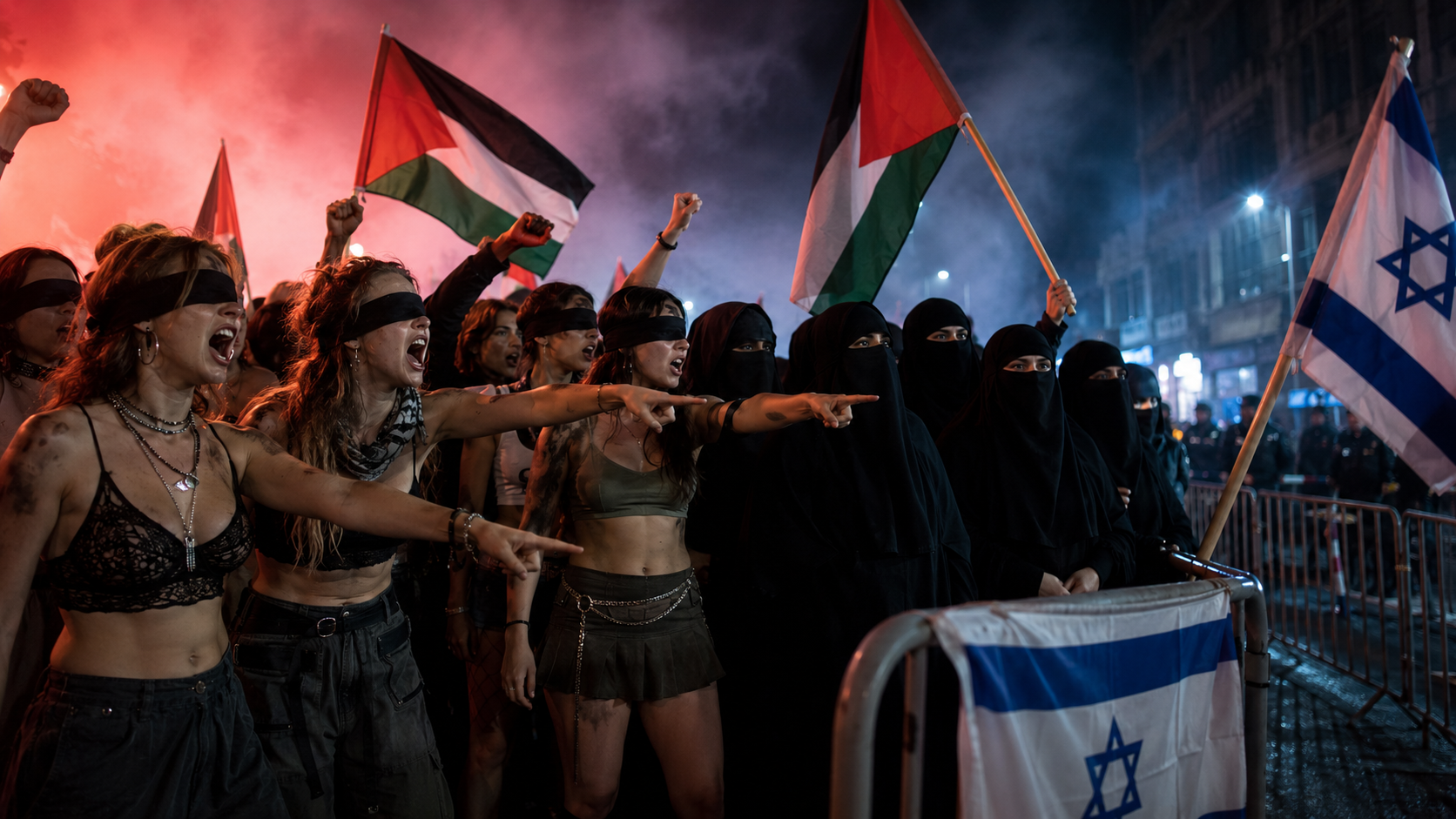
United by hostility toward Israel: progressive eyes covered, radical Islam locked on target.
For years, much of the Western left spoke about Israel and the Palestinians through the language of peace. Its members called for negotiations, territorial compromise, coexistence, and two states. I often disagreed with their understanding of Israeli security, yet I could recognize their stated goal. They wanted the conflict to end with Israelis and Palestinians living beside each other.
I grew up in Israel, served in the IDF, and have spent decades teaching martial arts. Peace is measured by whether the remaining threat allows people to return to their lives safely. The defender stopping is only one part of that calculation.
A powerful part of the activist left has moved away from that goal. Its language now centers on resistance, decolonization, and liberation. Israel is increasingly treated as the source of the conflict, which leads activists to imagine its disappearance as a form of justice.
The data requires precision. In 2026, Gallup found that 65 percent of Democrats sympathized more with Palestinians, while 17 percent sympathized more with Israelis. The same survey found that 77 percent of Democrats supported two states, and Pew found that at least eight in ten Democrats viewed Hamas unfavorably. Support for Palestinians can coexist with support for Israel. My concern is the activist faction whose demands have abandoned that balance.
At many protests, Israel is expected to stop fighting while the hostages receive limited attention. Hamas’s weapons, its control of Gaza, and its declared intention to attack Israel again rarely become conditions for a ceasefire. The future safety of Israeli communities is left for Israel to solve after its military has been restrained.
Hamas started this war on October 7. Its forces crossed into Israel, attacked civilian communities, murdered families, killed people at a music festival, and dragged hostages into Gaza. Human Rights Watch concluded that killing civilians and taking hostages were central aims of the planned attack. Hamas had already spent decades attacking Israeli civilians through suicide bombings, shootings, kidnappings, and rockets. Senior official Ghazi Hamad later said that October 7 would be repeated until Israel was removed.
Israel didn’t ask for this war. The country was forced to respond to a massacre, recover its hostages, and prevent Hamas from attacking again. If Hamas had returned the hostages, surrendered its weapons, and ended its attacks, Israel’s reasons for continuing the war would have disappeared. Jewish tradition recognizes self-defense as a duty when lives are under threat. The same duty applies to a nation responsible for protecting millions of people.
The activist left has lost its moral balance because it increasingly judges conduct through group identity and power. The radical form of what people commonly call woke ideology sorts the world into oppressors and victims. Once the categories are assigned, evidence has less influence. Power attracts suspicion, while weakness attracts explanations and excuses.
This framework removes Hamas’s agency by presenting the organization as a product of oppression. Its leaders’ deliberate choices become consequences of occupation, and military activity conducted from civilian areas is reduced to Gaza’s geography. The refusal to release hostages receives less attention than Israel’s military response. Erasing Hamas’s responsibility excuses the leaders who placed Palestinian civilians inside a war designed to serve Hamas’s political goals.
Military weakness doesn’t provide moral innocence. A person armed with a knife remains responsible for stabbing someone who carries a gun. The stronger person still has rules governing the response, while the initial aggression remains clear. Decades of teaching self-defense have shown me how quickly observers lose this distinction once their attention settles on the response and leaves the original attack behind.
The alliance between progressive activists and radical Islam adds another layer of confusion. Progressive movements claim to defend women, gay people, religious freedom, and personal autonomy. Islamist movements routinely restrict those freedoms when they gain power. The Taliban requires Afghan women to cover their faces in public and has pushed them out of education, work, and public life. Hamas built its rule in Gaza around religious authoritarianism, repression of political opposition, and restrictions on personal freedom. The oppressor framework sustains this alliance by assigning Muslims to the oppressed category, which allows activists to overlook coercion from movements they have decided to protect. Many Muslims reject Islamism and its control over private life. Treating them as one political body repeats the same error.
In Afghanistan, women are forced to cover themselves from head to toe and see the world through a narrow opening. In the West, activists enjoy freedom over their clothing and bodies while closing their eyes to the people who would take that freedom from them.
Hatred appears when Israel is denied the right to defend its citizens, Jewish self-determination is treated as a crime, and Israeli victims are presented as obstacles to the preferred political story. Palestinian compassion then becomes a vehicle for hostility toward Israel.
A credible peace movement would demand the release of the hostages, the surrender of Hamas’s weapons, an end to attacks against Israel, and a political future that offers Palestinians dignity alongside Israeli security. The public demands of the activist left concentrate on Israel, leaving Hamas with the chance to survive, rebuild, and produce another war.
Condemnation of Israel has become a source of political identity and social belonging. This faction is no longer looking for peace. It is looking for someone it is permitted to hate, and Israel has become that target
Do something amazing
Tsahi Shemesh
Related Topics
Related Posts