London based entrepreneur, cybersecurity analyst doing a PhD in AI
The Prophetic MBA.
What Shepherds, Steve Jobs, Elon Musk, Larry Page and Sam Altman Can Teach Us About Innovation in the Age of AI
There is a remarkably simple Islamic idea that could sit above an entire business school.
The Prophet Muhammad ﷺ is reported to have said:
“The best people are those most beneficial to people.”
The report from Jābir ibn ʿAbdullāh was graded ḥasan by al-Albānī. A longer narration from Ibn ʿUmar, which al-Albānī graded ṣaḥīḥ, goes further: “The most beloved people to Allah are the most beneficial to people,” before giving concrete examples—relieving distress, helping with debt, feeding hunger and helping somebody fulfil a need.
There are even stronger canonical formulations of the same principle.
In Sahih Muslim, the Prophet ﷺ says:
“Whoever among you can benefit his brother, let him do so.”
— Sahih Muslim 2199.
And in another authentic narration:
“Allah is in the aid of the servant so long as the servant is in the aid of his brother.”
— Sahih Muslim 2699.
Put these together and we get a remarkably demanding definition of excellence:
knowledge should become benefit.
Not merely information.
Not prestige.
Not sophistication.
Not technology for the sake of technology.
Benefit.
The Qur’an gives us an extraordinary parallel:
“As for that which benefits the people, it remains on the earth.”
— Qur’an 13:17.
The verse is a parable about truth and falsehood, not a business prediction. The foam disappears while what genuinely benefits people remains. But as an intellectual principle, it is powerful:
noise rises quickly; usefulness has substance.
That may be exactly the lesson entrepreneurs need in the age of AI.
Why were the Prophets shepherds?
There is another extraordinary hadith.
The Prophet Muhammad ﷺ said:
“Allah did not send any prophet but shepherded sheep.”
When his Companions asked whether he had done so himself, he replied that he had shepherded the sheep of the people of Makkah for payment. — Sahih al-Bukhari 2262.
Why shepherding?
We cannot claim to know every wisdom Allah intended. But as an education in responsibility, it is remarkable.
A shepherd has a flock.
The flock has needs: water, pasture, safety and rest.
Those needs exist within a landscape containing opportunities and constraints.
There may be good pasture in one direction.
Water somewhere else.
A cliff.
A predator.
Bad weather.
One sheep that cannot keep up.
Another that wanders away.
And the shepherd’s responsibility is not simply to make the animals move.
It is to understand the whole system well enough to get the flock safely to what it needs.
That is a profoundly useful model of leadership.
I discovered this with actual sheep
My first job after university was as a financial analyst at BG Group.
During graduate training week, our group was given an unusual exercise: herd a flock of sheep into a pen with the help of trained shepherds and a Border Collie.
It sounded easy.
It was not.
Almost the entire flock could be going in the correct direction while one or two sheep did something completely different.
One wandered away.
Another stopped.
Another refused to enter the pen.
Move aggressively towards one stray and you could disturb the whole group.
Focus exclusively on the majority and you could lose the outlier.
Try to control every sheep individually and nothing moved.
Pasted markdown.md
Researchers at the Royal Veterinary College later described sheepdog behaviour in strikingly simple terms. The dog switches between two modes: collecting, when animals are too dispersed, and driving, once the flock is cohesive enough to move towards the goal.
But this needs to be translated carefully into business.
Customers are not sheep to be controlled.
The lesson is about stewardship of a system, not manipulation of people.
The entrepreneur must understand who the people are, what they need, what resources exist around them and what safe path connects the two.
That is the real Prophetic MBA.
Steve Jobs: make life easier
Steve Jobs expressed an unexpectedly modest view of technology in a 1996 interview with WIRED.
He said:
“These technologies can make life easier.”
Jobs then gave ordinary examples: helping parents find support, connecting people who otherwise might never meet and making useful information easier to obtain. He explicitly warned against pretending that every technology had to “change everything” in order to matter.
That sentence may be more important than “Think Different.”
Does this make somebody’s life easier?
Jobs’s great strength was his ability to combine disciplines around that question.
Computing.
Industrial design.
Typography.
Software.
Hardware.
Manufacturing.
Music.
Psychology.
Human interaction.
Consider the old mobile phone.
A hardware engineer might ask how to improve the keyboard.
A software engineer might improve the menu.
An industrial designer might make the buttons prettier.
Apple instead combined hardware, software and human interaction and asked:
Why should most of those buttons exist at all?
Turn the surface into a screen.
Now one surface can become whatever the human needs at that moment.
That is what interdisciplinary thinking can do.
It does not merely optimise the existing solution.
It can remove the need for it.
Elon Musk: how useful is the improvement?
Elon Musk arrives at a similar principle from another direction.
In a 2016 interview conducted by Sam Altman, Musk described his own decision-making philosophy:
“I really was just trying to be useful. That’s the optimization.”
He then suggested thinking about a new technology in terms of the improvement it produces over the existing state of the art, multiplied by the number of people it affects.
In rough form:
Usefulness ≈ Improvement × People affected
A dramatic improvement for a smaller group can matter.
A modest improvement affecting hundreds of millions can also matter.
Musk adds another question:
Which constraints are real?
Physics may impose a constraint.
Safety may impose one.
Materials may impose one.
But an industry’s existing procurement structure is not a law of nature.
This is why interdisciplinary thinking matters.
Physics tells us what is possible.
Engineering tells us how to make it work.
Manufacturing tells us whether we can repeat it.
Economics tells us whether it can survive.
Human need tells us whether any of it is worth doing.
Larry Page: would you use it like a toothbrush?
Larry Page developed another wonderfully concrete test.
Fortune reported in 2013 that new Google products were expected to pass what Page called the “toothbrush test”: they should be important enough that most people would use them at least once or twice every day.
TIME later described Google’s acquisition version of the test even more plainly:
Is this something you use daily, and does it make your life better?
That is excellent because it attacks a common innovation mistake.
Founders often ask:
How technologically impressive is this?
Page’s test asks:
Will this repeatedly matter in someone’s actual life?
Frequency alone is not sufficient—people can repeatedly use harmful or addictive products—but it is an excellent indicator that you have found a real behaviour rather than an imagined market.
Sam Altman: make something people want
Sam Altman’s famous startup instruction reduces the idea even further:
“Make something people want.”
His accompanying advice is equally important: write code, talk to users, remain focused and care deeply about execution quality.
The mistake many AI startups currently risk making is reversing this order.
They begin with:
We have AI.
Then ask:
What can we attach it to?
A stronger company begins with:
Someone has a problem.
Then asks:
What combination of technology, design, behaviour, economics and human judgment can solve it?
ChatGPT itself illustrates the distinction.
The underlying research lineage existed before ChatGPT.
What changed dramatically was accessibility.
A very complex capability appeared behind one of the simplest human interfaces imaginable:
conversation.
Technical complexity stayed behind the interface.
Human simplicity appeared in front of it.
That is useful design.
Larry, Steve, Elon and Sam are asking the same question
Their language differs, but the pattern is remarkably consistent.
Jobs asks:
Does it make life easier?
Musk asks:
How much useful improvement does it create?
Page asks:
Will people repeatedly use it because it improves their life?
Altman asks:
Do people actually want it?
The Prophetic standard sits above all four:
Does it benefit people?
And the Qur’an introduces one crucial qualification:
benefit must exceed harm.
Qur’an 2:219 acknowledges that intoxicants and gambling contain some benefits, but says their harms are greater.
That is extremely relevant to technology.
A product can be convenient yet addictive.
Profitable yet psychologically damaging.
Efficient yet unsafe.
Engaging yet destructive of attention.
“People use it” is therefore not the final test.
Neither is “people want it.”
The higher question is:
Does it create net human benefit?
David: technology with a purpose
The Qur’an gives us a striking technological example through Dawud—David, peace be upon him.
Allah says:
“We taught him the fashioning of coats of armour to protect you…”
— Qur’an 21:80.
This is technology described through its purpose.
David is taught:
material knowledge,
craft,
engineering,
precision,
manufacture.
But the verse does not end with the brilliance of the technology.
It tells us what the technology is for:
“to protect you.”
That provides an extremely simple technological axiom:
Technical Excellence → Human Benefit
Not technical excellence for display.
Not innovation theatre.
Not AI because everyone else is putting AI into their product.
Technology earns its value by what it enables for people.
The polymathic advantage
This is also where Waqas Ahmed’s The Polymath becomes relevant.
Ahmed argues against excessive hyper-specialisation and for human versatility: the ability to develop depth while also connecting ideas across different domains.
This does not mean specialists are obsolete.
We need extraordinary surgeons.
Aerospace engineers.
AI researchers.
Statisticians.
Designers.
Economists.
The problem is not specialisation.
The problem is specialists becoming intellectually isolated from the whole problem.
A shepherd may need somebody who understands animal disease far better than he does.
Someone else may know the terrain.
Another may understand weather.
Leadership is not knowing more than every specialist.
It is knowing which knowledge needs to meet.
AI makes this increasingly possible.
It can help an engineer understand behavioural science.
A designer understand software.
A physician interrogate statistics.
A founder investigate manufacturing.
AI does not instantly make them experts.
It makes it cheaper to develop adjacent literacy.
That is enormously valuable.
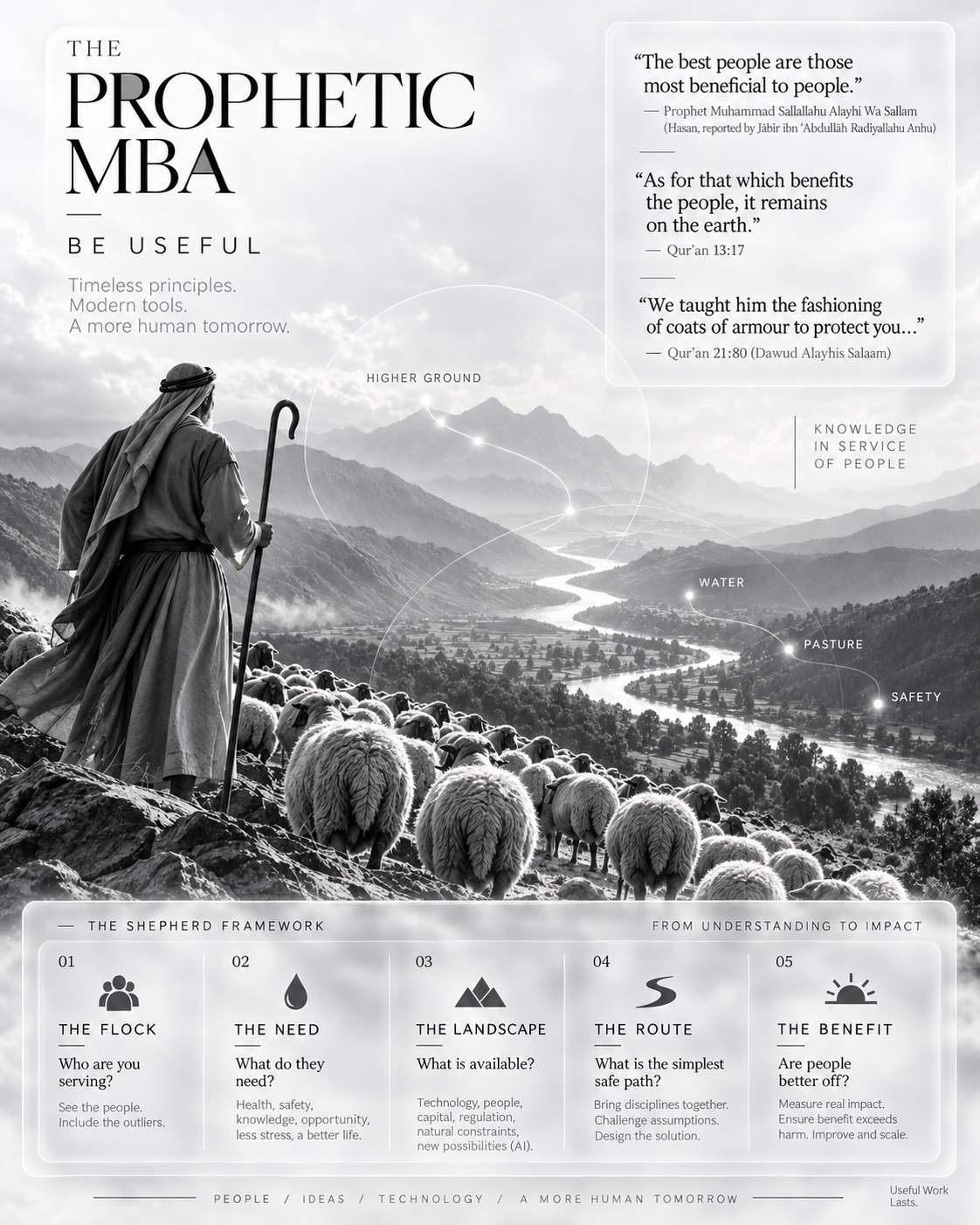
The Shepherd Framework
The framework should therefore follow the logic of actual shepherding rather than forcing business language onto “collect and drive.”
Here is the simpler model:
- THE FLOCK — Who are you serving? Define the people clearly. Not “the market.” Which people? Which subgroup? Who is being missed? The outlier matters too.
- THE NEED — What does the flock need? A flock needs pasture, water, safety and rest. Your users have equivalents: lower cost, less stress, faster work, better health, safer transport, clearer information. Start here—not with your technology.
- THE LANDSCAPE — What is available? Map the environment surrounding the need: existing technology, AI, science, design, suppliers, capital, regulation, behaviour, competitors and physical constraints. This is where interdisciplinary range matters.
- THE ROUTE — What is the simplest safe path from need to solution? Bring the right disciplines together. Challenge inherited assumptions. Jobs removes unnecessary buttons. Musk questions an inherited cost. Page tests whether the product enters everyday life. Altman asks whether people genuinely want it. The product is the route between today’s condition and a better one.
- THE BENEFIT — Did the flock actually reach better ground? Measure the human outcome. Did life become easier? Safer? Cheaper? Healthier? Less stressful? Did benefit exceed harm? If yes, improve and scale. If not, change the route.
That is the whole model:
Flock → Need → Landscape → Route → Benefit
And one principle sits above every stage:
Protect the flock.
That means safety.
Honesty.
Privacy.
Attention to outliers.
Avoiding foreseeable harm.
It also clarifies AI’s proper role.
AI is not the shepherd.
It is closer, metaphorically, to an extraordinarily capable sheepdog: a tool that can search, analyse, draft, model, code and accelerate movement.
But the dog does not decide where the pasture should be.
The shepherd remains responsible for the destination.
That is perhaps the critical lesson of AI-era leadership.
Machines can give us more capability.
They cannot absolve us of responsibility.
The future will contain astonishing amounts of intelligence, information and automation.
But the fundamental entrepreneurial question may remain ancient and simple:
Who is my flock?
What do they need?
What does the landscape make possible?
What is the safest and simplest route?
And are people genuinely better off when we arrive?
The Qur’an says that what benefits people remains.
The Prophet ﷺ teaches that the best people are those who benefit people.
Steve Jobs asks whether technology makes life easier.
Elon Musk asks us to optimise for usefulness.
Larry Page asks whether something becomes useful enough to enter daily life.
Sam Altman asks whether people actually want it.
David, peace be upon him, gives us the technological example:
learn the craft—
to protect people.
Perhaps the age of AI does not require a completely new philosophy of innovation after all.
Perhaps it requires an older one, applied with better tools:
See people clearly.
Understand what they need.
Read the whole landscape.
Bring knowledge together.
Build the route.
Protect them on the way.
Measure whether their lives became better.
That is the Prophetic MBA.
And that is usefulness.
Related Topics
Related Posts