I write what I see
The rabbi who rocked my shabbat
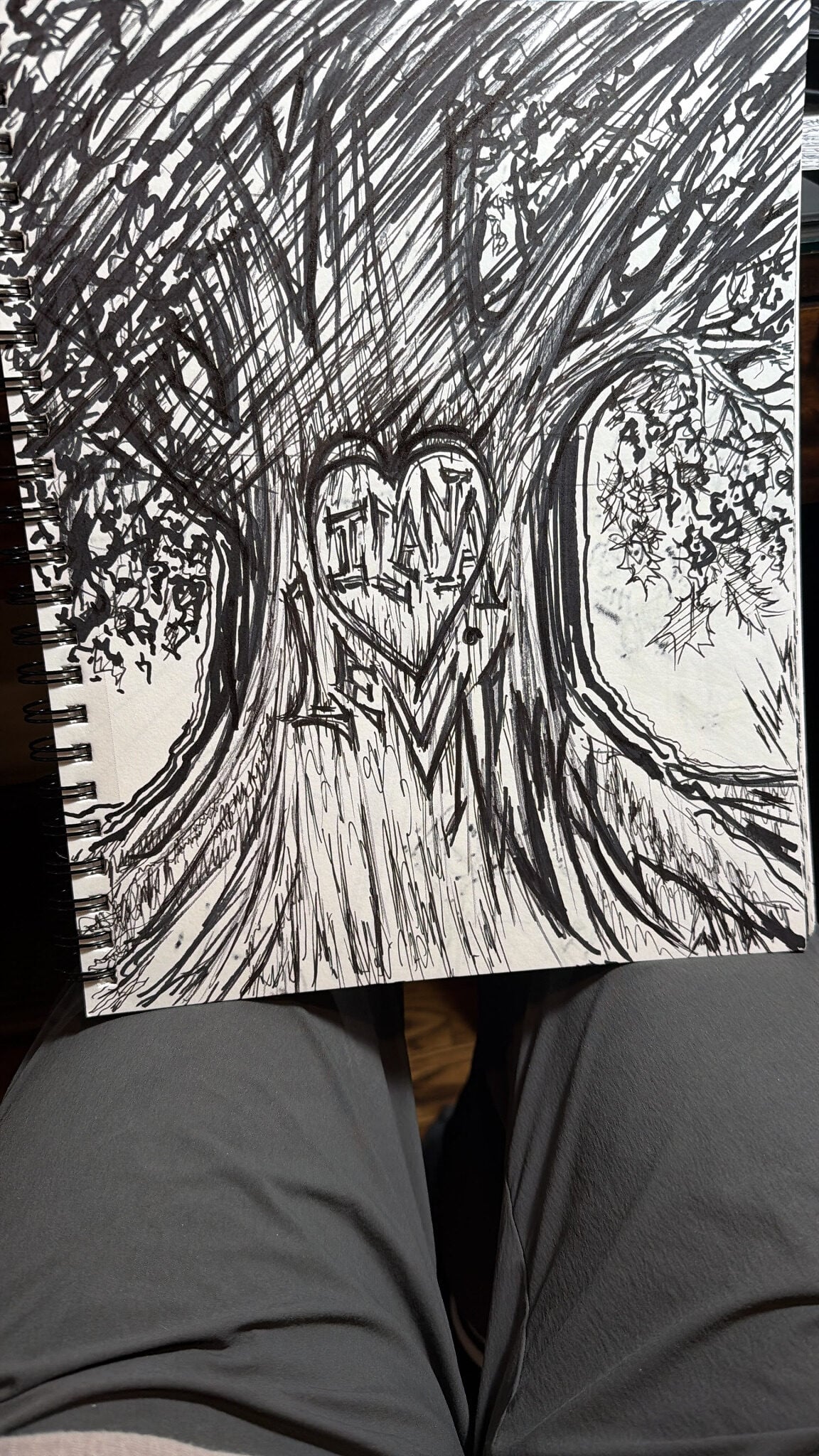
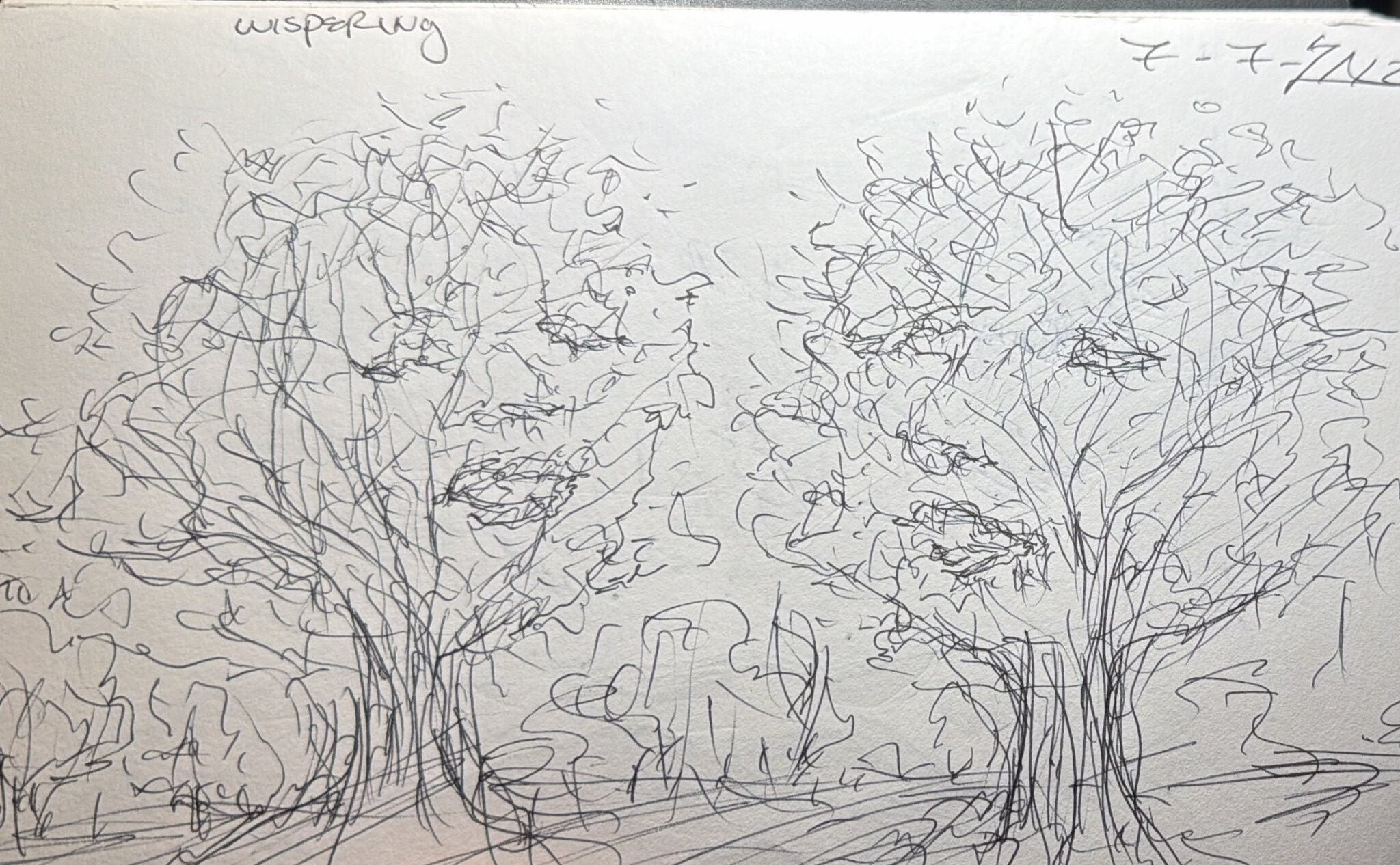
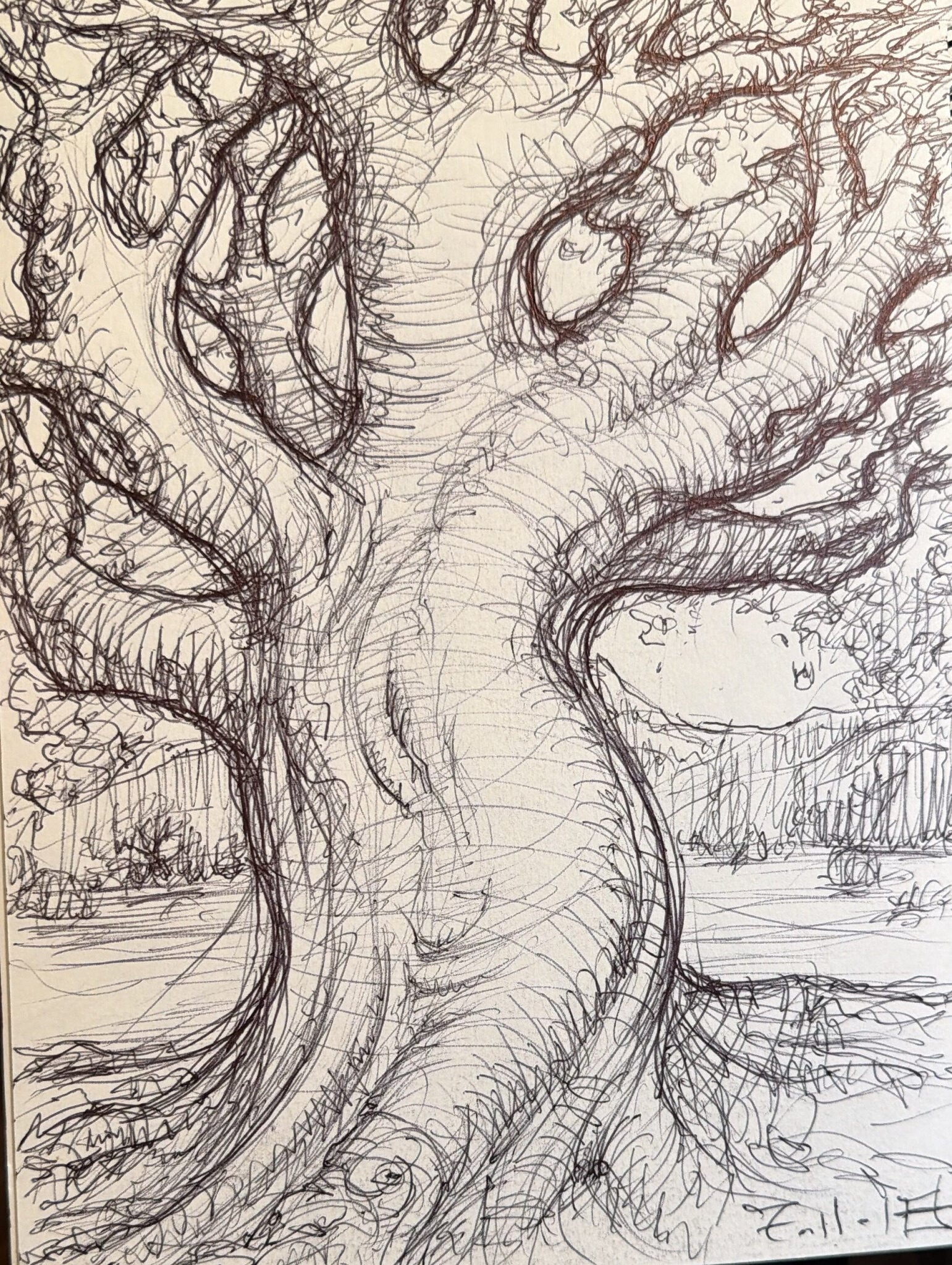
Forever — from artist Joseph Yuss Simon's Sketch a Day collection. (Image courtesy of Levinsky)
According to Jewish tradition, 60 marks the beginning of old age. Ben shishim lazikna, declares Pirkei Avot, apparently without consulting anyone approaching that milestone. Nevertheless, I decided to celebrate my 60th birthday in Santa Cruz by sleeping in a tree. Well, a treehouse, to be precise.
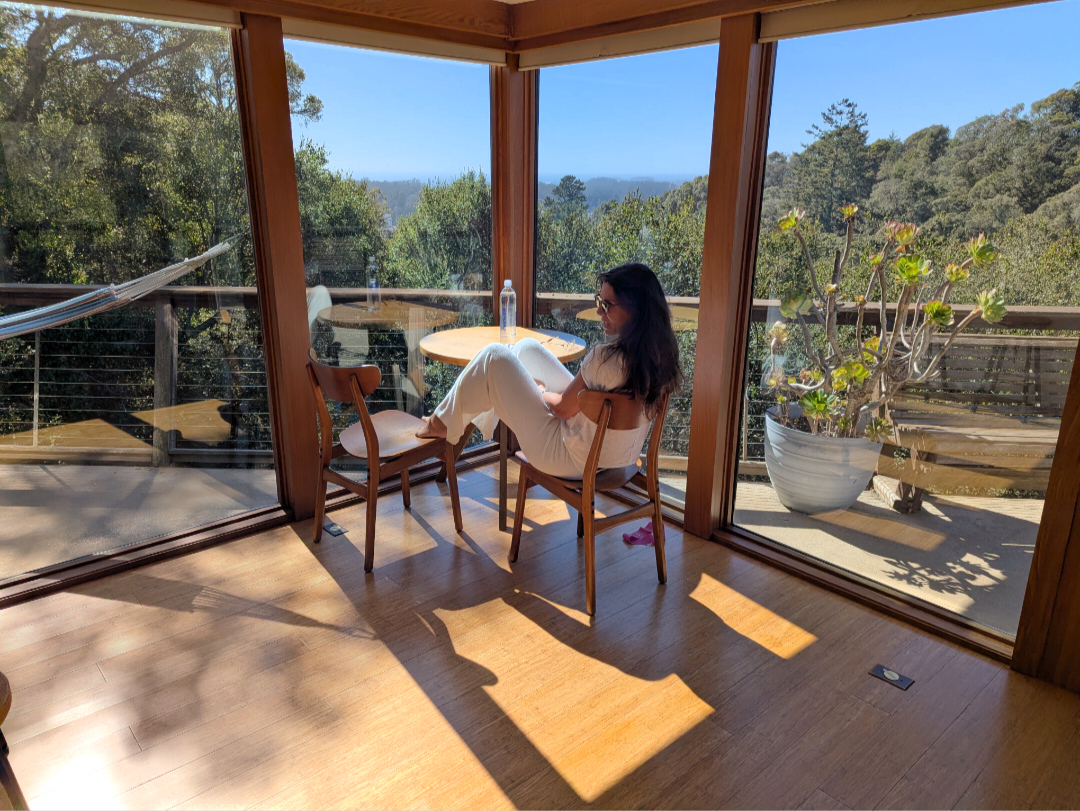
My Hebrew name, Ilana, means tree, and my boyfriend Joe has a great fondness for drawing and painting them. We’re both artists, although our chosen mediums are rather different. Joe paints and draws, while I create edible works of art in sugar. His creations have the advantage of permanence. Mine can take hours to complete and minutes to devour.
The synagogue was practically a stone’s throw away from our treehouse, and Joe suggested we attend Friday night services. So off we went.
Now Joe is an observant Jew, and as for me, well, I am observant primarily in the sense that I notice things. My earliest experiences with synagogue life came through my grandfather, an observant Yemenite Jew. I would accompany him to his neighborhood synagogue on special occasions or meet him after prayers, when the discussions could be almost as entertaining as the service itself. Someone had mispronounced a Hebrew word, another had strayed from a traditional melody, or some minor point of religious custom had become a matter of considerable importance. I found these exchanges rather charming, particularly the seriousness with which the men defended their positions. A misplaced syllable could apparently provoke enough discussion to rival the length of the service itself.
Later, my occasional visits to Reform synagogues came largely through teaching at Jewish schools or listening to my daughter sing in her angelic voice during holiday performances. Despite these experiences, I never developed the habit of attending services regularly.
Joe’s religious observance is woven into his daily life, and I admire the commitment behind it. The service we were about to attend was hardly the sort he would ordinarily frequent back home, but I was delighted to accompany him. That was how I came to spend a Friday evening with Rabbi Paula Marcus at Temple Beth El in Aptos.
With her silver curls, guitar in hand, and a flowing white embroidered outfit that could have come straight out of a Johnny Was catalogue, Rabbi Marcus was quite the sight. And then she began to sing. She didn’t look like Joan Baez, but she certainly channeled her folk-singing style. And what a voice! Clear, powerful, utterly captivating. I could have listened to her all evening. For a moment, I wondered whether I’d stumbled into a folk concert that happened to have a Torah ark.
Behind her was a dedicated band and accompanying singers, all performing with the confidence and familiarity of people who had been doing this together for years. Nothing appeared improvised or uncertain. The music flowed, the voices harmonized, and the rabbi seemed to be enjoying herself enormously.
This was Rock Shabbat, and they certainly lived up to the name. The sanctuary was packed. Children, parents, grandparents, all singing with the enthusiasm of an audience that knew every number on the programme. Except this wasn’t a concert. They had come to welcome Shabbat, and appeared genuinely delighted to be doing so.
What held my attention wasn’t simply the music, impressive though it was. It was Rabbi Marcus herself. Never have I encountered a religious leader so relaxed, so talented, and so evidently loved by her congregation. She commanded attention without appearing to demand it, entirely comfortable in her own skin, without a trace of solemn posturing or self-importance.
I watched the people around me almost as closely as I watched her. They knew the prayers, the melodies, and evidently one another. The affection between Rabbi Marcus and her congregation was unmistakable, and I found myself wondering how many years it had taken to cultivate such an extraordinary relationship.
I’ve attended services where the congregation seemed to regard the closing prayer as the equivalent of the final bell at school. Nobody here appeared particularly anxious to escape.
Somewhere between the guitars, the prayers, and the sea of smiling faces, I found myself contemplating the different expressions of Jewish religious life. I can already hear the objections: Guitars in a synagogue? A band accompanying the prayers? What next, a disco ball suspended above the bimah?
I know perfectly well that the differences between Orthodox, Conservative, Reform, and other Jewish movements involve considerably more than a choice of musical accompaniment. For an observant Jew like Joe, playing instruments on Shabbat is prohibited under Jewish law, and I wouldn’t dream of trivializing convictions that are so important to him.
But must acknowledging those differences prevent us from appreciating what another community has accomplished? I looked around that packed sanctuary, at the children singing alongside their parents, at the sheer delight on people’s faces, and wondered how many religious leaders would give anything to inspire that kind of participation.
I grew up in Israel, where Jewishness was part of the atmosphere, whether one entered a synagogue regularly or not. I am Jewish by birth, of course, but how I choose to express that identity is another matter. For me, it has been through teaching, writing, family traditions, and a lifelong attachment to the history of our people. Regular synagogue attendance has simply never been part of the equation.
We live in an age when people’s attention is divided between work, family obligations, and the countless distractions that consume our days. Persuading families to put everything aside for Friday evening services is no small accomplishment. Yet here they were, children and adults alike, singing with remarkable enthusiasm, and I could hardly argue with the evidence before me.
There is enormous beauty in traditional worship, and I would never reduce religious devotion to the mere business of following rules. I see in Joe how much thought, discipline, and conviction such a life requires. But surely the influence of a religious leader must also be considered in terms of the people they manage to reach. What Rabbi Marcus had accomplished extended well beyond conducting Friday evening prayers. She had cultivated a community that genuinely wanted to be there, and I couldn’t help thinking how many religious leaders would welcome that kind of devotion from their congregations. If Jewish continuity matters to us, surely this achievement deserves its own measure of recognition.
Watching the children around me, I thought of my grandfather’s Yemenite synagogue. Decades later, I still remember the familiar faces, the prayers, and those spirited disagreements that followed the service. I suspect the children at Temple Beth El will carry equally vivid memories, albeit with considerably more guitar accompaniment.
We devote considerable attention to preserving Jewish traditions, and rightly so, but we should also appreciate those who succeed in making them meaningful to the next generation. Rabbi Marcus certainly has a gift for that.
I hadn’t arrived in search of a new religious identity. Nor was I contemplating a sudden commitment to regular synagogue attendance. Sixty years of rather casual attendance suggest that such a transformation is unlikely.
Joe and I approach religious observance differently, but I value the fact that we can share an experience without expecting it to mean precisely the same thing to both of us. I was glad he’d suggested we go.
As for the ancient sages who pronounced 60 the beginning of old age, I was in no hurry to oblige them. A birthday in a treehouse, followed by a Friday evening with Rabbi Marcus and her remarkable congregation, seemed a perfectly good way to begin the decade.
I couldn’t stop smiling.
Related Topics
Related Posts