
Middle East Analyst
The Real AI Conversations in Corporate Boardrooms
Graphic by Author/ChatGPT
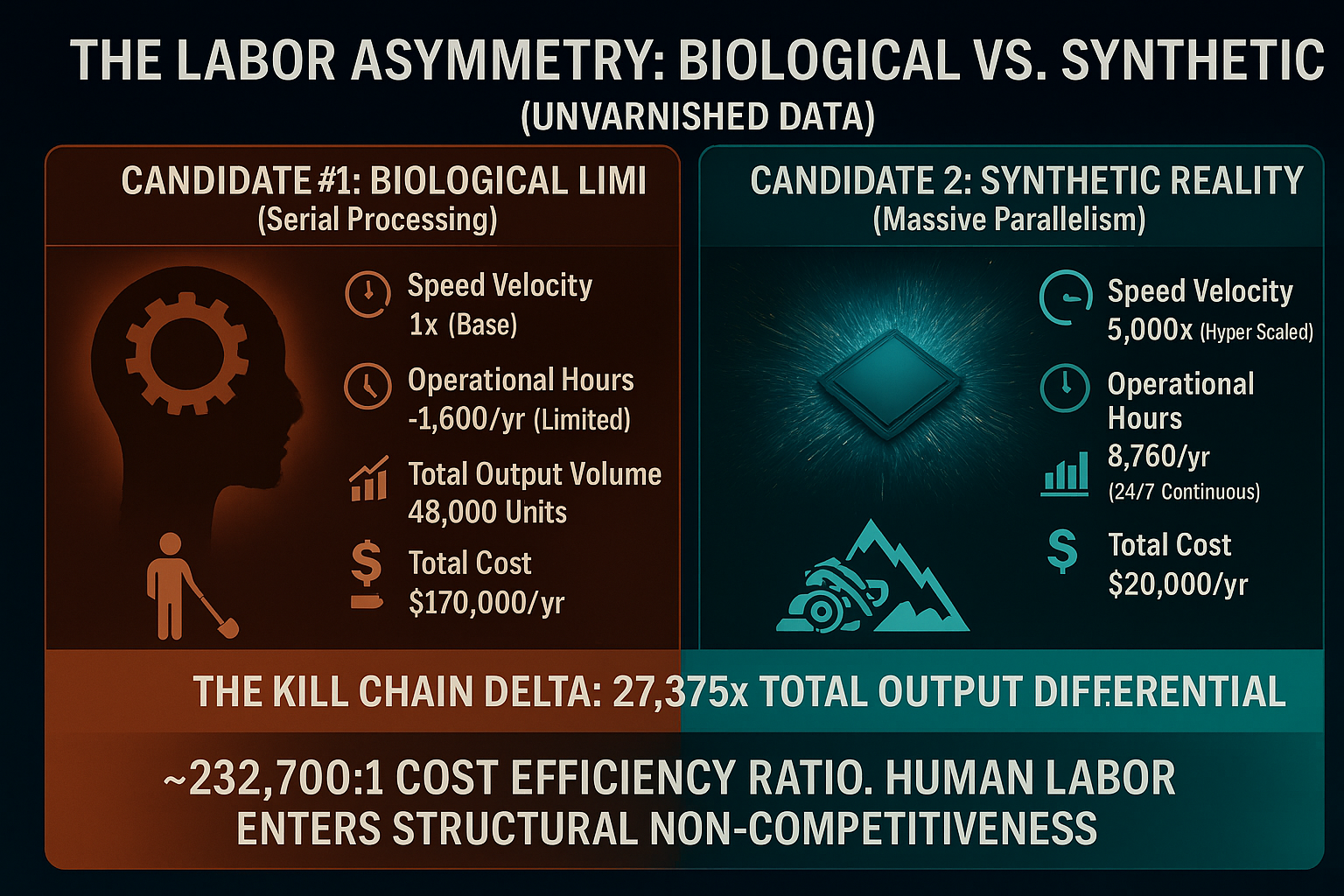
This slide captures the economic reality driving 2025 AI adoption: the labor asymmetry between human workers and AI systems has crossed a threshold so extreme that boards, CFOs, and operations chiefs can no longer ignore it. What was once speculative is now embedded in cost-cutting agendas and strategic planning.
Across industries, boards are asking three core questions:
- Can human labor costs be justified against synthetic alternatives?
The slide compares a mid-level analyst at $170,000/year (including benefits) to an AI system delivering exponentially more output at $20,000/year. On a per-hour basis, AI labor costs roughly $9/hour versus $81/hour for humans. But the deeper asymmetry is throughput: synthetic labor runs 24/7 at hyper-scaled speeds, producing tens of thousands of times more output. Boards interpret this not as an efficiency edge—but as a displacement curve.
- Where does labor become structurally non-competitive?
Mid-level analysts are the tipping point. Their tasks—synthesis, reporting, monitoring, summarizing—map directly onto current AI capabilities. Even if AI doesn’t match human quality in every case, its cost-performance ratio overwhelms any marginal advantage. That’s why consulting firms, banks, insurers, and defense contractors are already modeling 20–40% workforce reductions in these roles.
- What is the board’s fiduciary obligation?
Once synthetic labor becomes both cheaper and faster, boards face a legal and competitive imperative: if rivals adopt and you don’t, your cost structure becomes obsolete. Directors are now asking: How much EBITDA (Earnings Before Interest, Taxes, Depreciation, and Amortization) uplift are we leaving on the table by maintaining legacy workflows? In many boardrooms, this is no longer theoretical—it’s part of 2026–2027 capital allocation.
Related Topics