
Rabbi • Jewish & Israel Educator • Community Builder
The Real Israel Divide No One Admits
Zionism contains multitudes—fractured, complex, and still forming a coherent whole.
It has now been 774 days since October 7, 2023, and Hamas continues to hold the bodies of three deceased hostages. That painful reality should focus our conversations about Israel and about the future of Jewish life. These discussions are not abstract. They shape identities, relationships, and the moral fabric of our communities. Yet too often, we find ourselves talking past one another, especially across generational lines.
Last week, I participated in the in-person component of the Spertus Institute’s Leadership Certificate in Combating Antisemitism, a program grounded in critical thinking, communal responsibility, and practicing the skills required to navigate complex Jewish communal challenges. Over several days of intensive study, our faculty emphasized a foundational truth: people engage the world through the prisms shaped by their lived experiences. Until we understand those prisms—and the realities they reflect—our attempts at leadership, persuasion, or bridge-building will fall flat.
The generational divide on Israel is not primarily about values. It is about what each generation sees when they look at Israel. Older Jews carry the memory of a young, vulnerable state fighting for survival and absorbing refugees with little more than determination and grit. That memory is real, and it continues to inspire loyalty and gratitude. Younger Jews, however, see a different landscape: political dysfunction, the entrenchment of occupation, the rise of religious extremism, and a government they believe violates both democratic norms and Jewish ethical principles. That experience is also real.
The generational divide on Israel is not about values—it’s about what each generation sees when they look at Israel.
At Spertus, we revisited the humility of Beit Hillel—the commitment to articulate another’s position fully before offering one’s own. It’s a discipline of intellectual honesty that our community desperately needs. Instead, we often dismiss or caricature the experiences of those who see Israel differently than we do. But if we want genuine dialogue, we must acknowledge that these perspectives are rooted in real encounters with Israel’s complexities.
Young Jews are not turning away from Zionism itself. They are turning away from a triumphalist, overly sanitized version of Zionism that collapses under scrutiny. They know Israel is imperfect because they have grown up in a world where they can see those imperfections unfiltered. They do not want propaganda; they want truth—about Israel’s accomplishments and its failures, its beauty and its brokenness. Teaching a simplistic narrative, or insisting that love of Israel requires ignoring its flaws, only widens the divide.
At the same time, we must be honest about the ways the current Israeli government has damaged Israel’s democratic institutions, its global reputation, and its relationship with Diaspora communities. Acknowledging these realities does not weaken Zionism. In fact, doing so strengthens our moral credibility and deepens our commitment.
Young Jews aren’t turning away from Zionism. They’re turning away from a triumphalist version of Zionism that collapses under scrutiny… They do not want propaganda; they want truth—about Israel’s accomplishments and its failures.
If we needed proof that Zionism can evolve—proof that Diaspora Jews retain real agency and influence—we received it during the recent World Zionist Congress. After two weeks of difficult negotiations, the center-left, pluralistic bloc, led in substantial part by MERCAZ and its global partners, achieved one of the most consequential victories in modern Zionist politics. These agreements were not symbolic statements. They reshaped budgets, leadership roles, priorities, and policy direction for the next five years across the national institutions: the World Zionist Organization, KKL/JNF, the Jewish Agency, and Keren HaYesod.
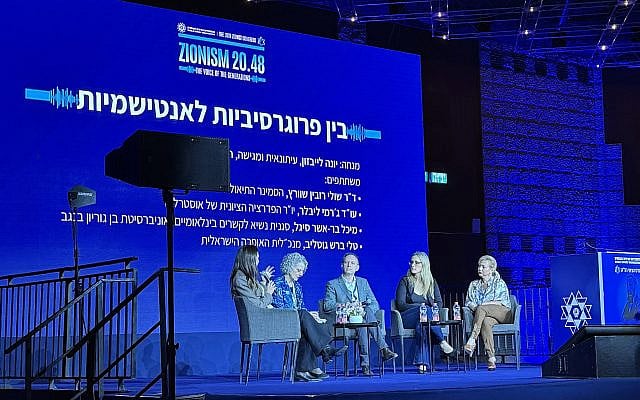
The pluralistic bloc secured significant increases in funding for Conservative/Masorti and Reform institutions worldwide, strengthened financial support for Zionist and Israel education programs, and expanded its representation and influence following a notable rise in its share of the Congress. Senior leadership positions that had been held exclusively by the right-wing and ultra-Orthodox bloc in the previous term are now shared with pluralistic partners. Extremist political allies who had previously held influence were marginalized. MERCAZ’s senior leadership role—the WZO Vice Chair—gained expanded authority to advance democratic, inclusive values within the national institutions. And in a moment of genuine significance, broad coalitions passed resolutions affirming the need for an equal draft law in Israel, calling for an impartial State Commission of Inquiry into October 7, and endorsing full equality for the Egalitarian Kotel.
The World Zionist Congress proved that Diaspora Jews still have real agency—and that Zionism can evolve.
This achievement demonstrates that Zionism remains accessible to Diaspora Jews who disagree with the policies of Israel’s current government. It proves that the global Zionist movement is broader, healthier, and more diverse than Israel’s governing coalition. And crucially, it shows young people that Zionism still contains the tools for accountability, reform, and democratic renewal.
The answer to the generational divide is not more talking points. It is more courage—the courage to teach real history, confront real moral questions, and trust that our young people can handle complexity. During the Spertus program, we discussed resilience not as a return to the past but as the ability to learn, adapt, and grow in the face of challenge. That is precisely what Zionism must do now. Young Jews are not abandoning Israel; they are abandoning a fantasy Israel that never truly existed. If we want them back, we must be willing to embrace a Zionism grounded in honesty, capable of self-reflection, and committed to democratic values.
This is not a crisis of Zionism. It is a call to rebuild it.
This moment is not a crisis of Zionism. It is a call to rebuild it. The World Zionist Congress showed that Diaspora communities can lead with integrity and vision. The Spertus leadership program reminded me that the work of combating antisemitism requires both clarity and humility, both courage and compassion. Zionism’s renewal will not come from slogans or defensiveness. It will come from leaders—across generations—who love Israel enough to demand that it live up to its highest ideals. That is a Zionism worthy of our young people, our ancestors, and our shared future.
Related Topics
Related Posts