
The Real Reason Behind the Iranian Protests
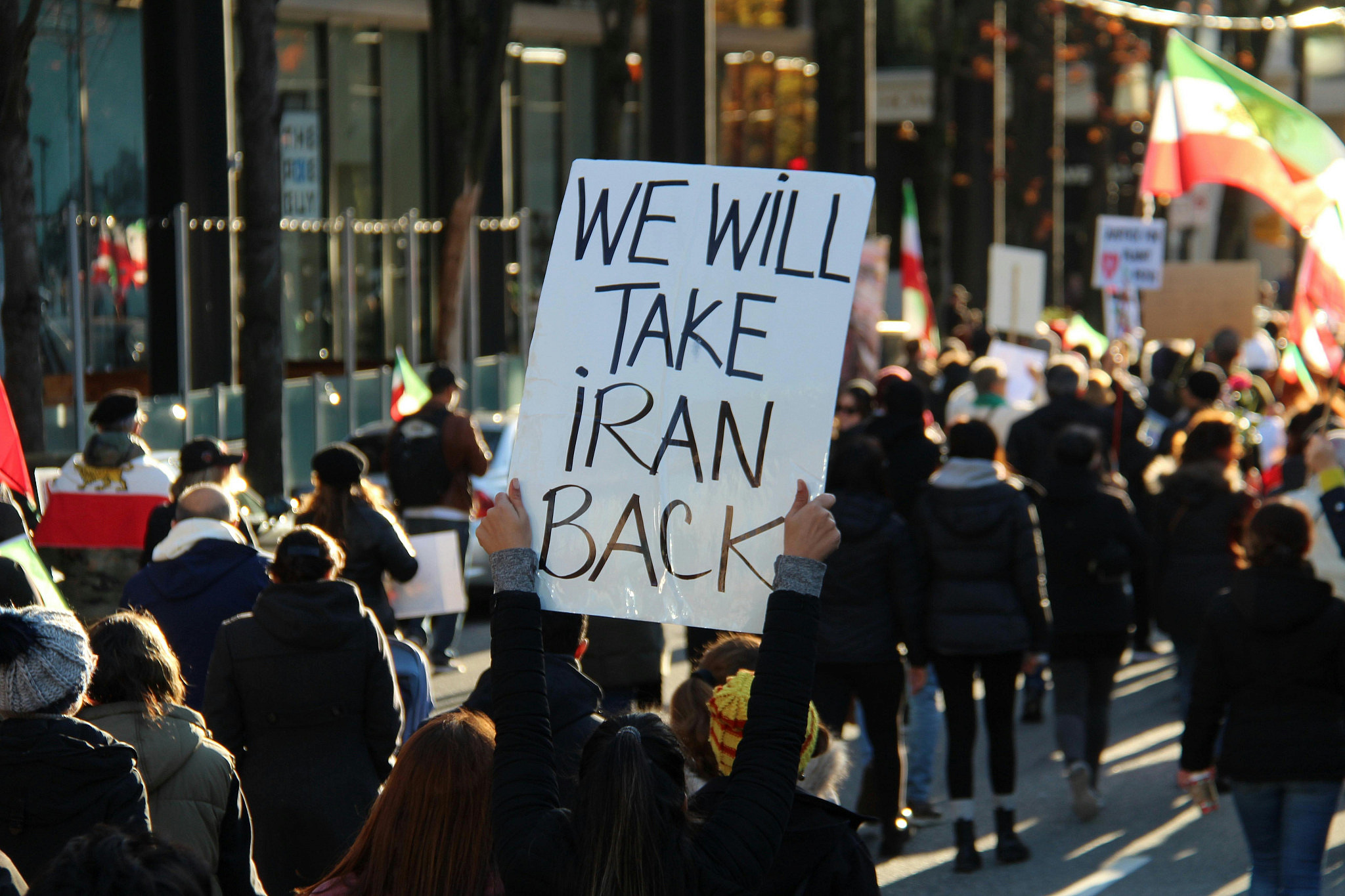
With protests recently erupting all over Iran, which has resulted in six people being killed in clashes with security forces so far, much controversy has arisen about what sparked these protests.
Some commentators have argued these protests are not anti-regime, but rather Iranians expressing their frustration at the economic state of the country. One chief analyst behind this view is Bushra Shaikh, who blamed Iran’s economic crisis on Western sanctions and complained that Israel and propagandists are hijacking the protests in order to replace the Islamic Republic with a western puppet. However, Shaikh’s portrayal of the recent protests as frustrations at financial hardships and not anti-regime, falls apart under the slightest scrutiny.
Firstly, Shaikh conveniently forgot to mention that Western sanctions are in place because the Islamic regime funds multiple terrorist groups, like Hezbollah and Hamas, in its attempt to destroy Israel and take over the Middle East. Rather than stopping their financing of terror, the regime has preferred to let their people suffer economically just so they can fund their jihad.
Further, while the protests did begin due to the economic crisis, initially with some shopkeepers in Tehran striking, it soon turned into complete rejection of the regime. The US-based Human Rights Activists News Agency reported that some protestors screamed “Death to the dictator” and “Woman, Life, Freedom” (in reference to anti-regime protests in 2022).
One protester acknowledged that poverty in Iran hard worsened but said:
“This is no longer about specific issues. It’s against the principle of the regime.”
Clearly, the recent protests have evolved into a call for the end of the Islamic Republic, but why would the Iranian people reject the principle of the regime? The answer is obvious when one examines the various atrocities the Islamic Republic has inflicted on its population.
Executions
For example, the regime has executed many Iranians over the years, including 975 people in 2024, and 834 in 2023, according to the human rights organisation Iran Human Rights. While this may seem like a massive number of executions, it pales in comparison to last year’s executions, which is unprecedented. Iran Human Rights Monitor reported that by the end of Sept, 2025, 1,176 people had been executed, whilst other tallies report that up to 2,201 executions occurred in 2025. Many – if not all – of these victims are innocent as the regime executes people for many things, such as a repeatedly consuming alcohol, which is illegal in Iran.
Minorities
The regime has also abused minority populations based on their religious identity. Followers of Zoroastrianism, the ancient and pre-Islamic religion of Iran, for example, are not given equal religious rights. One Zoroastrian in Iran explains:
“We don’t have the right to make programmes about our religion. I have no platform on radio or television to go and speak about Zoroastrianism. We cannot get any budget for building a new fire temple when mosques are being built one after another.”
Iranian Jews can live largely unmolested as long as they know their place but have faced discrimination. For example, Iranian Jews have been forbidden to venture out in public when it rains as the regime feared the rain may splash off them and hit a Muslim, rendering the Muslim unclean.
One Iranian Jew recounted:
“When I was a boy, I went with my father to the house of a non-Jew on business. When we were on our way home, it started to rain. We stopped near a man who had apparently fell and was bleeding. As we started to help him up, a Muslim akhond (theologian) stopped and asked me who I was and what I was doing. Upon discovering that I was a Jew, he reached for a stick to hit me for defiling him by being near him in the rain. My father…begged the akhond to hit him instead. The surprised akhond did not hit anyone and we were permitted to continue homeward.”
Iranian Christians fare no better. Open Doors, a human rights organisation that tracks the global persecution of Christians, ranked Iran as the ninth worst country for Christians in the world as of Jan, 2026. Recent events of Christian persecution include five Christians who were sentenced to ten years in prison each for spreading propaganda, which included distributing Bibles, and a raid by the regime’s police on a Christian gathering, with reports of agents ripping “crosses from individuals’ necks.”
Child Marriage
Another issue in Iran is child marriage. According to the Center for Human Rights in Iran (CHRI), the regime allows 13-year-old girls to be legally married off to older men. The girls can be married off even younger with the consent of “a male guardian or judge.” Within these marriages, the girls are often abused while the regime lets it happen. CHRI explains:
“girls and women lack legal protection against domestic violence that is severe and widespread, and women have extremely limited ability to divorce and thus escape abusive marriages. As a result, some are driven to kill their abusers as a last resort.”
Women’s Rights
Finally, the regime has oppressed women by forcing them to cover up in line with Islamic teaching. In 2022 Masha Amini, a Kurdish Iranian, was arrested for not wearing her veil properly and was supposed to be sent to “Vozara for an “educational” class aimed at “reforming” the behaviour of women…who violate the country’s…Islamic dress code.” However, reports deemed credible claimed that morality police beat and tortured her inside a police van, causing her to fall into a coma. Three days later Masha died, aged just twenty-two.
Masha’s death sparked the Women, Life, Freedom movement, where Iranians mass protested the Islamic Republic’s oppressive laws on women. The regime responded by cracking down on protests, killing more than 500 protestors and detaining more than 20,000.
16-year-old Nika Shakarami vanished from one of these anti-regime protests and her body was found nine days later. While the regime claimed she killed herself, the BBC investigated a leaked report, which revealed Nika was kidnapped by the regime’s security forces and forced into a van, where they sexually assaulted and murdered her, before dumping her body on the streets.
This is just a small sample of the atrocities the Islamic Republic has committed against the Iranian people, and there are many more, such as the events of the Green Movement in 2009. It is the human rights abuses that have caused great hatred for the regime among Iranians. Economic crisis may have sparked the recent protests, but it is only the tip of the oppression Iranians endure under the Islamic Republic.