
The Recognition of a Palestinian State: A Legal Misconstruction
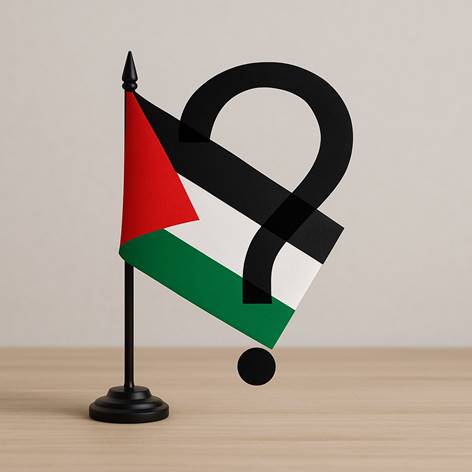
Some governments, invoking “historical justice” or less avowable motives, have chosen to recognize a State whose borders, institutions, and sovereignty remain undefined. Yet, from the standpoint of international law, such premature recognition constitutes a legal fiction — one that contradicts the very criteria by which statehood is determined.
The 1933 Montevideo Convention, a cornerstone of public international law, sets forth four conditions for statehood: a permanent population, a defined territory, an effective government, and the capacity to enter into relations with other States [1]. These criteria are clear, concrete, and objective.
Recognition of a State should be a declaratory act — an acknowledgment of a pre-existing reality — not a constitutive act that artificially bestows status upon an incomplete entity. To recognize a “Palestinian State” under the current circumstances is to invert this logic and politicize a fundamental legal concept.
The Oslo Accords (1993–1995) laid the groundwork for Palestinian self-governance in the West Bank and Gaza. However, they did not establish a State. On the contrary, they defined a transitional process during which the parties were to negotiate so-called “final status” issues: borders, Jerusalem, security, settlements, and refugees [2]. This process has never reached a conclusion, and the interim provisions of Oslo remain in force more than thirty years later.
The West Bank is divided into Areas A, B, and C. Only Area A is under full Palestinian civil and security control. Areas B and C — which constitute over 80% of the territory — remain under Israeli military or administrative control [3]. Borders have not been defined. Airspace, trade, customs, and water resources remain under Israeli control. In Gaza, since 2007, the Hamas organization — designated as a terrorist group — holds de facto power.
There is neither territorial continuity, nor political unity, nor effective sovereignty.
Under these circumstances, can one truly speak of a “defined territory” or an “effective government”? Can a fragmented entity, divided between two antagonistic regimes (Ramallah and Gaza), genuinely be considered capable of acting as a subject of international law?
The answer is clearly negative.
To recognize a Palestinian State under such conditions is to violate not only positive international law, but also the contractual commitments undertaken by the parties. The Oslo Accords explicitly prohibit any unilateral action that might prejudge the outcome of final status negotiations [4]. Yet the unilateral recognition of statehood is, manifestly, just such an action.
Rather than fostering a negotiated resolution, such recognition acts as a substitute for compromise. It entrenches positions, fuels illusions, and undermines existing processes. It turns international law into a political tool, stripped of its coherence and legal rigor.
Moreover, such recognition is devoid of tangible effect.
It belongs more to the realm of political maneuvering than to that of law. It does not improve the condition of the populations concerned. It does not bring a resolution any closer. It exploits the law to serve a posture, rather than respecting its foundational principles.
To recognize a Palestinian State with no defined borders, no political unity, no sovereignty, and no effective control over its territory, is to reduce international law to diplomatic rhetoric. It is to concede that statehood may exist absent the conditions of statehood. And ultimately, it is to forgo a negotiated solution in favor of symbolic political gesturing.
[1] Convention on the Rights and Duties of States, Montevideo, 26 December 1933, Article 1.
[2] Declaration of Principles on Interim Self-Government Arrangements, Washington, 13 September 1993, Article V.
[3] Israeli-Palestinian Interim Agreement on the West Bank and the Gaza Strip (Oslo II), 28 September 1995.
[4] Ibid., Article XXXI.7.