
Writing on Jewish life, relationships, trauma, and resilience
The Refusenik Refuses Again
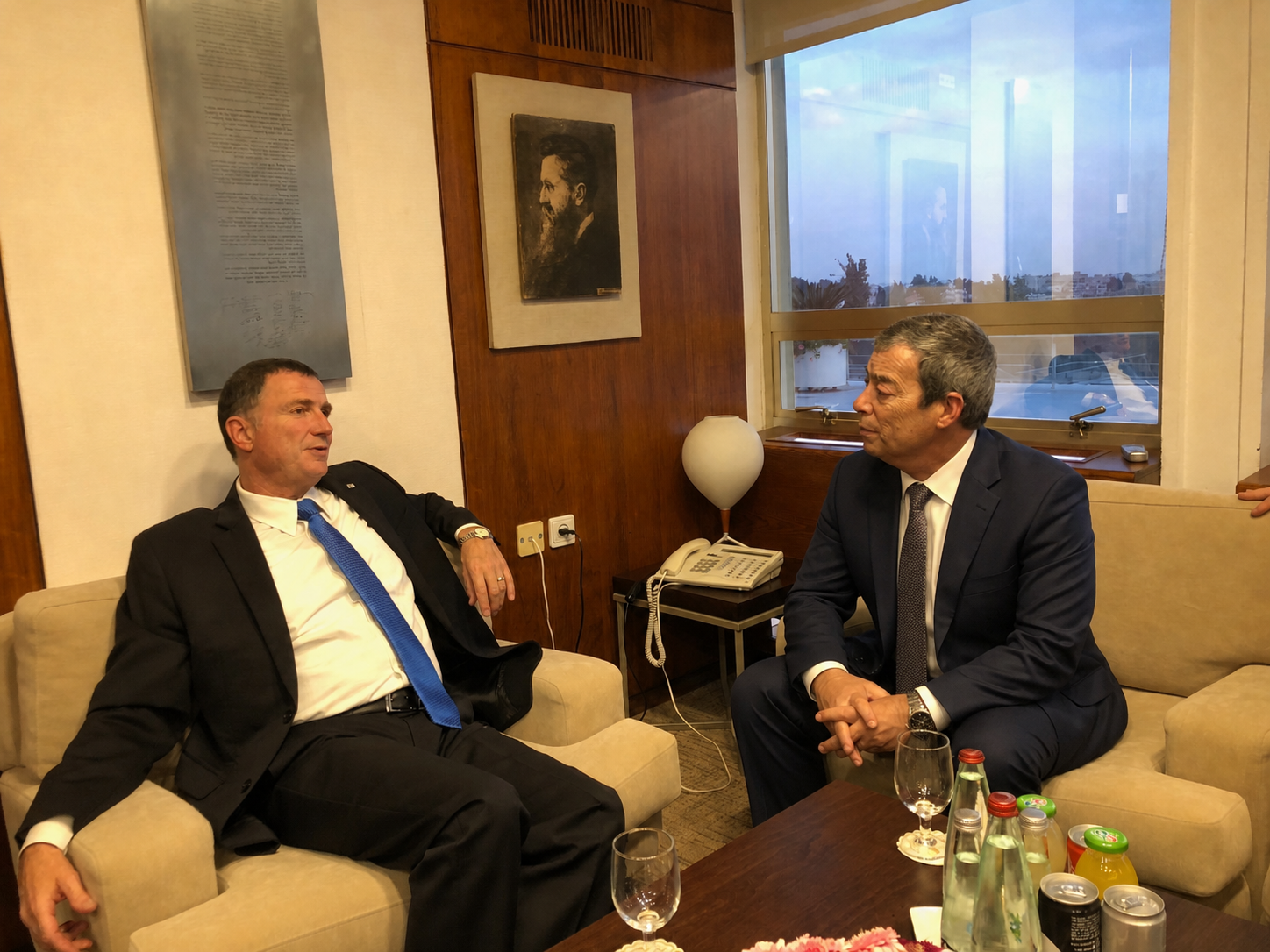
The author, right, with Speaker of the Knesset Yuli Edelstein in November 2017. (Courtesy)
Yuli Edelstein has spent much of his life saying no to powerful institutions. He said no to a Soviet system that tried to decide how much Jewish memory a person was allowed to carry. Now, decades later, he is saying no to his own political home.
Edelstein recently announced that he could no longer remain in Likud under its current course. He said he could not keep campaigning for a party that continues to support large-scale draft exemptions for ultra-Orthodox men. If he won a place on the list, he explained, he would have to stand before voters and say, “Vote Likud, we will…” — and he no longer knew how to finish the sentence. What, exactly, would he be promising? A continuation of what he bluntly called “freeloading”?
That is not the language of a man making a tactical adjustment. It is the language of a man who has reached the edge of what he can honestly defend.
Edelstein apologized to longtime Likud supporters, but said there was no other way. Then he added the sentence that, to me, reveals the continuity between his past and his present: “The State of Israel has always come before my party.” For a man with his story, that is not a line tested on a focus group. It is a refusenik’s sentence.
A refusenik understands what happens when institutions demand loyalty without conscience. He understands the danger of repeating what one no longer believes. That is why Edelstein’s decision matters. To understand how much, it helps to remember who is speaking — and I had the unearned good fortune to hear that voice in person once.
I had not come to the Knesset that day to meet Yuli Edelstein. It was November 2017, and I had come as a father, to introduce my youngest son, then seven years old, to Prime Minister Netanyahu. While we were there, my host offered something unplanned, almost in passing: would we like to meet the Speaker of the Knesset? I knew Edelstein then only by reputation, as one of the most famous refuseniks ever to make it to Israel.

I did not expect that unscheduled meeting to be the one I would still be carrying nine years later.
His office held the quiet weight of Israeli democracy: wood-paneled walls, framed history, a portrait of Herzl gazing past us, Jerusalem light through the window, and the awareness that decisions made in that building can alter the fate of a people. But the conversation did not feel merely political. It felt historical.
Before he was a minister, before he became Speaker, before he became one of the most recognizable figures in Israeli public life, Yuli Edelstein was a Soviet Jewish refusenik. That history was not background. It was the foundation.
What he shared that day was not a campaign biography. It was a memory of Jewish life under a system designed to make Jewish continuity difficult, dangerous, and humiliating — a world in which Jewish identity survived in fragments: a Hebrew book, a whispered lesson, a private gathering, a grandparent’s memory.
He had grown up in Czernowitz, in western Ukraine, in a Jewish world severed from much of its inheritance. What stayed with me was his insistence that Soviet Jews should not be casually described as assimilated, as if they had simply chosen to walk away. Many had not abandoned Jewish culture. They had been deprived of access to it. Assimilation suggests surrender. What Edelstein described was closer to dispossession: a Jewish life narrowed by force, yet never fully extinguished.
Then he told us about his grandfather.
As a boy, he was taken by the hand to obtain matzot — not in the open life of a free Jewish community, but quietly, almost furtively, through the small acts by which memory survived. His grandfather learned Hebrew late in life, copying words into a notebook, a grown man teaching himself the alphabet of his own people in secret. After his grandfather died, those notebooks became part of Edelstein’s awakening.
I remember hearing that story with my own seven-year-old beside me — a Jewish child brought openly by his father into the parliament of a Jewish state, needing to hide nothing, whisper nothing, fear nothing. Two boys, half a century apart, each taken by the hand toward his inheritance. The distance between them is the story of the century.
That is the kind of detail that changes how one hears a person. When Edelstein spoke about Israel, he was not speaking only as a legislator. He was speaking as someone for whom Hebrew had once been treated almost like contraband, Jewish learning had been an act of defiance, and Aliyah was not a slogan but a life-altering demand of conscience.
He seemed to understand the Knesset differently from many who pass through it. To some, it is a place of noise, factionalism, and endless argument. To Edelstein, I sensed, the argument itself had dignity. It meant Jews were free: free to disagree, free to organize, free to criticize, free to replace governments, free to shout in a parliament rather than whisper in a kitchen.
For a former refusenik, democracy is not an abstraction. It has an opposite: the knock on the door, the security service bursting into an apartment where Hebrew is being taught, a state powerful enough to humiliate, arrest, exile, and silence anyone who insists on living with memory.
He spoke about teaching Hebrew in private apartments, about the way a successful Hebrew teacher became a target: lessons interrupted, books and tapes seized, students frightened away. The machinery of the state did not need to arrest everyone in order to suffocate Jewish life. It only needed to make the cost of participation high enough.
He spoke about imprisonment — punished not directly for teaching Hebrew but through the familiar cruelty of fabricated charges — and about the absurdity of Soviet power: some refuseniks sent to Israel, others to Siberia, with no moral logic to explain who was spared and who was crushed. He spoke of the lengths a prisoner might go to hold onto symbols of dignity. There are moments when a person’s values become visible not in speeches, but in what he is willing to risk for a symbol: a siddur, tefillin, a hunger strike.
Edelstein’s commitment to Israel was not sentimental. It was forged in the knowledge that Jewish dignity requires both memory and power: memory so we know who we are, power so others cannot decide it for us.
I want to be honest about the man, because honesty is what makes his current choice meaningful rather than mythical. His record is not a clean line. In March 2020, as Speaker, Edelstein refused to convene the Knesset to vote on his own replacement, defying an order of the Supreme Court, and resigned rather than comply. Critics saw a man placing party and power above the institutions he was sworn to protect, and that reading cannot simply be dismissed.
It was the low point of his public life, and it sits uneasily beside everything I have written here. But it also makes his decision now more interesting, not less. He has stood at the junction of party and conscience before and chosen party. This time, at real cost to his own standing, he chose the other way.
And the cost, let us also be honest, is not Siberia. No one is sending Edelstein to a labor camp for leaving Likud. He is a veteran politician reading a shifting map, and skeptics will say his conscience arrived conveniently, after his standing inside the party had already fallen. That criticism deserves to be heard. Political conscience rarely arrives in a vacuum; it is usually mixed with timing, ambition, calculation, and circumstance. But the presence of politics does not erase the presence of principle. Conscience is a muscle. The question was never whether Edelstein could refuse when refusal cost him his freedom. The question was whether that muscle still worked when the cost was only a career. It appears that it does.
Edelstein is not leaving the Israeli right. He is making an argument about what the right must become if it is to govern responsibly. He has described the goal as a “responsible right”: a right that would advance ultra-Orthodox conscription, pursue judicial reform, address Israel’s security needs, and form what he calls a broad Zionist government. By that, he appears to mean a coalition not structurally dependent on parties he sees as outside the Zionist governing consensus, especially some Arab and ultra-Orthodox factions — a formulation that raises serious questions about representation and legitimacy.
People will debate every part of that vision. They should. That is democracy.
Whether his new path succeeds is a question of coalition arithmetic, and most of that arithmetic belongs to the analysts. In Israel’s system, a small party can be decisive — but only if it crosses the electoral threshold, and splinters that fail can strengthen the very forces they hoped to restrain. Edelstein may become unavoidable to the next government, or he may disappear beneath the threshold. The meaning of his decision does not depend on which.
Because the issue he chose for his break is not a technical one. Ultra-Orthodox conscription is not merely a fight over military manpower. It is a test of shared citizenship. It asks whether the burdens of sovereignty can be permanently shifted onto some families while others are protected by political bargain. It asks whether a state under threat can keep excusing one sector from the sacrifices demanded of another. It asks whether coalition survival has become more important than national cohesion. For a man who once risked prison to teach Hebrew, the question of who carries the burden of Jewish sovereignty cannot feel minor.
Israel cannot be held together only by emergency. It cannot rely forever on trauma, threat, and coalition arithmetic. It needs a shared civic ethic strong enough to ask all communities to carry responsibility — and leaders who can say to their own side: this arrangement may help us survive politically, but it is not fair, not sustainable, and not worthy of the state we are asking young people to defend.
That is what I hear in Edelstein’s break with Likud.
The photograph from that November afternoon means more to me now than it did then. At the time, I saw a former refusenik serving as Speaker of the Knesset — a living arc from Soviet repression to Jewish self-government. Today I see something else: a man seated inside power, but never fully claimed by it.
Power can reward silence, parties can reward obedience, and political survival can reward the ability to say what one no longer believes. Edelstein’s decision suggests he reached the point where he could not do that.
My son is a teenager now. Someday I will show him that photograph again and tell him about the man across the coffee table — the boy taken by the hand to find matzot in secret, the prisoner who went hungry for a siddur, the Speaker who presided over the parliament of the people who had once been forbidden to him, and the old lion who walked away from his own party because he could no longer finish its sentence.
From Czernowitz to the Knesset. From hidden Hebrew lessons to the Speaker’s chair. From Likud loyalist to potential kingmaker. From refusenik to, once again, a man refusing.
What I will want my son to understand is the lesson I carried out of that office before I fully understood it myself: democracy survives not only because people vote, but because, at decisive moments, some people still know how to say no.
Related Topics
Related Posts