


The Renoir Girls as a Cautionary Tale
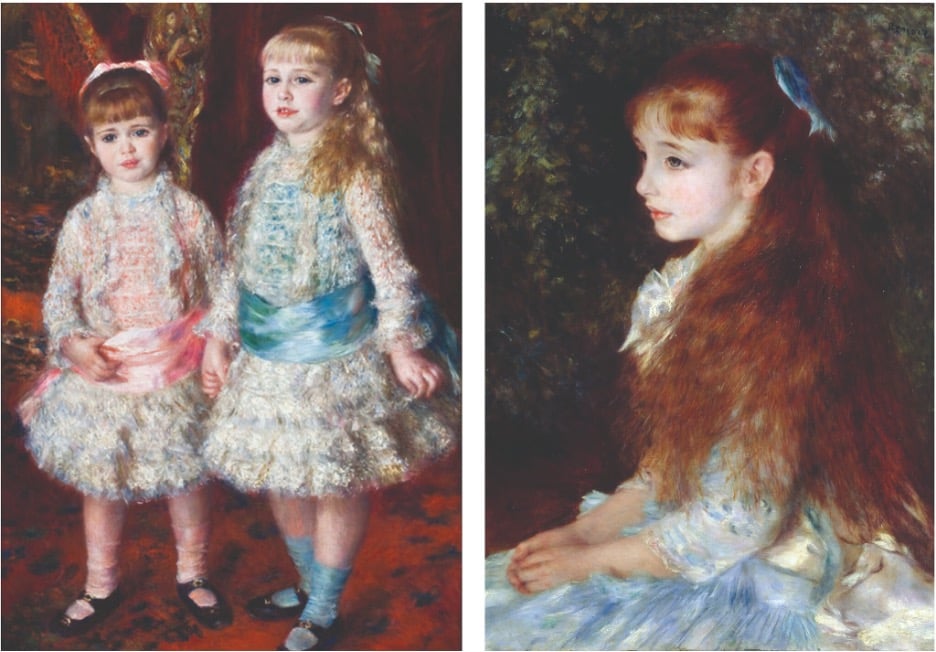
British journalist and historian Catherine Ostler’s The Renoir Girls has emerged as one of the most important non-fiction books of the year. Its inclusion amongst the New Yorker’s top books of 2026 and listing this week in the Economist’s “best books of 2026”, make that official. Yet apart from an insightful interview with the author in the Times of Israel, the Jewish press has been surprisingly silent.
That is a pity. The book has little to do with art of the Impressionists. Rather, it is a meticulous account of how, over some seventy years, the Jews of France rose to economic, political and cultural prominence in what was ostensibly the most open, liberal and tolerant society on earth. Then, under Nazi occupation, French antisemitism, that had long simmered beneath the surface, was unleashed with devastating consequences.
My own reasons for reading the book had nothing to do with Jewish history. In fourth grade, my rather ambitious teacher, Virginia Sanders, had students in her advanced reading group choose a painting and write a paper about it, complete with footnotes. For reasons I can no longer recall, I chose Renoir’s Young Girls at the Piano. I have been a Renoir enthusiast ever since and have by now seen most of his paintings in museums and traveling exhibits. The book, however, says relatively little about Pierre-Auguste Renoir himself, beyond his mild disdain for the Jews of late-19th-century Paris, even though those same Jews were among the first to appreciate, and pay for, his work.
The book unfolds as an intergenerational tragedy centered on Louis and Louise Cahen d’Anvers (roughly: the Cohens of Antwerp) and their five children. In a single generation, the Cahens rose from modest Jewish merchants to bankers who helped finance the nation-states of modern Europe. Along the way they acquired aristocratic titles, commissioned portraits from France’s leading painters and accrued phenomenal wealth.
At the twilight of the 19th century in Paris, the Rothschilds were in a class of their own. But there were at least ten other Parisian Jewish families who grew enormously affluent once they were allowed into the emerging global economy. My AI supported estimates suggest that Louis inherited some 4.6 million francs from his father in 1881. Within thirty years he had turned it into more than 50 million through his private bank, Banque Cahen d’Anvers, and a series of shrewd ventures in mining, railways, cattle ranching and arbitrage. By today’s standards the family would be billionaires, with several estates and villas, innumerable lavish social events and generous patronage of charities and the arts.
Ostler gives the family’s business dealings little attention. She focuses instead, in remarkable detail, on the family’s artistic and social life. Louise Cahen d’Anvers was born in Trieste into a leading Jewish financial dynasty that, among other ventures, helped fund the Suez Canal. She arrived in Paris as a young bride and flourished in the cultural explosion that followed the Franco-Prussian War of 1870-71. Charismatic, outgoing and attractive, she embraced the good life with gusto. Louise hosted regular salons that drew the leading writers and artists of the day, from Guy de Maupassant and Marcel Proust to Édouard Manet and Léon Bonnat.
It was natural, then, for the Cahen d’Anvers to commission a struggling, little-known painter to portray their daughters. Anyone with a thimbleful of appreciation for Impressionism knows the two resulting canvases: Little Irène and Pink and Blue, which shows her younger sisters, Alice and Elisabeth. It is something of an irony that the Cahen d’Anvers did not think much of Renoir’s masterpiece portraits, and relegated the latter to the servants’ quarters on the upper floor of the family’s mansion.
In her introduction, however, Ostler sets out the book’s real theme. Neither the family’s place at the heart of Parisian society nor its sacrifices in France’s First World War effort, including heroic loss of life in battle, could overcome the country’s simmering antisemitism. Some sixty years after her portrait made her one of the most recognizable faces from this era in Paris, Elisabeth was betrayed by her French countrymen to the Nazis. She was murdered at Auschwitz, together with other grand children and great children of Louis and Louise.
How did this happen?
Readers of history who prefer authors who “show” rather than “tell”, will enjoy Ostler’s book. The Renoir Girls displays a dazzling command of the intricate, often arcane relationships among the period’s wealthy protagonists. A casual attitude toward fidelity makes those relationships more tangled still. As a former editor of Tatler, Ostler is unusually adept at mapping the social hierarchies, romantic intrigues, extravagant lifestyles and personal rivalries of Belle Époque Paris. Drawing on the press of the time, she documents countless gatherings, from evenings at the opera, soirées and recitals to elegant dinner parties and vacations, paying full attention to the fashion statements of the day.
For pedestrian readers like me, largely unfamiliar with these glittering figures, the book’s glossary of personalities and family trees are a mercy. They make this sprawling, multi-generational story possible to follow. And over the course of some sixty years, the family appears to be indefatigiable, with a seemingly insatiable appetite for horse racing, banquets, luxury automobiles, music, art and romance, which are described with an almost encyclopedic command of the period.
Ultimately, though, this is a book about antisemitism. Readers meet Édouard Drumont, the journalist, polemicist and politician who did much to popularize modern antisemitism in France. His notorious 1,200-page bestseller, La France juive (Jewish France), appeared in 1886. By 1914 it had gone through some 200 editions and sold over a million copies.
A chapter is devoted to the Dreyfus affair, in which the fiercely patriotic Jewish army captain was disingenuously framed for passing secrets to the Germans. Anyone with even a passing interest in Zionism knows how deeply the trial, along with the violent anti-Jewish agitation and riots surrounding it, shaped the thinking of Paris correspondent for a Viennese newspaper named Theodor Herzl. Herzl was shaken by the visceral, enduring hatred for Jews in what he assumed was the most enlightened of societies. He concluded that only a Jewish state could keep his people safe.
Despite her extensive research, Ostler does not establish how the family felt about the hateful rhetoric and litany of anti-Semitic events at the time. Clearly, they could not have been indifferent. The affair almost certainly informed the three privileged sisters’ decision to convert to Christianity as they sought optimal marriage prospects in an antisemitic high society. It definitely was not motivated by theological conviction.
Ostler notes that the two Cahen d’Anvers brothers, Robert and Charles, both married Jewish women, which may say something about the persistence of Jewish identity among the French Jewish elite in the late nineteenth century. Yet ultimately, readers learn little about the family’s religious or cultural attachment to its heritage. Apart from weddings and funerals, we hear nothing of Jewish holiday celebrations or intellectual engagement with specifically Jewish concerns.
Presumably, Louis and Louise were a generation or two removed from Orthodox observance. Yet they seem to show surprising equanimity about their daughters’ desire to leave their religius heritage behind, even though that ultimately proved impossible. Those concerned about Jewish continuity will probably not be surprised by the extremely rapid disappearance of Jewish identification.
The final chapter traces the family’s fate during the Second World War. By then Louis and Louise have long since passed away. The family had rallied together through its tribulations during the First World War. But its bonds could not survive the toxicity of the Holocaust. Irène, the eldest of the three Renoir girls, emerges as a collaborator of sorts. She kept herself safe during the war by falsely denying any Jewish lineage, and apparently profited from the loss of life dispossession of their property. Most harrowing is the story of the relatives who stayed put, hoping that decades of Catholic affiliation would protect them. Ostler gives an unsparing account of their arrest, deportation and murder.
Those of us who have embraced the Zionist paradigm will find some validation here. Suppose the Cahen d’Anvers had reached Herzl’s conclusion that European, antisemitism was ineluctable, instead of doubling down on French nationalism. They presumably would have survived, and been spared betrayal and the loss of both lives and generational wealth.
Today, prosperous Jewish communities in Western countries from America to Australia again face an explosion of antisemitism, whether open or disguised as anti-Israel vitriol. In telling the story of one gilded family’s catastrophe, The Renoir Girls forces an uncomfortable question: is the Jewish reality of the 21st century really so different?