Protect What You Love
The Responsibility We Were Born Into
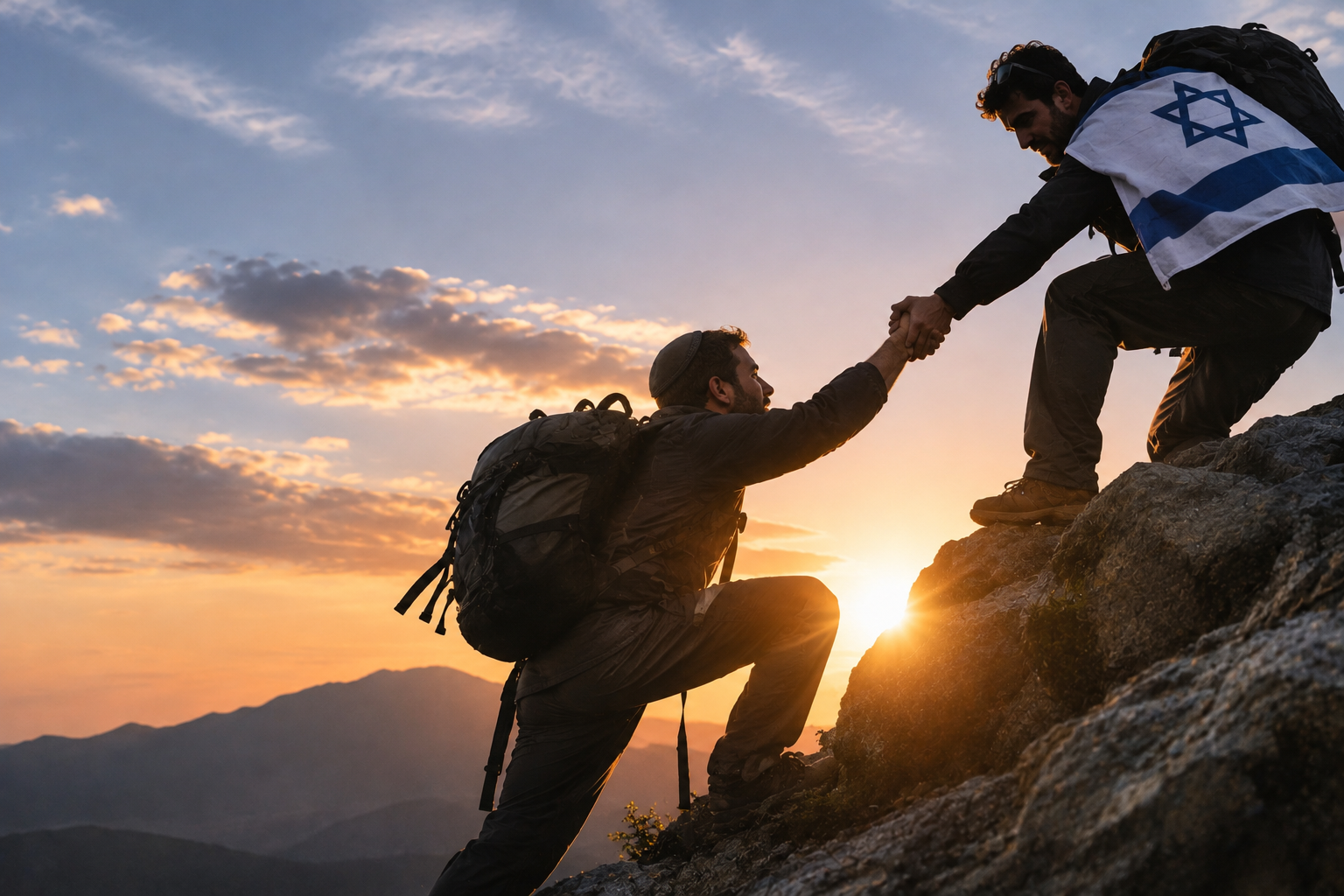
AI-generated image
A few nights ago in New York, I attended an evening for NATAL, the Israel Trauma and Resiliency Center, which treats Israelis wounded psychologically by terror and war. On stage, at the piano, sat Alon Ohel, the young musician abducted from the Nova festival on October 7 and held by Hamas for 738 days, most of them underground. He has said that in captivity he kept moving his fingers as if he were playing. Now he was playing for real.
Beside me sat an Israeli reservist who had nearly lost his legs in Gaza and had come close to losing his life. I kept looking from one man to the other. I don’t know whether they had ever met. I do know that the reservist went to a war in which bringing the hostages home was one of Israel’s declared goals. Part of what he risked his body for was sitting at the piano.
What connects two strangers like that? Israelis have an answer we learn as children: Kol Yisrael arevim zeh bazeh, usually translated as “all of Israel are responsible for one another.” The translation loses the most important part. An arev is a guarantor, the person who co-signs a loan. When Judah begs his father to let Benjamin come to Egypt, he says, “I will be surety for him,” and later offers to become a slave in Benjamin’s place. A guarantor signs before anything goes wrong. His obligation sleeps until the other person cannot pay, and then it belongs to him entirely. The Talmud applied that word to an entire people.
That is why the reservist could go to war for a man he did not know. The signature was already there. The war was the moment it was called.
The same guarantee works far from any battlefield. On November 11, Israelis living on the Thai island of Koh Phangan learned that an Israeli man in his sixties had been swept out to sea. They set up an improvised command center and searched through the night. In the morning, volunteers on jet skis found him clinging to a rock, where he had held on for about twenty hours, and brought him back unharmed. Nobody ordered them to look. Each of them decided that a stranger lost at sea had become their problem.
Some people carry that decision for the rest of their lives. In 2021, Yanai Rimon, 25, from Sderot, was swept away by a river in Mexico. Dozens of volunteers searched for him until his body was found. His mother, Nirit, has said that what stayed with her was how many people came to look. In 2023 she founded Haverim Mehalzim, a volunteer network that has since answered more than 230 emergencies involving Israelis and Jews in 49 countries. She received what the guarantee had to give, and then she signed for everyone else.
A guarantee does not require the guarantor to like the borrower or share his politics. Israelis argued bitterly, for two years, over how to bring the hostages home. The argument itself assumed they had to come home. We are roughly 15.8 million Jews in a world of eight billion, divided by language, religion and politics, and the signature holds across all of it.
That evening taught me something else. The guarantee does not end when someone is brought home. Alon Ohel is free, and his healing has only begun. The reservist will carry his wounds for years. The therapists, donors and volunteers in that room had come to pay the part of the debt that begins after the rescue, for injuries most people never see. Israel works the same way at the national level. Forty years after Ron Arad was captured in Lebanon, the state has still not let him go. I see a civilian version of this in my own work. Teaching Krav Maga and self-defense has convinced me that protecting the person beside you is a responsibility long before it becomes a skill.
This kind of guarantee has one weakness. No court enforces it. It exists only as long as people answer when it is called. The first time a family sends out a plea and nobody comes, it becomes a phrase we teach children. Modern life lets each of us choose whom we owe. Arevut asks for something older and harder: a debt carried for people we did not choose and may never meet.
Most of us will never go to war or search the sea at night. All of us will, at some point, learn that someone we do not know is in trouble and feel the quiet pull to decide it belongs to somebody else. To belong to a people, as I have come to understand it, is to have had that decision made for you before you heard the news.
That night in New York, a man who nearly gave his legs sat a few meters from a man whose freedom was part of what he had fought for. Neither of them had signed anything. Both had been signed for, long before that night.
Do something amazing,
Tsahi Shemesh
Related Topics
Related Posts