
The Responsible Powers
Three wars have unfolded across three different corners of the world, and for the most part they are not treated as a single system. There is the confrontation between the Sunni states and Israel against Iran and its proxies that has reshaped the Middle East — a war that, after months of fighting, is now drawing toward its close: on 14 June 2026 a memorandum of understanding was announced, and on 17 June it was signed by the presidents of the United States and Iran, intended to bring the conflict to a formal end within sixty days — even as its consequences continue to settle.
There is Russia’s war in Ukraine, dragging on far beyond what anyone anticipated and recasting Europe’s very conception of its own survival. And there is the steadily mounting tension in the South China Sea — for now spilling into open force only intermittently — at the center of which lies China’s ambition to absorb Taiwan.
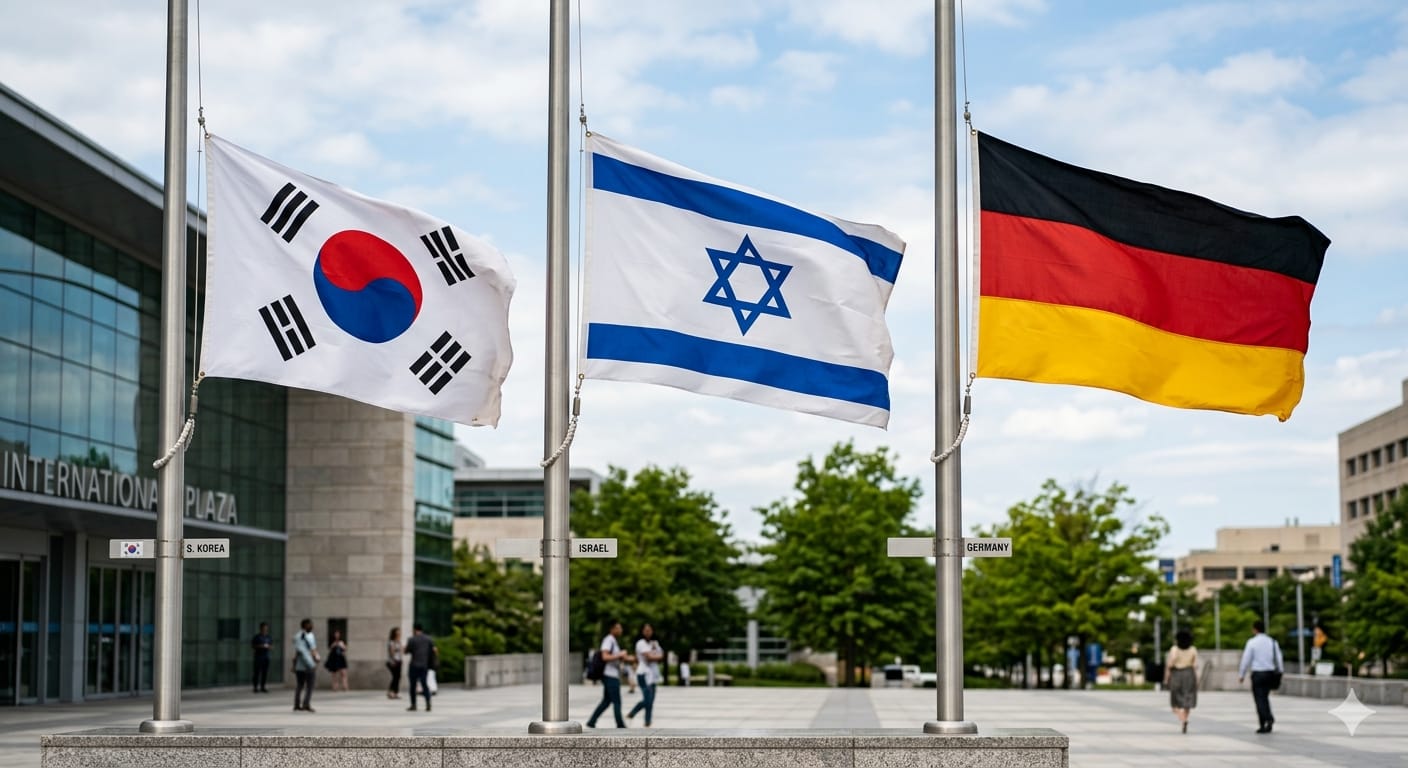
The recognition that these are bound to one another carries real consequences for how we see the world, and for how the world’s states must prepare for what is coming. Germany, South Korea, and Israel are key states in these three regions — three democracies that, for all the criticism leveled at them, act out of a sense of responsibility to the international community and contend with the challenges the democratic world holds in common.
The war between Russia and Ukraine forced Germany to confront a truth it had avoided for decades — that economic prosperity is not, in itself, a security policy. The tension in the South China Sea, alongside the continuing hostility with the North, sharpened South Korea’s understanding that what has not yet happened may well be precisely what comes next. And Israel — which sought to carry out “the dirty work” together with the United States (to borrow the German chancellor’s phrase) and now finds itself left to wage the campaign largely alone — has every reason to examine the possibility of new alignments, which is exactly what this article sets out to propose: an alliance of responsible states.
Each of the three is the strongest actor in its region, and each contends with an adversary that treats the threshold of escalation as an instrument of policy. That combination produces a shared trait whose importance is hard to overstate — the capacity to read the strategic environment and to respond to it. Not to deny it, not to slow-walk it, not to wait for someone else to provide security. Simply to respond.
This is not self-evident. Many states, including powerful ones, struggle at precisely this point. Japan is an economic and technological powerhouse, yet remarkably slow to translate strategic understanding into a change of policy. Britain talks at length about the threats before it but struggles to organize against them at the required pace. South Korea, by contrast, adapts quickly — its defense planning treats the threat across the border as a live variable, not a historical fixture. Germany, which for decades leaned on the American umbrella and on Russian gas, at least now understands that it must prepare: its 2022 Zeitenwende and the subsequent surge in defense spending mark a genuine, if still incomplete, reorientation. And Israel translates its reading of reality into action almost daily, because it has no other choice.
This is the real common denominator: not geography, and not necessarily a shared enemy — even if the link between Russia, China, and Iran is, by all accounts, real — but what might be called strategic metabolism: the speed and fidelity with which a state turns its identification of a threat into action. These three convert perception into policy faster than other states, and that shared reflex, more than any single identifiable adversary, is what makes them legible to one another. It is, in the end, a willingness to pay a price now to avoid catastrophe later — precisely when no one else underwrites your security.
Why now?
The order within which these three states grew is shifting beneath them — though not in the same direction for each, which is exactly why the point is missed. For Europe, and so for Germany, the American commitment has grown audibly conditional, tied to spending demands and domestic politics in ways that were once unthinkable. For South Korea, the dynamic is almost the reverse: Washington’s pivot toward Asia raises Seoul’s value but also its exposure, drawing it closer to a confrontation it did not choose.
For Israel, the guarantees once thought unconditional have shown their limits in the most public way imaginable: in the middle of the campaign, the United States signaled — openly — that Israel risked being left to act alone. The common thread is not abandonment but finitude: American attention is a finite resource, and each of these states is learning to plan as though it cannot be assumed indefinitely. Coordination among strong regional actors stops being a pleasant luxury and becomes a necessity.
A logic worth naming
This need not begin as a formal alliance or a treaty — and it doesn’t have to, to matter. What these three states already share is an outlook, and in several domains, working relationships. The case for deepening that cooperation — bilaterally, and where it makes sense, trilaterally — is stronger than the public conversation in any of the three countries currently reflects. Naming it is the first step; where it leads is a question worth leaving open.
The obvious objection is that their interests diverge — that South Korea has no stake in the Middle East, Germany none on the Korean peninsula. But this is precisely the misconception worth dismantling. South Korean shipping runs through the Strait of Hormuz, hostage to any escalation in the Gulf; Germany and the entire industrial world depend on semiconductors fabricated within range of Chinese missiles in the Taiwan Strait. The fronts are not separate. A crisis in one theater propagates through supply chains, energy markets, and shipping lanes into the others, whether or not the states involved have chosen to notice. The interdependence already exists; what is missing is the recognition of it.
Beneath that shared exposure lies a second, quieter affinity: the lessons each accumulates are precisely the lessons the others need. How to harden critical infrastructure, how to sustain a civilian population under prolonged pressure, how to read an adversary’s intentions before they harden into action — these transfer between the three even where interests do not. That is why dialogue, rather than alliance, is the right vessel: it shares the transferable layer without demanding agreement on the rest. The cost of failing to do this is not abstract. The war in Ukraine made the battlefield revolution of fiber-optic drones — immune to jamming, guided by a filament of glass — visible to anyone willing to look. That lesson was there to be learned, and it was not learned in time; today those same weapons are killing our soldiers. A lesson that does not travel is paid for in lives.
What stands in the way, then, is rarely interest. It is imagination — the habit of seeing one’s own front as unique, and of looking for partners only among the largest powers rather than among the states that share one’s actual predicament.
The world is entering a period in which states able to read reality and act within it will be a rare asset. Three of them already exist, each at a different edge of Asia and Europe. We do not pretend to know how far the logic runs. But recognizing what they have in common — and beginning to act on it — is not a grand design. It is simply the sensible thing to do.
This piece was co-authored by Alon Sackstein, who is a geopolitical advisor at the Geopolitics Laboratory and a former strategic research team lead in the Research and Analysis Division of Israel Defense Intelligence. He holds an Executive MA in Diplomacy and Security from Tel Aviv University.