
The Right to Bad News
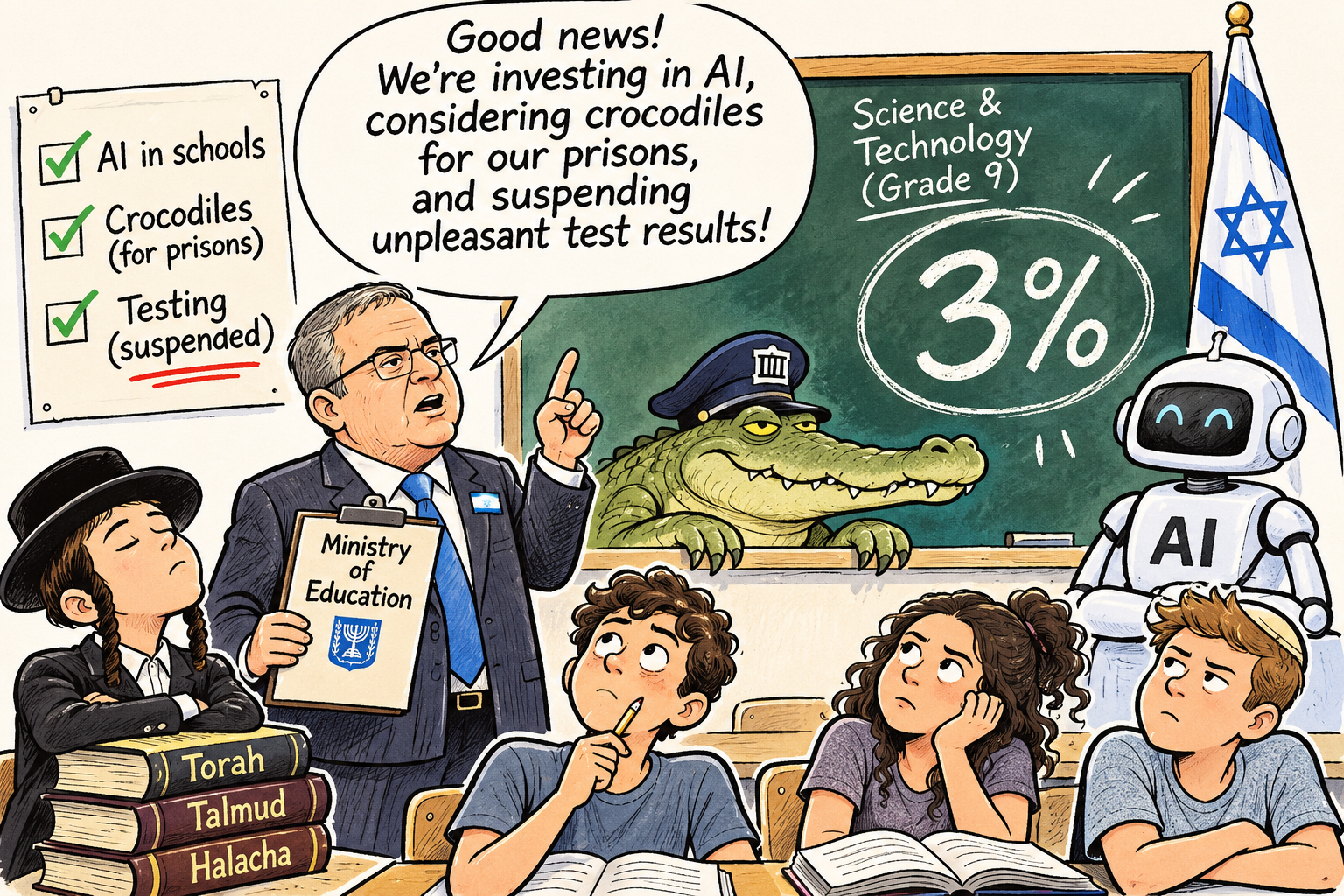
Israel regularly examines its children to determine what they know. Recent events at the Ministry of Education suggest that the adults responsible for their education might benefit from an examination of their own.
On Wednesday, November 25, Israeli ninth-graders sat a national mathematics assessment that Education Minister Yoav Kisch had sought to suspend. The examination went ahead following legal intervention. I find it deeply embarrassing that a country so proud of its intellectual achievements should require the intervention of legal authorities to establish what its children have learned.
The controversy followed the publication of disturbing results by the National Authority for Educational Measurement and Evaluation (RAMA). According to RAMA’s published classification, only 3 percent of the ninth-graders assessed in science and technology fully met the curriculum requirements, with another 16 percent approaching that threshold. Kisch questioned the reliability of the results and commissioned an independent review. Although the review identified problems with the presentation of the findings, it found no grounds for rejecting their reliability and recommended a stable assessment policy. The minister nevertheless suspended the testing program, arguing that reforms were necessary.
There are legitimate reasons to criticize standardized testing. A child’s intellectual capacities cannot be adequately described by a numerical score, and the reduction of education to measurable performance has impoverished teaching in many countries. Nor can the consequences of war for Israeli children be disregarded. Interrupted schooling, displacement and psychological distress must inform our interpretation of the results. But these circumstances make reliable assessment particularly important. How else are we to establish which children need help and what resources their schools require?
A child who returns home with a disappointing school report is expected to explain what went wrong. Parents may be summoned, additional work prescribed, and future educational opportunities reconsidered. We have developed an elaborate vocabulary of responsibility for people who are 12 or 14 years old. I would welcome its occasional application to those who administer their education.
Michel Foucault examined the school examination as a technique through which institutions acquire knowledge of individuals. What interests me here is the reversal of that operation. The results of examining children become knowledge about the institution that examines them. The difficulties encountered by thousands of pupils tell us something about the educational world that adults have constructed for them.
There is a further detail in the RAMA report that deserves public attention. Pupils in the Haredi education system were excluded from the science assessment because the test did not correspond to their curriculum. The exclusion reveals something about the fragmentation of Israeli education. Research published by the Israel Democracy Institute has documented persistent deficiencies in the teaching of core subjects in parts of the publicly funded Haredi school system, particularly in schools for boys.
I have no objection to a child acquiring a profound knowledge of Torah and Talmud. I object to adults deciding that such an education need not provide the intellectual resources necessary for that child to choose a different way of life. Religious freedom cannot be understood exclusively as the freedom of parents, rabbis and religious institutions. The child will eventually become an adult, entitled to make decisions of which those responsible for his education might thoroughly disapprove. His education should make those decisions possible.
The use of public money to maintain educational arrangements that restrict this independence raises a question that Israel has been reluctant to confront. Parliamentary compromises may explain why certain schools are permitted to provide inadequate instruction in mathematics, science and English. They hardly constitute an educational justification. Somewhere in these negotiations between adults, the intellectual future of the child has become negotiable.
Citizens cannot meaningfully evaluate public institutions if the production of knowledge about those institutions remains subject to the discretion of the people responsible for their performance. The independence of educational assessment is therefore a political question, irrespective of the merits of any particular testing methodology.
I am reminded of the encounter between King Ahab and Micaiah ben Imlah in the First Book of Kings. Surrounded by prophets who assure him of military success, Ahab expresses his dislike of Micaiah because the latter never prophesies anything favorable concerning him. The king has no shortage of advisers. His difficulty concerns the kind of knowledge he is prepared to receive from them. Israel ought to appreciate the political significance of this passage without requiring further explanations from an ancient Hebrew prophet.
In June, the government announced a program to introduce artificial intelligence into English-language instruction in Israeli schools. According to the OECD’s PISA 2025 findings, half of Israeli students attended schools whose principals reported that shortages of teaching staff were hindering instruction to some degree. The precise scale and distribution of these shortages remain open to discussion. There is nevertheless a danger in treating technological innovation as a solution to problems that are fundamentally institutional.
Having spent years teaching physics, I know how much of a teacher’s work begins precisely where the textbook becomes insufficient. A child’s hesitation, an unexpected answer or a seemingly irrelevant question may reveal a difficulty that no prescribed sequence of exercises anticipated. Sometimes the entire lesson has to be abandoned because something more interesting has happened in the classroom. Artificial intelligence may prove a valuable educational instrument, but purchasing software does not absolve a government of its responsibility to train, recruit and retain good teachers. I would be rather embarrassed to announce the technological modernization of schools in which children cannot reliably obtain the attention of a qualified human being.
In August, I wrote in these pages about the extraordinary administrative enthusiasm surrounding the proposed introduction of Nile crocodiles into Israeli prison infrastructure. Senior prison officials visited a crocodile farm, preparations were undertaken, and a minister even found time to revise the legal classification of the animal. The project subsequently encountered judicial obstacles. Perhaps crocodile husbandry will prove to be one of the more promising branches of Israeli public administration.
I would nevertheless be interested to hear a minister explain to a classroom full of 14-year-olds why the government could devote such attention to the prospective recruitment of reptiles into public service while legal intervention was required to ensure that a mathematics assessment took place. I suspect the children might ask some rather good questions.
These same children will eventually be expected to assume responsibility for the society that educated them. They will be asked to acquire professional qualifications, contribute to the economy, participate in democratic life and, in many cases, undertake military or national service. Politicians will deliver speeches about their obligations to the country and describe them as the generation upon which Israel’s future depends. Yet a 14-year-old cannot reorganize the education budget, recruit qualified teachers or determine the terms of the political agreements governing his education. Those who speak so readily about the obligations of the younger generation might spend rather more time considering their own.
Israel needs independent educational assessment, transparent methodologies and public access to aggregate findings. Publicly funded schools should provide children with the knowledge necessary for independent adult life. Teachers need working conditions that allow them to exercise their professional judgment, and the government should be required to explain how its allocation of resources corresponds to the educational difficulties identified through independent research.
I would also like to see ministers recover a capacity that rarely figures in contemporary discussions of political competence: the capacity to be ashamed. There is nothing shameful about discovering that children need help. What should embarrass those entrusted with public authority is allowing educational deficiencies to persist because addressing them has become politically inconvenient.
A government has no right to dispose of a child’s intellectual future in exchange for the political cooperation of adults. The child was not a party to that agreement. His education should eventually enable him to question the people, institutions and traditions that educated him, including the state itself.
Long after the ministers responsible for his education have disappeared from public life, he will still be living with the consequences of their decisions. I wonder whether they ever consider what it means to owe something to a child who cannot yet hold them accountable.
Yochanan Schimmelpfennig