
Exploring Memory, War, and Survival
The Roof Where I Watched the War
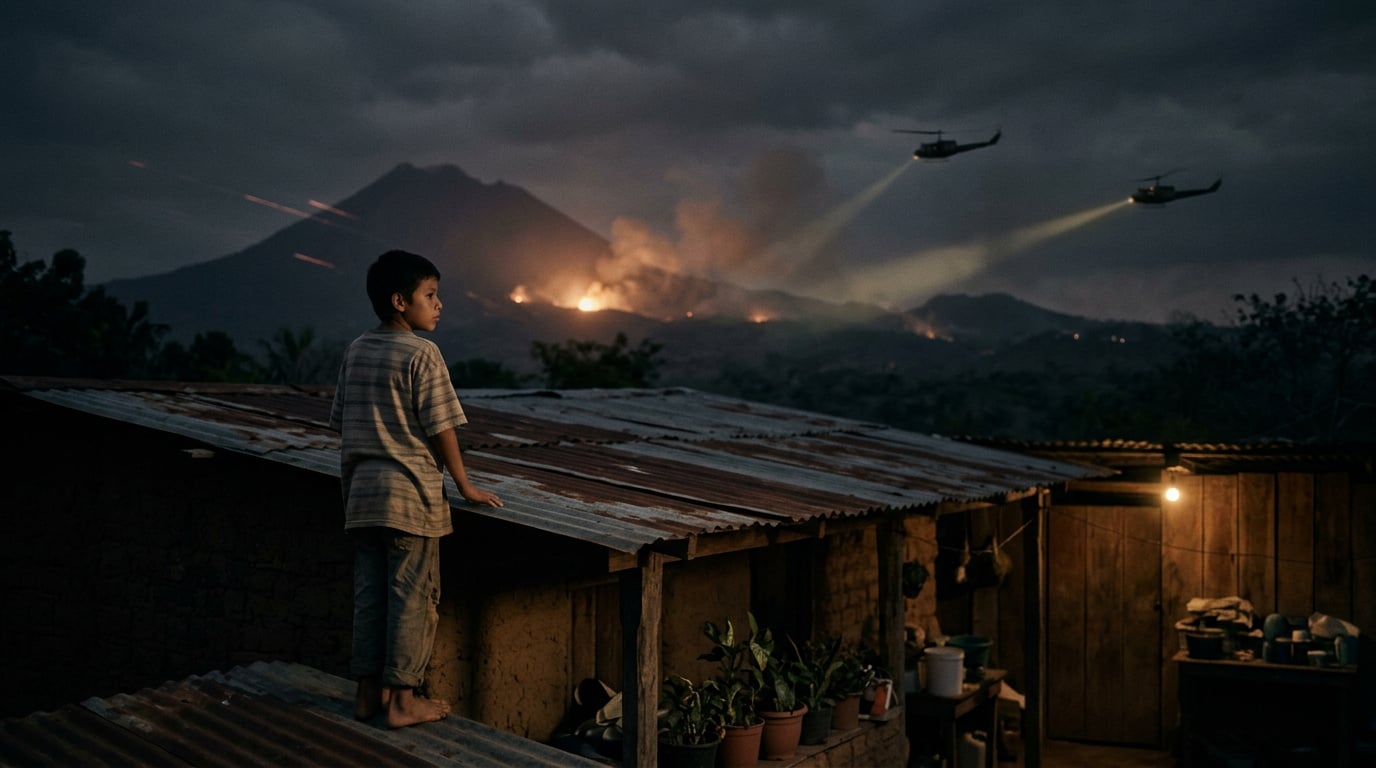
Illustration inspired by the author's childhood memories of watching the Salvadoran Civil War from the rooftop of his family home in San Jorge, El Salvador.
There are memories that return first as light. Not faces. Not names. Not even fear. Only flashes against the darkness.
When I was a child during the Salvadoran civil war, I used to climb onto the roof of our house in San Jorge at night and watch the war unfold across the mountains. I know how strange that sounds now. Children are supposed to fear war completely. Adults imagine that bombs, helicopters, and gunfire exist only as terror in the mind of a child. But childhood does not always understand horror immediately; sometimes it mistakes destruction for spectacle first.
From the roof, I could see the distant slopes near the volcano glowing beneath the flashes of explosions. Helicopters crossed the sky like giant insects made of metal and fire, their searchlights sweeping across the darkness while tracer rounds stitched brief lines of light through the night air. The earth trembled beneath the house. Tin roofs rattled. Dogs barked wildly from faraway farms hidden in the dark.
And still, I watched. Part of me was afraid, but another part could not look away. The war looked unreal from a distance—beautiful in the same terrible way lightning can look beautiful before it strikes nearby.
Some nights the flashes appeared beyond the hills like silent storms. Other nights the gunfire sounded so close that my mother would call me down from the roof with panic in her voice: “Get down from there.” But curiosity always pulled me back. I did not yet understand that many of those lights marked the final moments of someone’s life. To me, they were movement in the darkness. Mystery. Noise. A world larger than the small town where I lived barefoot among dust roads, mango trees, and fear people rarely spoke aloud.
War entered childhood strangely. Not all at once, but first through sounds, then through silence, and finally through the behavior of adults. I remember how conversations would suddenly stop when helicopters passed overhead. I remember radios lowered quickly in volume whenever news arrived from nearby villages, and the nervous barking of dogs before explosions rolled down from the hills. Even the birds seemed to understand when danger was near.
But still, every night, I climbed onto the roof alone. Sometimes afraid, sometimes paralyzed by a strange fascination, sometimes pretending a bravery I did not actually feel. From there I watched the mountain breathe fire. I watched the sky pulse with violence before I was old enough to fully understand death.
And perhaps that is one of the cruelest things war does to children: it slowly teaches them to normalize what should never become normal. The lights stopped feeling extraordinary after a while. The trembling became familiar. The helicopters became part of the landscape.
Combat planes reached the mountains and dropped five-hundred-pound bombs over the hillsides. Moments later came the sound—deep, violent, impossible to mistake—followed by the shaking of the tin roofs and the trembling of the earth itself, as if the ground beneath San Jorge had turned into a living thing. Sometimes the explosions struck near the slopes of the Chaparrastique volcano, and then the mountain seemed to answer. Not with fire, but with ash and dust. A gray cloud would rise slowly into the night sky before drifting over the town, covering the roofs, the roads, the trees, and the yards in a thin layer of gray. By morning, everything looked muted, as if the war itself had settled over the town during the night. And that frightens me now more than the explosions themselves. Because children should never become accustomed to war.
Years later, after crossing borders and building a life far from San Jorge, I still think about that roof sometimes. I think about the boy standing there beneath the night sky watching flashes over the volcano as if the world were performing some terrible ceremony just for him.
I want to tell him to go inside. I want to tell him that those lights are not fireworks. That somewhere beneath those explosions, mothers are screaming, children are hiding, and entire families are losing everything they love. It is the same harrowing reality that, decades later, children in conflict zones around the world still look up to face tonight.
But memory does not work that way. The boy remains on the roof. The helicopters still pass overhead, and the mountain still burns in the distance. Somewhere inside me, part of that child still watches the war through the eyes of someone too young to understand that innocence was already disappearing with every flash of light across the dark Salvadoran sky.
Related Topics